Close-up of the large eye spots on the forewing of a Common Wood-Nymph butterfly (Cercyonis pegala).
Here's the entire butterfly, perched among grasses:
Close-up of the large eye spots on the forewing of a Common Wood-Nymph butterfly (Cercyonis pegala).
Here's the entire butterfly, perched among grasses:
If you've been at the coast recently, you might have encountered these dragonflies zipping around, sometimes in large numbers. Wandering Gliders (Pantala flavescens) sometimes appear in our area during late summer, especially with passing weather fronts.
They're impressive fliers, but it's harder to spot them perched on vegetation. This morning we found lots of them roosting in a grassland, and after many attempts we were able to get close enough to one of them for a few photos.
Note the beautiful golden abdomen and the very broad wings.
Walking over to the farmers market this morning, I caught a glimpse of a dragonfly exploring the sun-exposed branches of a willow tree. It disappeared, but when I turned the corner I started scanning up high, looking for potential sites where it could have landed. I was about to give up, when my eyes caught the blue of the darner's eyes.
Blue-eyed Darner (Rhionaeschna multicolor) in Sebastopol on 17 May 2026.
The beautiful wings of a California Darner (Rionaeschna californica). Note how shiny and new they look. [You can click on the image for a larger version.] I could see this darner's wings glittering in the sun as it flew across a grassland. When it landed nearby, I leaned in for a closer view. Because the wings are so fresh, it's likely this individual metamorphosed recently. Once a dragonfly has been flying for a while, the wings lose their shine and can show nicks and other impacts.
We spent some time watching an American Dipper (Cinclus mexicanus) in a creek along the Oregon Coast today (5 April 2026). I had trouble deciding which photos to share, so here are a few different views. Enjoy!
Air temperatures reached at least the high 60s in Bodega Bay today (7 March 2026). I started seeing butterflies zipping by in the morning, so I went out after lunch for a short walk and took a few photos.
California Tortoiseshells (Nymphalis californica) were the most common butterflies I saw today (photo above), but I also noticed quite a few Margined Whites (Pieris marginalis) and at least one Western Pine Elfin (Incisalia eryphon).
Many of the tortoiseshells were nectaring on willow catkins:
Air temperatures reached a balmy 65-70°F in Cotati yesterday (1 February 2026). I took a quick look for butterflies in the afternoon. Here's a West Coast Lady (Vanessa annabella) from above (above) and from below (below). :)
I helped out with the Western Sonoma County Christmas Bird Count today (28 December 2025). It was a very calm and warm day at the coast, with air temperatures reaching at least 56°F (13°C) and perhaps even higher. (I think it's my first Christmas Bird Count wearing a t-shirt for part of the day!)
Although it was a nice day for birding, I also saw quite a few insects — a half a dozen bumblebees, at least 4-5 butterflies, and possibly one dragonfly. Some of the butterflies flew by too quickly for an i.d., but at least two of them were Red Admirals (Vanessa atalanta) basking in the sun.
Air temperatures reached the mid-high 50's today, but the afternoon sun was warm enough to activate this dragonfly. It zipped into our backyard and landed on one of the remaining hot peppers in the garden.
Variegated Meadowhawk (Sympetrum corruptum) photographed in Cotati on 1 December 2025.
With many thanks to Eric for the great photo!
Satyr Anglewing (Polygonia satyrus)
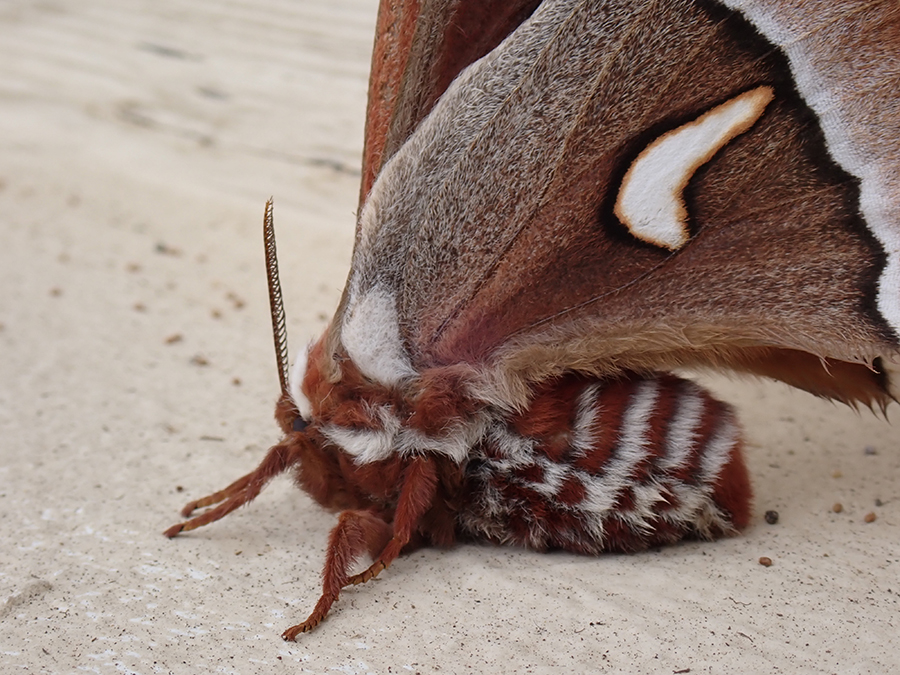
Wow! When Claire started to ask me if I could help with a moth i.d. today (1 May 2025), I had no idea she would be taking me to see this beautiful Ceonothus Silkmoth (Hyalophora euryalus)!
Claire and Emma spotted this amazing moth while they were eating lunch. It was cool at the coast today and the moth was very still, so we were able to get some nice photos.
Here's a close-up of her very fuzzy body, including the wonderful striped pattern on her abdomen:
It warmed up quite a bit in Cotati today — at one point our outdoor thermometer was reading ~80°F (~26°C). Butterflies were definitely taking advantage of the sun.
Above, a Mourning Cloak (Nymphalis antiopa).
Next, a Red Admiral (Vanessa atalanta):
And, a Satyr Anglewing (Polygonia satyrus):
Also, we checked on the Anna's Hummingbird fledgling. Eric spotted it very high, about 50 feet up in a tree adjacent to the nest site. Mom flew in a couple of times to feed the fledgling, but only about every 20 minutes (see below). In between feeding visits from mom, the fledgling probed nearby buds and leaves and practiced short flights among the branches.