If you're interested in using any of these photographs or this content in any way, please contact me. Send an e-mail to naturalhistoryphotos(at)gmail.com. Thanks!
Showing posts with label camouflage. Show all posts

Friday, December 5, 2025

Find the fish


Quick photo of a sculpin in the rocky intertidal zone after field work tonight (5 December 2025).  Amazing how much it looks like the surrounding rock, gravel, and shells.

Sunday, August 25, 2024

Like sand, like spider?


Here's another great example of camouflage with beach sand.  Eric photographed this jumping spider, Terralona californica, on 21 August 2024.

It's a little bit easier to see than the isopod, but it's still impressive to see how well the colors of the spider match the colors of the sand:

 
Although they are small and can be overlooked, we often see Terralona running along the high tide line on the beach, and sometimes catching small flies.  Here's the same spider from the front, showing its large eyes:
 
 
Thanks for the great photos, Eric!
 

Thursday, August 22, 2024

The hidden one


Alright, this is a little bit of a test.  Scan the image above can you spot the isopod (an oval-shaped crustacean with a segmented body)?  Look carefully, it's a tough one! 

Okay, here's another view, a little bit more zoomed in (below).  Can you find it now?  (Hint: Look for something that doesn't look quite like sand grains.)

 
And now even closer  I'm sure you'll see it now!

 
And, because this isopod is so cool, here's a slightly different view:

 
Meet Tecticeps convexus!  Amazing to see how well its coloration matches the surrounding sand  black, orange, gray, white, and even pale blue!
 
It is so well camouflaged that it might still be hard to see, so here's another image without the sand.  [Note the two dark eyes and the short antennae on the head, and the large pale spots in the center and on the last segment.  You can use those features to locate the isopod in the photos above.]
 
 
We're so lucky that Suzanne looked down to see this isopod on the beach!  
 
Eric and I have been interested in finding this species for many years, but it probably lives mostly in the subtidal zone (so a little out of reach for biologists who spend most of their time in the intertidal zone).
 
One more extreme close-up so you can really appreciate the colors and patterns:
 
 
With many thanks to Suzanne for noticing Tecticeps and bringing it to our attention, and to Eric for the fantastic photos of this seldom seen species.
 

Friday, March 8, 2024

A chiton with flair


Eric snapped this great photo of a Veiled Chiton (Placiphorella velata) during field work this afternoon (8 March 2024).  Impressive how well this species looks like the surrounding habitat rock, coralline algae, and red seaweeds.  This individual even has a little bit of branching coralline algae growing on its shell plates!  

Here's another image from a little farther back:

 
For more information about this intriguing predatory chiton, you can review the post called "A veiled threat" from 21 August 2012.  And there's a beautiful underwater photo in the post called "Camouflaged like coralline" on 11 August 2021.

Saturday, September 16, 2023

A wolf dressed in beach clothing


Eric found this amazing spider on the beach at Reid State Park in Georgetown, Maine, yesterday (15 September 2023).  Meet the Shoreline Wolf Spider (Arctosa littoralis)!

The spider blends in with the sand so well that sometimes it was hard to see the entire spider.  It was a little easier from the side, so here's that view:

 
And one more view looking down at the spider from above.  This perspective made me think of a kaleidoscope, with repeating patterns radiating outward:
 
 
Shoreline Wolf Spiders have a broad distribution, so if you're walking a sandy beach, keep your eyes open. This wolf spider is so well camouflaged that you may notice some movement across the sand before you realize that there is a predator hiding in plain view!

Saturday, September 2, 2023

Against the grains

 
Okay, so this post is a follow-up to last night's photo.  This shrimp is a master of camouflage, but here are a couple of photos (above and below) where it might be a little easier to see them because they're on the surface of the sand.

 
We've learned the pair of white spots just in front of the tail (on the 5th abdominal segment) are consistent enough that you can use them to locate the shrimp and orient to its tail and head ends.  Sometimes the white spots are merged into the shape of a heart.
 
The shrimp's coloration is remarkable  they match the sizes and colors of the surrounding sand grains and shell pieces so well that even when the shrimp was right in front of us it was often hard to see it.  The next two photos are a little more challenging, but I'm guessing you'll find the shrimp!  (Hint: You can also look for the narrow white stripes on the legs.)


We think this beautiful shrimp is Crangon handi, although we had to look more closely at several features to work through the identification (and see note at bottom of this post).  Some of these characteristics are hard to see in the field, but because we've noticed there aren't many Crangon handi photos online, Eric made this really useful guide to point out some important features (see below). 
 
Note the shape of the antennal scale, the shape of the claw on the cheliped (fancy name for a leg that bears a claw), and the three tiny spines that flank each side of the very tip of the tail (telson):

 
Drawings modified from Kuris, A.M. and J.T. Carlton (1977). Description of a new species, Crangon handi, and new genus, Lissocrangon, of crangonid shrimps (Crustacea: Carida) from the California coast, with notes on adaptation in body shape and coloration.  Biological Bulletin 153: 540-559.
 
We found these shrimp in small patches of open sand between rocks in the intertidal zone.  Although the shrimp are so well camouflaged that we've probably walked by them many times without noticing them!
 
I can't help showing a few close-ups so you can appreciate how well they match the sand.  One of the anterior end (with two rounded pearly eyes), one of the tail, and a close-up of the pigment spots called chromatophores (there are also some actual sand grains on the shrimp):


P.S.  I showed a photo of Crangon handi from a more wave-exposed site back in June  see "Perfect match" on 23 June 2023.  Note that the larger color patches on that shrimp match the coarser grains on the outer coast.
 
P.P.S.  There are a few things about these shrimp that stray from the original description  e.g., we found them on finer-grained sand and their color patterning is finer.  However, we noticed a photo in Jensen's Crabs and Shrimps of the Pacific Coast (2014) that shows Crangon handi with similar patterning to the shrimps we photographed.  But if you have thoughts about this identification, let us know!  We're interested and open to looking further at any defining traits for this species.
 

Friday, September 1, 2023

Find the shrimp?


Can you find the shrimp?

More info tomorrow night!

Thursday, July 13, 2023

What do you see?

 
Many of you know that I love when sculpins look just like their surroundings.  Parts of this fish look like sand, coralline algae, bits of white shell, and red algae.  Is there a fish there?  Such effective camouflage!

Tuesday, July 11, 2023

Nothing to see here

 
Eric and I have encountered several of these small decorator crabs during the last month or so.  We don't recall seeing them before (in the intertidal zone in the Bodega Bay area), so I'm posting a photo for the record.  
 
It's possible we've missed them, or that they more often occur in subtidal areas.  And maybe a lot of juveniles survived this year, so they're showing up in more places and in sites where they're not as commonly seen in most years.
 
Perhaps it's even hard to tell that this is a crab?  Meet the Masking Crab (Loxorhynchus crispatus).  "Masking" because they attach algae and bits of other animals to their rostrum and carapace (e.g., sea squirts and sponges) and the decorations serve as excellent camouflage.

The individuals we've seen this summer are all smaller juveniles, only ~2 cm across.  Photographed on 6 July 2023.

Friday, December 30, 2022

Disappearing act


One of the most impressive features of many animals in the intertidal zone is the way their color patterns match their surroundings.  It makes it challenging for visual predators to spot them.  And it also requires an observer to slow down and let their eyes and mind adjust to the setting in the tidepool.  (Maybe we need a new phrase ="slow tidepooling"?)

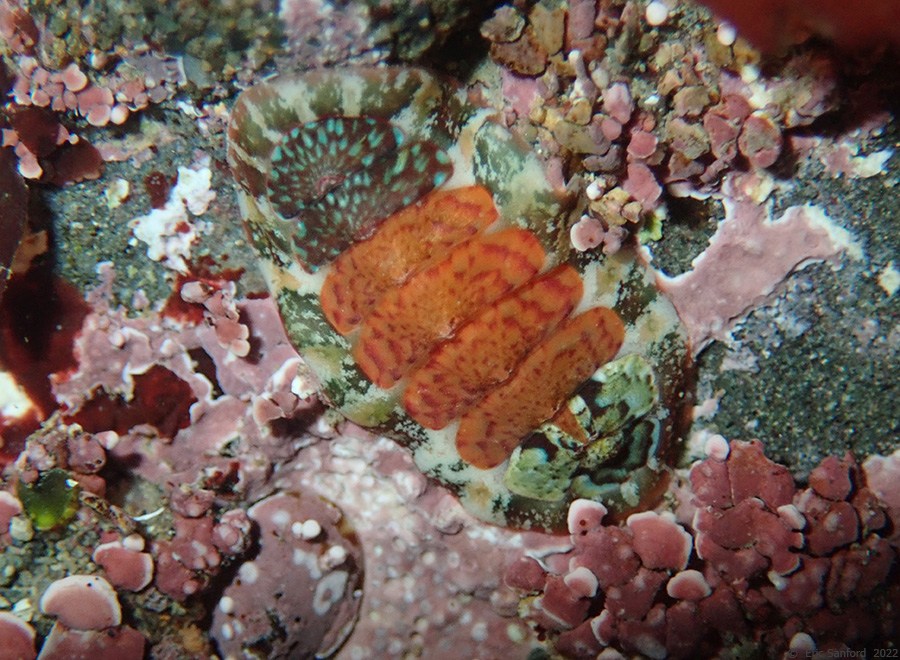
We thought it would be fun to show some examples.  Above is a chiton (perhaps Lepidozona radians) note there are eight plates, but the middle four plates are orange, the front two plates near (head end) are flecked with brown and green, and the back two plates (tail end) are mottled.  These varied colors make it hard to identify this as a chiton at first.

Below is a small sculpin.  Check out the way the pink stripe running across its body matches the coralline algae patches on the rock.  And the other colors look like the surrounding rocks (grays and greens) and encrusting algae (deep maroon).  It also helps that sculpins often stay very still the lack of movement makes it less likely that they'll catch your eye:


The camouflage abilities of octopus are well known they can settle on a new substrate and blend in within seconds by adjusting pigment cells (chromatophores) in their skin.  Here's one looking a lot like a rock but also note how well the arms/tentacles on either side of the body have a different color and pattern than the main portion of the body.  It's hard to make them out!  (If you look closely sometimes you can spot the suckers on the underside of the tentacles.)


And here's one more an intriguing shrimp called a Deep-blade Shrimp (Spirontocaris prionota). (Hint: Look for the shrimp's eyes in the center of the photo.)  Not only do the colors of the shrimp match the coralline algae, but the shrimp also has small hairs (setae) that accumulate bits of debris that help it look "messy", making it less clear that this is a shrimp.

 
It takes some special attention to spot animals like this when they're so well camouflaged, but it's worth the extra time! 

ADDENDUM (31 December 2022) P.S.  To make it easier to find the octopus, here's an edited photo showing the outline and main features:


Thursday, December 22, 2022

Blue highlights


How lucky!  Eric found an octopus for my birthday!

Here's the entire animal from the other side.  Always amazing to see how well they blend in with the surrounding rocks and algae:


Tuesday, September 13, 2022

Color matching

 
I love how the colors of this sculpin match so many different things in the tidepool rock gray, shell white, mussel blue, anemone green, coralline pink...even the reddish-brown markings on the tail match the encrusting algae on the rock!

Photographed in Mendocino County on 12 September 2022.

P.S.  I'm going to be giving an online presentation on Thursday night (15 September 2022) for the Stewards of the Coast and Redwoods.  I'll be telling four tidepool stories.  Everyone is welcome to join (via Zoom) you can register here if interested: 

https://stewardscr.org/events/tales-from-the-tidepools/

Saturday, July 23, 2022

Blocks of color

 
A fun isopod (Synidotea sp.) photographed in the low intertidal zone on 15 July 2022.  (There are two individuals in this image; the larger male is holding a smaller female underneath him.)
 
I was struck by the interesting blocks of colors.  And even more so a little while later when I was trying to photograph a cluster of sea spiders (pycnogonids).  
 
I didn't noticed it at first, but a smaller isopod with similar coloration was hidden among the hydroids and sea spiders.  Can you find the isopod in the image below?
 
 
The isopod is very close to the center of the image.  
 
I've circled it in the photo below.  (Its head is down and to the left side of the circle.)
 
You can see how well the various colors of the isopod blend in with the sand grains, hydroid stalks (red/brown), and scattered shell fragments.


Sunday, July 17, 2022

Colors like stones


Whew, we had a long week of field work during the good low tides this past week.  On the side, Eric managed to photograph this beautiful sculpin.  It looked just like the surrounding stones!
 
Here's a close-up of its wonderful marbled patterning:
 
 
Many thanks to Eric for sharing these images.  If anyone has thoughts about which species of sculpin this, we'd love to learn more.
 

Friday, December 24, 2021

Christmas decoration


Since many folks are decorating at this time of year, we thought you might enjoy seeing this local decorator crab.  Meet the Cryptic Kelp Crab (Pugettia richii)!  They're known as decorator crabs because they add pieces of seaweed to their rostrum (nose) and carapace (back) for camouflage.  In the photo above, the narrow red-brown seaweed and the green leafy seaweed are attached to the back of the crab.
 
If you look closely on the backs of the crabs, you can even see the specialized hooks for holding seaweed.  Below, look for the clusters of narrow curved hooks near the base of the seaweed.  The crab pushed the seaweed under these hooks to hold it in place.  The better to hide from fish and octopus!
 
 
Happy Holidays to all!

Tuesday, December 7, 2021

How to become invisible

If you're a resident shrimp in a tidepool filled with hungry sculpins, you might find it advantageous to be invisible.  So how do you become invisible?

Step 1: Become a color that matches things in the background of the tidepool, e.g., pink like coralline algae:


Step 2: Add highlights spots and bands of different colors that show up in the background.  For example, white stripes that match the white tips of the coralline algae, and some darker reds that match the shadows:


Step 3: Make some of your body parts look like algae.  For example, you could make your head appendages, or the sides of your abdomen, or the tip of your tail look like the branches of coralline algae.  And you could hold your abdomen and tail in an upright position:


Step 4: Adapt your behavior to make it hard for a fish to spot you.  For example, stay very still, and only become more active at night.  (Shhhh...no shrimp here!)


Meet the incredible shrimp, Lebbeus lagunae!  Eric spotted this amazing shrimp while we were tidepooling during the exceptional low tide on 5 December 2021.  It was hard to believe what we were seeing at first.  It's a fantastic example of crypsis avoiding detection by predators via use of colors and patterns and shapes that help to blend in with the background. 

The geographic distribution of this species is typically described as Baja California, Mexico to Monterey, California.  However, we are looking into a possible record from Mendocino County (thanks to Jim!). So this shrimp could be a primarily southern species that is rare here, or it might just be rarely seen here given that it's almost invisible and more active at night.


Many thanks to Eric for his excellent observation skills!  Now you can imagine these shrimp hiding among the coralline algae in the local tidepools.

Sunday, November 21, 2021

Anemone addendum

Okay, last night I shared a couple of photos of Ten-tentacled Sea Anemones (Halcampa decemtentaculata).  There's lots to be intrigued about with this species.  One of the notable things is the variation in color patterning.  

Below are a few more examples interesting patterns sometimes show up on the oral disc (like flowers or snowflakes); occasionally there's a beautiful maroon color on the disc or the tentacles; other individuals we found were brownish overall but nearly transparent:


Having such variable color patterning might help to thwart predators, making it harder for them to develop a search image for a consistent color form.  [For another example of this in brittle stars, see the post called "Colorful discs" from 1 October 2016.]
 
One of the more notable color forms had a remarkable combination of white, gray, and brown patterning which made it look like bits of shell or other debris mixed in with the gravel on the bottom of the tidepool.  (We started calling this form the "moustache-type" since the dark bar across the white on the central disk looked like a moustache.)  It's hard to tell that this is a sea anemone, especially from a distance, because the overall anemone shape is disrupted by the color pattern.  It was very effective!  [You can click on the image for a larger version.]


For the record, Eric's sharp eyes also spotted a few tiny juveniles (less than 5 mm across):
 
 
We hope you enjoyed this introduction to Halcampa!  [Another fun fact: This anemone was first described by Cadet Hand, the founding director of the Bodega Marine Laboratory, back in 1954.]
 
P.S.  I know some of you will be wondering those purple bits in the background of some of these images are sea urchin spines.