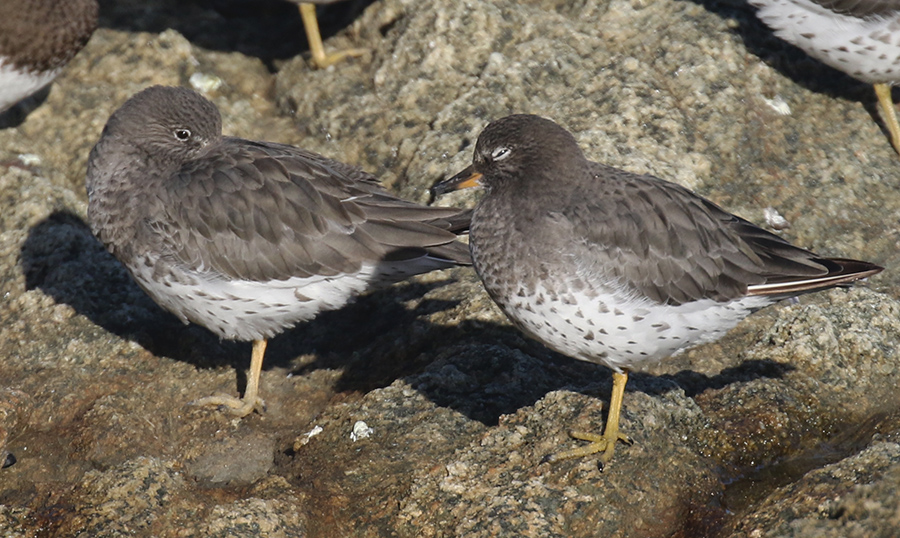
I'll write more about this soon, but for now I'm sharing a photo of a Surfbird (Calidris virgata) eating a By-the-wind Sailor (Velella velella). Photographed on Bodega Head on 21 March 2026.
If you're interested in using any of these photographs or this content in any way, please contact me. Send an e-mail to naturalhistoryphotos(at)gmail.com. Thanks!
Showing posts with label surfbird. Show all posts
Saturday, March 21, 2026
Saturday, March 11, 2023
Probing
Surfbird (Calidris virgata) probing Pyropia (the seaweed draped over the rocks) to find prey on 11 March 2023.
Friday, April 8, 2022
New feathers
Surfbird (Calidris virgata) starting to acquire breeding plumage (e.g., the black feathers with white edges, some with rust-colored spots). Photographed on 7 April 2022.
Saturday, January 8, 2022
Wednesday, November 10, 2021
Saturday, January 9, 2021
Tuesday, January 21, 2020
Surfbird photo journal
Yesterday (20 January 2020), I spent a little time watching Surfbirds (Calidris virgata, formerly Aphriza virgata) along the rocky outer coast. Here's a bit of a photo journal of Surfbird behavior:
Resting on the rocks after a large wave splash.
Feeding on a juvenile mussel.
Bathing in a tidepool.
Aggressive behavior, during which the two birds were very vocal.
I'm curious about this aggressive behavior. The birds were bathing along the edge of a very large tidepool. There was plenty of space for all of the birds in the flock, but aggressive interactions between Surfbirds seem fairly frequent in these situations (while the birds are bathing). I wonder if the intense interactions could be more about social organization and relationships, rather than competition for space?
The birds splash, call loudly, spread their wings, raise their tails, rise up, or lean over, open their bills, jab at each other, and sometimes even grab each other's bills (Ouch!).
Check out the serrations along the edge of the bill in the photo below. The sharp edges are probably useful for grasping prey, but perhaps they're also helpful in these interactions:
Even though Surfbirds are generally seen walking on rocks in our area, this pool was deep enough that sometimes the Surfbirds would swim across it. A different perspective!
I felt grateful for the opportunity to spend some time observing these Surfbirds. There's always something to learn!
Saturday, April 20, 2019
Blustery Day
Wow, was it windy today (20 April 2019)! Northwest winds were blowing about 25-30 mph (20-25 knots) with gusts up to 40-45 mph (35-40 knots). Spring conditions in Blow-dega Bay!
When it's "breezy" like this, sometimes birds will find shelter in Bodega Harbor. Here are a couple of quick photos from when we were leaving work late in the day:
A distant flock of Bonaparte's Gulls (Chroicocephalus philadelphia) — mostly adults in breeding plumage — resting on the tidal flats. We counted about 50 birds in the flock.
At least one Surfbird (Calidris virgata) feeding with Marbled Godwits along the mudflats at the north end of the harbor.
Labels:
bird,
bodega harbor,
godwit,
sandpiper,
shorebirds,
surfbird,
upwelling,
waves,
wind
Saturday, January 13, 2018
High on the rocks
Well, I finally found a few minutes to look for the Rock Sandpiper (Calidris ptilocnemis) that's been seen near the southern end of Bodega Head. Below are a couple of photos for the record, taken on 13 January 2018:
Here's the Rock Sandpiper (lower bird) with a Surfbird for comparison:
And one more, this time with a Surfbird (left), a Black Turnstone (right), and the Rock Sandpiper (bottom):
Today I almost would have called it a "Seaweed Sandpiper." Although rock was the base material, the sandpiper spent most of its time feeding very intensively among the seaweeds (primarily Pyropia sp., formerly Porphyra sp.) high on the rocks. I couldn't see what the sandpiper was eating, but perhaps it was finding amphipods?
P.S. If you're interested in seeing this bird, it's been pretty easy to observe from the main whale watching area at the outer parking lot on Bodega Head. Check the large sea stacks just offshore from the whale watching area (e.g., when you're at the whale watching area, look down and a bit to the north).
Labels:
calidris,
sandpiper,
shorebirds,
surfbird,
turnstone
Friday, December 29, 2017
Birds of a feather
A nice flock of Surfbirds (Calidris virgata, formerly Aphriza virgata) flew in and landed nearby while we were doing field work this afternoon on Bodega Head. Some began to feed, others rested, and several started preening. Here are a few quick shots.
Sunday, November 12, 2017
Rocky, Part 2
Lots of chores today, so here are two more images of the Rock Sandpiper on Bodega Head during the winter of 2012-2013. That year, the Rock Sandpiper stayed around until early March.
A comparison with Surfbirds:
(The Rock Sandpiper is on the right.)
Wednesday, May 6, 2015
Bouillabaisse?
Although Surfbirds are well known for feeding among rocks, they're less often seen foraging in soft sediments.
The Surfbirds sometimes had their entire bills buried in the sand (see below)!
After feeding on mussels among the rocks, and then adding crabs from the beach, it's as if the Surfbirds were partaking in a bit of bouillabaisse!
Monday, March 16, 2015
Just starting
Surfbird (Aphriza virgata), Bodega Bay, 16 March 2015
I wrote about molting Surfbirds a couple of years ago, but I can't help posting another picture tonight. I missed seeing Surfbirds this winter—
there didn't seem to be many around on Bodega Head for some reason.
I encountered a flock near Pinnacle Gulch today and it felt good to see them. I zoomed in on this one. If you look closely, you can see a few new feathers just starting to come in. [Click on the picture for a larger version.] Most of the older feathers are brown and worn, with tattered edges. The new feathers have dark gray centers and clean edges. You can review the post from 25 March 2013 for other examples.
It was interesting to compare the molt timing in these two years. It seemed like the birds in 2013 were farther along, and the date of those pictures is only about one week away this year. I'm not sure what drives the start of their molt in this area —
do you know?
Sunday, July 28, 2013
Different points of view
Yesterday I spent a little time watching a nice mixed flock of shorebirds on the outer coast of Bodega Head.
The photo below is mostly Surfbirds, but there are a couple of Black Turnstones. Can you find them? The turnstones are slightly smaller and have extra white stripes where the wing meets the body and up the center of the back.
[One Black Turnstone is by itself following a tight cluster of Surfbirds near the center of the flock; the other is in the very lower right corner.]
Surfbirds coming in to land:
I'm calling the next one, "A Peregrine's Point of View." I don't know if this is what a falcon sees when pursuing a shorebird flock, but it's interesting to wonder about!
Mostly Surfbirds (all but one) on the shore:
And one close-up (below). Since they have just returned from Alaska, most of the Surfbirds are still in breeding plumage (paler faces), but note the bird on the lower right (darker face) that has molted into non-breeding plumage already.
I hope you don't mind more pictures of Surfbirds...I just can't seem to resist them! I'm so glad they've returned from their journey north!
Labels:
bird,
sandpiper,
shorebirds,
surfbird,
turnstone
Tuesday, March 26, 2013
Rock slides and rugged reefs
After seeing the Surfbird photos last night, Peter Connors kindly sent a few images of
rocks he collected from Surfbird nesting habitat in Alaska! It's
wonderful to see these rocks (and the lichens growing on them), as it allows you to envision Surfbirds in
breeding plumage nestled among the colors of that northern landscape: blacks, grays, whites, and rusty orange. (The colors that the Surfbirds are acquiring now will enhance their ability to blend in with the backdrop of their breeding grounds.)
Here's a photo of the rocks alone:
And one with a small owl sculpture (~5 cm tall) for scale:
About
the rocks, Peter says: "I collected them and backpacked them out over
the mountains to a small lake where we had arranged to be picked up in a
float plane. The mountains are just north of the Yukon River delta,
almost to the Bering seacoast. It is the only place I have ever
encountered nesting Surfbirds."
Although native Alaskans suspected that Surfbirds nested away from the coast, the first Surfbird nest wasn't formally documented until 1926. Here's a quote from the article in which Joseph Dixon published a description of the long sought-after nest (From Dixon, J. 1927. The Surf-Bird's Secret. Condor 29: 3-16):
"One of the most striking things about the Surf-bird is the remarkable difference between its winter and summer habitat. Near the end of their northward migration in the spring these birds abandon the sea coast and take up their summer residence far in the interior, from 300 to 500 miles from salt water. This involves a great altitudinal shift. Instead of living at sea level as they do at other seasons, during nesting time they are to be found on barren, rocky mountains high up above timber line. During the entire summer we never found these birds below 4000 feet elevation...
The rocky character of the Surf-birds' surroundings appears to remain fairly constant throughout the year. In summer the birds are to be found most frequently near the summits of the rock slides where the broken rocks are much the same as the rugged reefs they inhabit during the winter."
I love that Surfbirds link the rocky shores of Bodega Head with the interior mountain slopes of Alaska!
Here are a few more Surfbird images from this past weekend. I cropped the images closely so you can compare the colors and patterns of the feathers with the rocks above.
Monday, March 25, 2013
Molting
Just a few pictures from 24 March 2013 highlighting Surfbirds (Aphriza virgata) molting into breeding plumage. Look for their new scapular feathers in the shoulder region.
After looking gray throughout the winter, Surfbirds are now replacing their feathers with more colorful versions in preparation for the breeding season. They haven't replaced all of them yet, so you'll see a combination of old and new feathers in these birds. The new feathers look much "neater" and less worn. Although variable among individual birds, many of the new feathers are black or dark gray with pale fringes, but some have very pretty rufous spots or blotches.
It's nice to see the Surfbirds getting dressed up for the breeding season! (Remember that they'll be heading north to nest in the mountains of Alaska and the Yukon. Most of them will depart the Bodega Bay region by the end of April.)
Sunday, January 13, 2013
In flight
Here's a fun little quiz. How many species of sandpipers can you find in this photo? And how many individuals of each species? (Which birds look similar to each other, and which birds look different?)
Answer: There are 3 species of sandpipers.
Below I'll reveal their identities, but I hope you found 5 individuals of one species, 1 individual of a second species, and 1 individual of a third species.
In flight, you can use a few different characteristics to separate these sandpipers:
* size: small, medium, or large
* tail pattern
* wing/back pattern
- The Surfbirds are the largest with a broad white tail band and single white wing bar.
- The Rock Sandpiper is the smallest and is the only one lacking a complete white tail band. Instead it has a dark line running down the center of the tail. It has a single white wing bar.
- The Black Turnstone shows the most white, with a complete white tail band, single white wing bar, additional white bar near the base of the wing, and a white stripe running up the back.
Here's the photo again. Can you tell which is which?
5 Surfbirds, 1 Black Turnstone, and 1 Rock Sandpiper
[The two lowest birds include the Rock Sandpiper (left) and Black Turnstone (right)]
Below is a slightly different view of the same birds (they're now in different positions). For practice, can you identify the three species again? (The light isn't quite as good, but I think you'll still be able to do it. Remember you can click on the photo to enlarge it.)
This time the Rock Sandpiper is second from the left and the Black Turnstone is fourth from the right.
On 2 December 2012, I posted images of a Rock Sandpiper. I've caught up with it a few more times since then (as recently as 12 January 2013), so this seems like a good opportunity to share some additional photos.
Three "rockpipers" (because they prefer rocks rather than sand):
From left to right: Rock Sandpiper, Surfbird, Black Turnstone
Patterned like granite:
Profile view:
Partaking in a nap (note the worn and tattered feather edges):
Probing the Porphyra (Rock Sandpiper at upper left):
Recently, all of these sandpipers have been foraging among the dark maroon patches of Porphyra (a red seaweed) growing on the rocks. I'm not sure what they're finding there —
amphipods?
Rock Sandpipers generally leave this area by the end of March. There's only one record for April (in 1969). It'll be interesting to see when this one departs for its northern breeding grounds.
Labels:
bird,
sandpiper,
shorebirds,
surfbird,
turnstone
Monday, December 31, 2012
Listening to Surfbirds
Last January I wrote about Surfbird behavior in high pools along the rocky shore. In that case, two Surfbirds were facing off, both expressing interest in using the pool to bathe. Today I encountered similar behavior, but this time between a Surfbird and Black Turnstone. And I was lucky enough to record a few Surfbird vocalizations during the interaction.
First the pictures. Here's a visualization of the behavior. I think you'll be able to tell that both birds were pretty invested in defending the pool!
And here are two images of Surfbirds bathing in high pools:
After taking a bath, the birds roosted on nearby rocks. For comparison, the Surfbird is on the left and the Black Turnstone is on the right:
And now for the recordings. Below are three short recordings of the Surfbird vocalizing. There are large waves breaking in the background, but listen for the high-pitched squeals. (You may need to turn up the volume.)
I can't find much information about Surfbird calls during the non-breeding season, so this is an opportunity to document what they sound like during the winter while defending a bathing site. (For the record, this is the individual on the left in the first two photos.)
Here's hoping for a year full of new and interesting natural history observations!
Happy New Year!
Subscribe to:
Comments (Atom)