After a day (or more) of strong northwest winds, we often see a distinct band of lighter-colored water near shore. Here's a picture of that phenomenon taken from Bodega Head on 4 April 2015.
If you're interested in using any of these photographs or this content in any way, please contact me. Send an e-mail to naturalhistoryphotos(at)gmail.com. Thanks!
Saturday, April 4, 2015
Friday, April 3, 2015
Wax on, wax off
This morning I watched a large flock of Cedar Waxwings (Bombycilla cedrorum) feeding on berries.
It was intriguing to see how they foraged so closely to each other (see below)...although waxwings are known for being "social."
I was also struck by how well their coloration — the light and dark markings — camouflaged them in the tree. It was easy to lose track of individuals as their masks looked like the bark of the tree or shaded spots, and their pale bellies blended with views of the sky.
Here's another example (next image). How many waxwings do you see? You can click on the image for a larger version. (Some of the birds are only partially in view.)
Below is another image with the birds that I found marked by yellow numbers. Let me know if I missed any!
Waxwings are named for the red, wax-like droplets that develop on the secondary feathers:
You might have noticed that not all of the waxwings have "wax on their wings." (See second photo of this post.) The image below shows one waxwing with its wing lifted, making it easier to see the isolated red droplets at the tips of the feathers. Birds with more red droplets are older, and tend to nest earlier in the season and have greater reproductive success, leading researchers to believe that the red markings have something to do with mate choice and social organization. (Facts from The Birds of North America account by Witmer et al. 2014.)
Today I also noticed one bird with red markings at the tips of its yellow tail feathers:
Interestingly, I learned that there's only one breeding record for Cedar Waxwing in Sonoma County (in Kenwood in 2007). In California, it's apparently rare for Cedar Waxwings to nest south of Del Norte and Humboldt counties.
Most Cedar Waxwings will leave this area during the next couple of months and then will return in the late summer or fall after nesting farther north. So if you know of a berry patch nearby, enjoy the waxwings now while you can!
Thursday, April 2, 2015
Do they sting when they go down?
The numbers of Velella washing ashore have continued to increase. The large concentrations appear to be attracting scavengers. In the early evening I watched Western Gulls feeding on them!
It was hard to see exactly what was going on. Sometimes it looked as if the gulls were swallowing them whole. Other times it seemed as though the gulls were nibbling at the tentacles:
Frequently, the gulls would pick up the Velella by their sails and walk with them back to higher ground:
How common is this? How often do gulls eat Velella? At first I had trouble finding any references to gulls eating Velella. When you read about predators of Velella, you'll see mention of pelagic nudibranchs (Fiona or Glaucus), pelagic snails (Janthina), and Ocean Sunfish (Mola mola).
When you read about gulls eating pelagic invertebrate prey, you'll see mention of krill, squid, pelagic gooseneck barnacles, and pelagic red crabs.
And then finally a search on the Internet brought up one line in a book — The Natural History of Skokholm Island — that mentioned gulls will eat Velella. I had to go all the way to Wales for confirmation that this had been seen before!
It raises all sorts of questions, doesn't it? Do Velella's tentacles sting the gulls? If the gulls swallow Velella whole, do they cough up the sails in their pellets? Do they only eat freshly stranded Velella? Do they prefer larger Velella? How nutritious are Velella? And you thought you'd be bored by another Velella post... ;)
A few more of my favorite pictures from tonight:
There are so many Velella washing up right now that they're starting to fill tidepools:
A shipwrecked Velella high on the rocks:
How many sizes do you see in the center of the picture?
Tuesday, March 31, 2015
Blue beaches
Okay, okay — I know I've written about By-the-wind Sailors (Velella velella) a few times already in March. But I haven't seen this many wash ashore at once since 2006, so I'm posting a few pictures to document this event and to record a few notes.
I wrote about small Velella (only 1-5 mm long) washing ashore on 24 March and 27 March. Local beaches are now blue with larger Velella, many 30-40 mm long, and the largest ~60 mm long.
Here's another image showing the density on 31 March 2015:
The next two pictures are close-ups to document the sizes present.
Below, scan carefully for very small Velella, too —
I can't imagine how many Velella have stranded during the last few days. Their extreme density makes counting a challenge.
I had started to wonder if it was common to see such a wide range of sizes at one time.
Last summer I posted a couple of graphs: one showing records of Velella sizes, and another illustrating a prediction of Velella's annual cycle of growth and reproduction.
Here's the first graph (below) from Bieri (1977). The vertical solid lines show the lengths of Velella recorded at different locations in different years.
Note that it looks like it's relatively unusual to have very small Velella (under 5 mm) and larger Velella present during the same event —
e.g., the lines in the middle of the graph hardly ever reach the bottom, and the short lines that start at the bottom don't extend very far up.
The distribution of sizes we're seeing on the beaches at this time match Bieri's prediction fairly well (although the timing might be different). Check out the next graph below. The purple line represents abundances of different sizes. For February, he predicts lots of small Velella (10 mm and under), good numbers of 20-30 mm Velella, and some up to ~40-45 mm. That was the situation here in early March. Now we're seeing more Velella in the 30-40 mm range, and the largest in the 60 mm range, so even though we're turning the corner into April, perhaps we're transitioning into his March prediction.
Are you seeing Velella in your area? How many? What sizes are you seeing? Although it can be sad to see so many wash ashore, it's also an opportunity to contribute to what's known about their life history.
Graphs above from Bieri, R. 1977. The ecological significance of seasonal occurrence and growth rate of Velella (Hydrozoa). Publ. Seto Mar. Biol. Lab. 24: 63-76.
Monday, March 30, 2015
Silver seas
Mixed swell off Bodega Head on 30 March 2015. Wave height ~11 feet, northwest winds ~18 knots (20 mph), with gusts to 25 knots (28 mph).
Sunday, March 29, 2015
Rewind
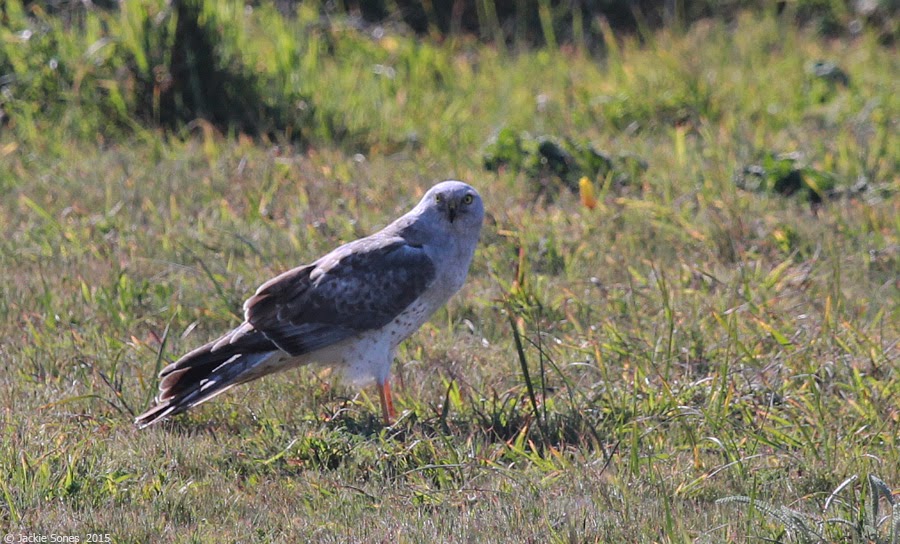
At the end of the day, I looked back to see this beautiful male harrier perched in the grassland on Bodega Head:
The harrier used its bill and feet to manipulate the lizard. In the next image, he is picking up the lizard with his talons. (Click on the image for a larger version.)
The photo above was actually one of my last pictures. When I'm reviewing pictures, if I think the best ones were taken last, sometimes I start with the final image and then step through them in reverse. This turned out to be a fun process for these harrier pictures today — one that I'll share with you.
The harrier had just caught something and was starting to eat it. I was too far away to identify the prey, but I decided to take pictures anyway.
Here's the next picture I encountered:
Hmmm...was it eating a snake?
On to the previous image in the series, and another clue:
Hmmm...at the harrier's feet you can see the prey's head, but is it a snake?
Rewind to clue number three (this one will give it away):
Aha! Legs! Not a snake! A lizard!
[It's likely this was an alligator lizard. For an example, review the post from 10 April 2014.]
Harriers are known for having a broad diet, including small mammals, birds, reptiles, amphibians, and insects.
Although their prey might not feel the same way, I'm so glad to be seeing harriers again on Bodega Head. For a while, it seemed like sightings of them had become uncommon.
Friday, March 27, 2015
How many tiny sails?
I know I just wrote about tiny By-the-wind Sailors (Velella velella) a few days ago. I have to post about them again because I don't think I've ever seen so many of this size, and it seems worth documenting.
Here's a picture showing a variety of sizes with a ruler for scale. The Velella on the left is the more typical size that you "expect" to encounter on a beach.
Below is the same picture, but it's a close-up of the left side of the ruler:
Now you can see the smallest of the Velella, just a couple of millimeters long. They looked like this for almost the entire length of the beach that we walked, about 3/4 mile.
I know they were probably variable along that stretch of beach. But if we used this picture just to come up with some sort of estimate —
then there were 25 tiny Velella/10 cm or 2.5/cm, and there are 160,934 cm in a mile, so there would have been ~400,000 tiny Velella washed up on a mile-long section of Salmon Creek Beach tonight. No wonder I kept saying, "Wow" as we walked along next to the receding waves.
Labels:
cnidaria,
hydroid,
salmon creek beach,
velella
Subscribe to:
Posts (Atom)