If you're interested in using any of these photographs or this content in any way, please contact me. Send an e-mail to naturalhistoryphotos(at)gmail.com. Thanks!

Wednesday, April 17, 2013

Springtime on the Sonoma Coast

Looking north along the Sonoma Coast into steady northwest winds on 15 April 2013

Tuesday, April 16, 2013

Shiny and tree-like

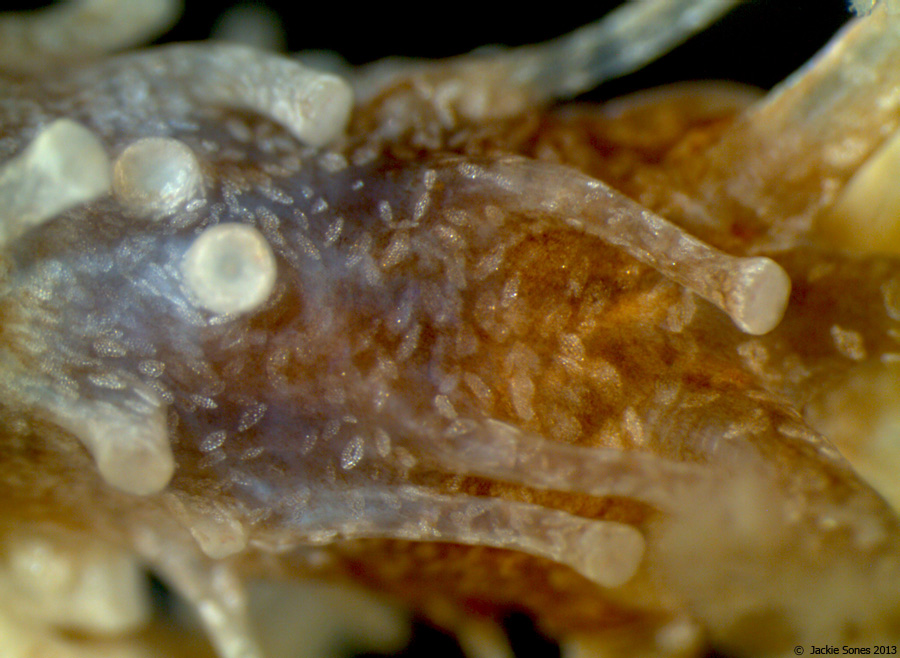
Okay, here's one of those mystery close-ups.  Do you have any guesses about what these might be?


I'll show you another example.  And I'll also reveal that these are under extreme magnification (viewed under a compound microscope).  [Beth — are you jumping up and down with a guess yet?] 


To help even more, I'll zoom out, and show a little more of this animal.


This may be difficult, so the next image is the entire animal.  (Yes, be forewarned, the answer is below.)


This is a sea cucumber (Cucumaria pseudocurata) that lives in the mussel beds along our local rocky shores.  This species is small; most individuals are less than 3.5 cm long, and many of the ones we encounter are only 1-2 cm long.

The skeleton in sea cucumbers has been reduced to small perforated plates called ossicles.  That's what was featured in the first and second photos of this post.

Under less extreme magnification, the ossicles look like small, leaf-like shiny plates.  They're visible in the sea cucumber's tubefeet (third photo of this post) and in the body wall (next image).


Sea cucumbers are holothuroids, one of five extant classes of echinoderms (they're related to sea stars, sea urchins, brittle stars, and crinoids — more about those other groups soon!).  Holothuroid means "in the form of a zoophyte."  A zoophyte is an animal that resembles a plant (zoo = animal; phyte = plant).  

So how does a sea cucumber look like a plant?  I'm actually not sure about this, but my guess is that it might be related to the shape of the specialized feeding tentacles.  Here's a view of one tentacle:


You can see how this tentacle (actually a modified tubefoot) is branched and tree-like.  (And note that it also has ossicles.)  The branches increase the surface area for feeding.  The sea cucumber captures phytoplankton and diatoms from the water and nearby surfaces and then sweeps the food particles to the mouth at the center of the tentacles.  In the image below, the mouth is a small raised bump in the middle of the ten tentacles.


Although hidden from view most of the time, deep within the mussel beds, these small sea cucumbers are fascinating members of the rocky shore community.  Think of them and their shiny ossicles and tree-like tentacles the next time you're next to a patch of mussels!

Monday, April 15, 2013

A blue day


Blue Dicks or Wild Hyacinth (Dichelostemma capitatum) 
photographed in the Bodega Dunes on 6 April 2013 


P.S.  I grew up watching the Boston Marathon with my family every year.  My heart goes out to everyone in Boston tonight.

Sunday, April 14, 2013

Wind, waves, and splash


Images from the Mendocino coast on 13 April 2013.

Wind and waves.  Hold on to your hat!


Black Oystercatcher and wave splash.

Saturday, April 13, 2013

From Mendocino to muskegs

We woke up at 3:45 a.m. so that we could arrive on the Mendocino coast for early morning field work.  But it was worth it!  The wind and waves were calm enough to get the work done, and then we had a little extra time afterwards to enjoy the morning before heading back to Bodega Bay.

I was pleasantly surprised to come upon a small group of Short-billed Dowitchers (Limnodromus griseus) feeding along the rocky shore.  (I see them more often on tidal flats.)  They spent a lot of time probing for food among the coralline algae (pink in all of the images below).


Dowitchers are on their way north to breed in the muskegs of Canada.  Wish them luck!


P.S.  For different pictures (from Bodega Harbor), and a little more information about dowitchers, see the post from last July.

Friday, April 12, 2013

Mystery blobs

It's been one of the windiest weeks of the spring so far.  When the wind blows this hard for this long, you never know what you'll find on the beach.  Last night Eric and I went for a quick walk on Salmon Creek Beach and found a few mystery blobs washed up on the sand.  Here's one in my hand:


We saw at least 8 of these masses, all about the same size and texture.  At first they looked like fish eggs, but you might be able to tell that although they stayed together, they were "mushy" or malleable.  Quite peculiar!  With a 10x hand lens we thought we might be able to see tiny eyespots, so there was still potential for this to be an egg mass of some sort.  We decided to bring it back for a look under the microscope.

Before I show you those pictures, I'll mention that these masses were buoyant.  We placed a few in a ziploc bag with seawater and they floated at the water surface.  Here's a picture I took later so you can see what the masses look like under water.


This is the first view under the microscope with low magnification:


The mass was made up of many thousands of tiny developing larvae!  In the image above (and those that follow), each larva has a greenish body and dark eyespots.  Here's a much closer view:


Now you should be able to see a head with four eyespots (two large, two small) followed by a segmented body.  You can also see three sets of setae or bristles on each side of the body.   

To make this even easier, we took a few pictures under a compound microscope (see below).  Note that we were able to do this because the larvae were fully developed and some were starting to leave the egg mass and were actively swimming around.  In the following images, note that the bristles can be also be splayed out to the side. 


These are the larvae of a polychaete worm (known as trochophore larvae).  The larvae use cilia to swim.  If you look very carefully between the bases of the bristles, you might be able to see the cilia — very fine hair-like structures that beat very rapidly to propel the larvae through the water.

So the mystery blobs are worm egg masses!  We don't know what species of worm produced these egg masses, but we'll be trying to figure it out.  If you have any ideas, let us know!  

Thursday, April 11, 2013

Northbound

I glanced offshore early this morning to see significant numbers of loons moving north.  This is always an exciting phenomenon.  April and May are the months to watch for loons heading to their breeding grounds in Alaska and northern Canada.

I made a few quick 1-minute counts.  The average was around 9 individuals passing by a spotting-scope-view per minute.  The highest count was 29 individuals/minute (15 Common Loons, 8 Pacific Loons, 6 Red-throated Loons).

I didn't get great photos today, as it was quite windy and the birds were pretty far out.  I'll show a couple of images so you can see what the conditions were like and you'll know what to look for...but then I'll add a couple of better shots from last year when the birds were closer to shore.

I'm really not sure it's worth posting today's images, but here goes.  The first shows three Pacific Loons.  If you look very carefully, you might be able to see their pale gray heads.  The second picture shows two Common Loons.  Look for their dark black heads. 


Now for the nicer images from 2012.

A small group of Pacific Loons close to shore near Mendocino on 9 May 2012.  Now you'll be able to see the pale gray on the back of the head.


A larger flock moving past Bodega Head on 6 May 2012.


In California, spring migration of Pacific Loons peaks in mid-late April and tapers off throughout May, so keep an eye to the ocean for these impressive northbound flights.