If you're interested in using any of these photographs or this content in any way, please contact me. Send an e-mail to naturalhistoryphotos(at)gmail.com. Thanks!
Showing posts with label Spud Point Marina. Show all posts

Saturday, July 11, 2026

Anchovies and a rock


I was at the Spud Point Marina docks briefly this afternoon and noticed lots of schools of what look to be young Northern Anchovies (Engraulis mordax).  [Feel free to correct me if I'm wrong!]

Also came across a nice juvenile rockfish (Sebastes sp.).  It was only ~4 cm (1.5 inches) long:


Wednesday, June 29, 2016

Nice spotting!


A beautiful White-spotted Anemone (Urticina lofotensis, formerly Tealia lofotensis) discovered nestled among mussels during a field trip to Spud Point Marina on 27 June 2016.  

Although this species can reach sizes of up to ~150-200 mm (~6-8 inches) across (including the tentacles), this tiny individual was only ~8 mm (~0.3 inches) across!

The deep red or scarlet color is distinctive, as are the white spots on the column — more easily seen when the tentacles are withdrawn (below).


Nice spotting, Chessie!  

Monday, November 16, 2015

Sittin' on the dock near Bodega Bay

Here's a close-up mystery photo for you.  Can you tell what type of animal this is?  (The answer is below the photo.)


These are the gill plumes of a nudibranch (sea slug).

Below is a view of the entire nudibranch:


Matt let us know that Kelly had spotted a few Polycera hedgpethi at Spud Point Marina.  I took a look on 14 November 2015 and found a few individuals.

On the West Coast, Polycera hedgpethi is generally a more southern species — most books list Marin County as the northern limit.  Although it has been noted in Bodega Harbor before, it might not be that common here.  It's another species that could be responding to warmer water temperatures.

This species has bright yellow markings, but it blends in well with the background of colorful marine invertebrates (in this case, tunicates, bryozoans and tubeworms) living on the docks:


Polycera hedgpethi eats Bugula — the purple, branched bryozoan in these photos.  Searching among patches of Bugula is a good way to find this nudibranch.  I'd love to hear about it if you spot any!

Saturday, September 12, 2015

Straight outta Santa Barbara


Wow is right!


Here's another view:


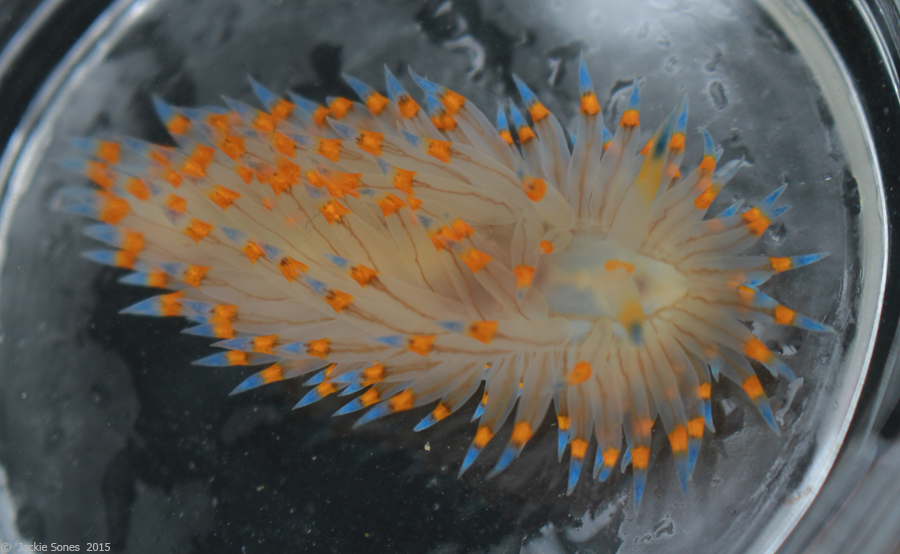
And another (the branching digestive gland is visible within the cerata cores):


I'm guessing many of you might know what type of animal this is.  The next picture will show you the entire animal as we found it on 12 September 2015:


Meet the Santa Barbara Janolus (Janolus barbarensis).  Spectacular, isn't it?  As the name suggests, this is a southern species whose northern range limit is generally considered to be San Francisco.  Above, this nudibranch is shown with bryozoan prey (Bugula sp.)

Because of warm ocean temperatures, Jeff had told us to keep any eye out for this species.  Then yesterday, Shawn Brumbaugh (SRJC) and Chris Kwan let us know they had found one at the Spud Point Marina. 

Due to its rarity (and beauty), Eric and I went to see if we could find one ourselves.  After an hour, Eric's sharp eyes and persistence paid off.


Note that the nudibranch's rhinophores (sense organs) are more yellowish, with slightly darker blue tips:


Here's an even closer view of a rhinophore:


If you're wondering, this individual was between 60-65 mm (2.3-2.5 inches) long — a large nudibranch!  (Most books say this species reaches up to 50 mm long.)  See below for a view with Eric's thumb for scale:


We were very excited to find this species in Bodega Bay.  It sounds like the Santa Barbara Janolus prefers more protected sites, so if there are bays/harbors with docks near you, it might be worth a look! 


Many thanks to Shawn and Chris for bringing their discovery to our attention! 

ADDENDUM (13 September 2015): Exciting news! Jeff Goddard confirmed that this is a northern record for Janolus barbarensis.

Monday, November 10, 2014

Risky business

Tonight I was simply going to share a nice photo of a juvenile Short-spined Sea Star (Pisaster brevispinus):


And a photo of an adult for comparison — this one was taken on a piling at the Spud Point Marina in October:


But when I was evaluating the pictures to choose the best one to share, something caught my eye that raised a question.

I noticed that one of the barnacles next to the sea star appeared to have its cirral fan (feeding structure) extended.

Do you want to try to spot it in the picture below?  It's subtle, but you can see a delicate fan extending upward from one of the barnacles (it's a side view).


I've highlighted the feeding barnacle in the next picture.  The arrow points to the extended cirral fan: 


Many species of sea stars eat barnacles. So this made me wonder: Can barnacles sense the presence of sea stars?  If so, why would one have its appendages out if a sea star was so close?  Why wouldn't it withdraw its cirral net and close its plates to discourage the sea star? 

Has someone studied this?  I did a quick search on the Internet and found that someone has.  In 1982, Richard Palmer et al. published a paper where they discovered that barnacles (Balanus glandula, the same species shown in these photographs) withdrew and stayed closed longer in response to predators compared to non-predators.

But Short-spined Sea Stars do eat barnacles.  So why was the barnacle in my picture still out feeding?

I don't know the answer, but it was fun to wonder about.

Thursday, October 30, 2014

October colors


A couple of weeks ago, Jason and Matt mentioned they'd been seeing these nudibranchs at the Spud Point Marina docks.  I've been saving the pictures because they seemed perfect for Halloween!

This is Polycera atra.  I've seen it called a Black Dorid, or an Orange-spike Polycera.  (Halloween Nudibranch wouldn't be such a bad name either!)

Although there is a consistent color theme, individuals are variable.  In contrast to the first individual, others are quite dark — see below:


The combination of black and white longitudinal stripes with yellow-orange spots is quite striking.  The next image is a close-up of one individual's head, showing the frontal veil with spiky processes and two spiraled rhinophores (sensory organs) extending upward.

 
Polycera atra feeds on Bugula, a common bryozoan growing on the docks.  Although the nudibranchs can blend in with their dark bryozoan prey, their eggs ribbons are bright white.  The easiest way to find the nudibranchs was to look for the egg ribbons and then to search for a nudibranch nearby.  [These nudibranchs were about 2 cm (3/4 inch) long.]


Happy Halloween!