If you're interested in using any of these photographs or this content in any way, please contact me. Send an e-mail to naturalhistoryphotos(at)gmail.com. Thanks!
Showing posts with label Tomales. Show all posts

Friday, November 23, 2012

Perched up high

A mild November day led us to a sailing adventure on Tomales Bay.  We launched from Nick's Cove and headed west towards Point Reyes.  

After passing Hog Island, I heard a series of high-pitched, descending whistles.  I recognized the call as a species I don't hear very often, so we started scanning to see if we could find the bird responsible for the call.  Eventually we located two birds perched up high in a tree on the north end of Hog Island.  Can you spot them?


We decided to sail past the north end of the island for a closer view.  This image, taken as we approached the island, should help you with the identification:


And although we were still pretty far away and the birds were perched at the top of the tree, luckily I had a zoom lens with me which resulted in a couple of decent close-ups:


Bald Eagles (Haliaeetus leucocephalus) are rare migrants, winter residents, and recently re-established breeders in Sonoma County.  (Hog Island is in Marin County, but this blog is mostly about Sonoma County, so I'm describing their status in the latter.)

Bald Eagles were more common in northern California in the early 1900s.  Their populations suffered steep declines in the mid-late 1900s (e.g., from persecution and pesticide impacts), but with protection they have recovered. They are still rare in this area, but sightings are now regular and there are two breeding sites in Sonoma County — Lake Sonoma (first recorded in 2001) and Laguna de Santa Rosa (first recorded in 2007).  [If you're interested in looking for Bald Eagles locally, two have been observed recently on Penny Island near the mouth of the Russian River.]


The call of the Bald Eagle is somewhat unusual.  You may see it described as "weak," "trivial," or "insignificant."  It's known as a chatter call and consists of several short descending notes sometimes written as kee kee kee kee ker.  

Interestingly, if you've ever seen a Bald Eagle in a movie, you may have heard a dramatic high-pitched scream.  This is not the true call of a Bald Eagle, but instead a Red-tailed Hawk.  I've never known if the movie-makers used the wrong call by mistake (lack of attention to detail) or on purpose — e.g., if the true call of the eagle was too "wimpy" for the powerful image of this majestic bird of prey.  But it always distracts me to hear a Red-tailed Hawk call when watching a Bald Eagle on-screen.  Movies are hardly ever accurate when it comes to bird sounds, but this is one of the most bothersome examples.

If you'd like to compare the two, listen to the Bald Eagle call and the Red-tailed Hawk call at the Cornell Lab of Ornithology's web pages.


P.S.  Now this is a little weird, but it may help with imagining what a Bald Eagle call sounds like.  As I was writing this, I was puzzled in that I thought I heard eagle call notes, but I wasn't playing a recording.  It turns out that there was a basketball game in the background (Celtics vs. Thunder), and the sounds of sneakers squeaking on the court are somewhat similar to eagle call notes!

Saturday, November 3, 2012

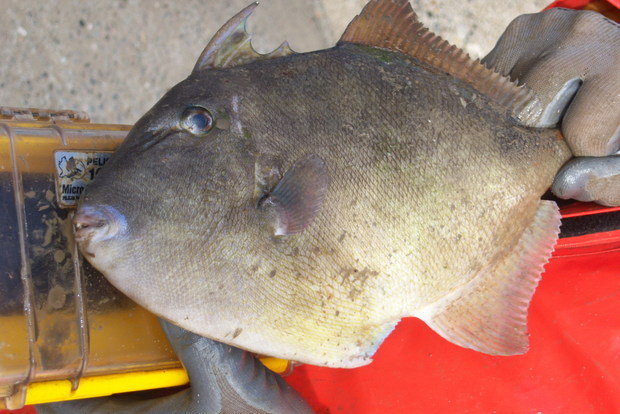
Triggerfish in Tomales


Finescale Triggerfish (Balistes polylepis) held by Chris Starbird.  He discovered it on 26 October 2012 in some oyster gear in Tomales Bay (near Marshall).  

Chris recognized this as an unusual find.  Finescale Triggerfish are subtropical species.  Although their range is listed as Point St. George (Del Norte County) to Peru, they're rare everywhere in California, especially north of Point Conception (range information from California Department of Fish and Game).

Below is a picture of Chris holding the fish (photo by Nicki Vogel).  In both photos, look for the following features (on the fish, not Chris!):

- strongly compressed body
- plate-like scales
- overall olive-brown to gray coloration, with hints of blue
- anterior dorsal fin with 3 spines
- only 1 gill slit (the vertical line just in front of the pectoral fin)
- small mouth with protruding teeth (used for crushing invertebrates such as sea urchins, crustaceans, and molluscs)


It's hard to know how this fish made it to Tomales Bay, but they may accompany warm water intrusions along the coast.  There's been some debate about whether this will be a strong El Niño year, but warm water anomalies have been recorded during the past few months.

I've been having trouble finding anyone who has seen a triggerfish in this area before.  If you have or know someone who has, I'd love to hear about other local triggerfish sightings (this year or in the past).

And keep an eye out for other species that signal possible warm water influxes!

Great find, Chris!  And thanks to Chris and Vicki for their generosity in sharing these photos and this intriguing story. 

Sunday, August 26, 2012

Bon voyage!

The view during a sail and kayak adventure on Tomales Bay on 26 August 2012.  From left to right are Tomales Point (the northern tip of Point Reyes), Bodega Head (in the far background through the mouth of Tomales Bay), and Tom's Point (with distinct trees).  Seals and pelicans (both species) are in the foreground.


A large flock of Brown Pelicans flying overhead.


A pretty hydromedusa in shallow water near shore.  This is a species of Aequorea, sometimes called a Crystal Jelly.  Note the many radial canals with pale blue gonadal folds.  This individual was ~8 cm across.


We were sailing with Nature today (sitting forward below) and wish her Bon voyage! on her upcoming journey to Washington, D.C. and beyond (including Antarctica!).


Safari njema! (in Swahili)

Oq yo'l (Happy journey in Uzbek) 

Cair Vie!  (Fair winds in Manx)