If you're interested in using any of these photographs or this content in any way, please contact me. Send an e-mail to naturalhistoryphotos(at)gmail.com. Thanks!
Showing posts with label fungus. Show all posts

Saturday, June 8, 2024

Local colors

Okay, I know this might seem like an unusual photo for the NHBH, but I couldn’t resist…and there’s a natural history connection!  We worked in Mendocino County today, conducting intertidal surveys during the early morning low tide.  But in the afternoon we made a few stops in Fort Bragg and Mendocino, including the Mendocino Art Center.  There’s a fun exhibit about kelp there, and a bonus was this amazing exhibit about dyes made from local mushrooms.  

I’m new to this world, but the dyed-wool examples above were made with different species of mushrooms.  The exhibit is about the collaboration between Dorothy Beebee (illustrator) and Miriam C. Rice (dye pioneer).  It showcases fabrics made with local dyes (including mushrooms collected from Mendocino County) and others on loan from the International Mushroom Dye Institute.  

I haven’t been able to check it out yet, but a documentary film called Try It and See: The Story Behind Mushroom Dyes will be available at www.mushroomsforcolor.com and www.myramadecolor.com.

Such a beautiful earth-toned color palette!

Monday, October 10, 2022

Mellow


Mushroom in Chatham, MA, on 29 September 2022

Sunday, April 17, 2022

Outward


We've been busy with low tide work lately, but here's a fun photo from late March, thanks to a mushroom!

Sunday, January 9, 2022

Ringing in the new year


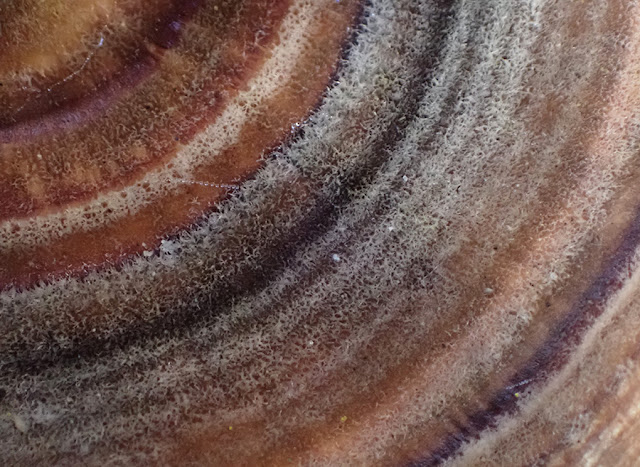
So cool to zoom in on these beautiful colors in a shelf fungus in our backyard!  (And what an amazing sweater pattern this would make!)

Here's a close-up:


 Photographed in Cotati on 9 January 2022.

Wednesday, April 3, 2019

Lovely lilac


Blewit (Clitocybe nuda) mushroom, photographed below a Monterey Cypress on Bodega Head on 3 April 2019.

I loved the lilac color of the cap!

Many thanks to Peter for helping me with the identification.
 

Sunday, February 10, 2019

Snownoma

This morning I was driving from Sebastopol to Cotati when something off to the east caught my eye.  Was that snow on Sonoma Mountain?  After doing some chores, I decided to go take a look.


Sure enough, there appeared to be remnant patches of snow at higher elevations.  (Not having been there when it fell, I don't know if this could have been accumulated hail.)  The patches were still substantial, so I could gather enough to make small snowballs!  By the way, Sonoma Mountain reaches an elevation of ~2400 feet (~730 meters).  It was ~10 degrees colder up there; my car thermometer read ~43°F (~6°C).

It was a beautiful day to be on Sonoma Mountain.  Scanning to the north, there were quite a few snow-covered peaks.  Below are two examples:


I have to admit that I spend so little time in the inland portions of Sonoma County that I'm not totally sure about identifying all of the peaks.  Perhaps some of you can help?

My best guess for the above is Cobb Mountain.  Cobb Mountain is at the Sonoma County/Lake County boundary.  At 4483 feet (1366 meters), Cobb Mountain-Southwest Peak is the highest point in Sonoma County.  Here's a closer view (with two ravens flying by in the distance):


I learned something fun about Cobb Mountain today.  Both sides eventually drain to the Pacific Ocean, but they do it in very different ways.  The western slopes feed into the Russian River (via Big Sulphur Creek), while the eastern slopes feed into the Sacramento River (via Putah Creek) and then to San Francisco Bay.

Now here's a different peak:


My guess for this one is Mount Saint Helena.  It reaches an elevation of ~4342 feet (~1323 meters). 

While snow-watching this afternoon, I caught a glimpse of what appeared to be a Golden Eagle (Aquila chrysaetos) in the distance:


Let me know if you can confirm or correct the identifications of these snowy peaks!
 

Monday, December 24, 2012

Lavender shelf


Shelf fungus growing on a stump in Walpole, MA, 24 December 2012

Tuesday, December 11, 2012

Emerging among the pine needles

When Peter mentions that he has found something interesting, you know you're in for a treat.  Such was the case last week when he brought me to a site near Bodega Head and pointed to these:


These beauties are all stages (from youngest to oldest) of the Fly Agaric or Fly Amanita (Amanita muscaria).

Note the progression from the "button" stage to globose and then to broad and plate-like. Apparently some can reach up to 40 cm (~15 inches) across!

The small, flattened patches on the cap are remnants of the universal veil — a layer of tissue that initially covers the emerging mushroom.

While scanning different mushrooms among the pine needles, we noticed that a few had been nibbled:


After a little more searching, we discovered the likely culprit.  Can you find it in the image below?


Yes!  A banana slug (Ariolimax sp.) can be seen near the base of the mushroom (see close-up below).


(Athough slugs eat them, beware that Fly Agarics are poisonous to people.)


Peter recalled that occasionally these distinctive red-and-white mushrooms show up on winter holiday cards.  This U.S. Forest Service ethnobotany page discusses this association and presents a few images of vintage cards with examples.  I especially like the one with children collecting mushrooms in the snow — a good idea for a knitted hat! 

Monday, August 27, 2012

Mystery photos

When I was younger, we used to get Ranger Rick magazine.  One of my favorite parts of the magazine was the back page. It contained a grid of mystery photos.  Each small square had an extreme close-up of an organism and you could try to guess which organism it came from.

Here's one for you to try!  (The answer is below the photo.)


If you guessed the underside of a fungus or mushroom, you're right!  The following are all different views of the same fungus on a eucalyptus tree photographed today.  I'm asking a friend for help with the identification, so will report back with more information soon.


ADDENDUM (28 August 2012): Peter and Brendan have both suggested that this is Laetiporus sulphureus (Sulphur Shelf or Chicken-of-the-Woods).  Thanks for the identification assistance!