If you're interested in using any of these photographs or this content in any way, please contact me. Send an e-mail to naturalhistoryphotos(at)gmail.com. Thanks!
Showing posts with label goldfinch. Show all posts

Sunday, February 25, 2024

Rosemary for breakfast?


While doing some errands in Sebastopol this morning, I noticed some movement in a rosemary bush at the edge of a parking lot.  Turned out to be a small flock of Lesser Goldfinches (Spinus psaltria) along with a few Pine Siskins (Spinus pinus).  They appeared to be eating the rosemary flowers.  

Siskins are often perched up high in trees, so it was fun to see them below eye level.  Above, two Pine Siskins.  (Note the nice yellow feather edges.)

Below, a bright male Lesser Goldfinch.


Tuesday, May 8, 2018

Flock of gold


American Goldfinches (Spinus tristis), 5 May 2018.  [Click on the image for a larger version.]

Wednesday, December 16, 2015

Breakfast in the sweetgum

The birds returned for "breakfast" in the sweetgum this morning.  

When I lived in Massachusetts, I didn't see Pine Siskins that often, so it's been fun getting to know them better in California.

Here's a classic pose, hanging onto a sweetgum seed pod:


The siskins frequently feed upside down, and often in close proximity to each other:


After feeding, they will sometimes sit quietly in the sun with their eyes closed: 


The activity of the siskins attracted other birds.  While the siskins would roll the seeds around in their bills, the Chestnut-backed Chickadees had a slightly different feeding strategy.  They would extract a seed, then take it to a perch and hammer on the seed to separate it from its winged covering.


The Lesser Goldfinches also hung from the pods, and fed in a similar way to the siskins, maneuvering the seeds in their bills.  How many goldfinches can you find in the photo below?


[There are four goldfinches in the photo above — three near the center (top, middle, bottom), and one in the upper right corner.]

Sunday, November 22, 2015

The small singer


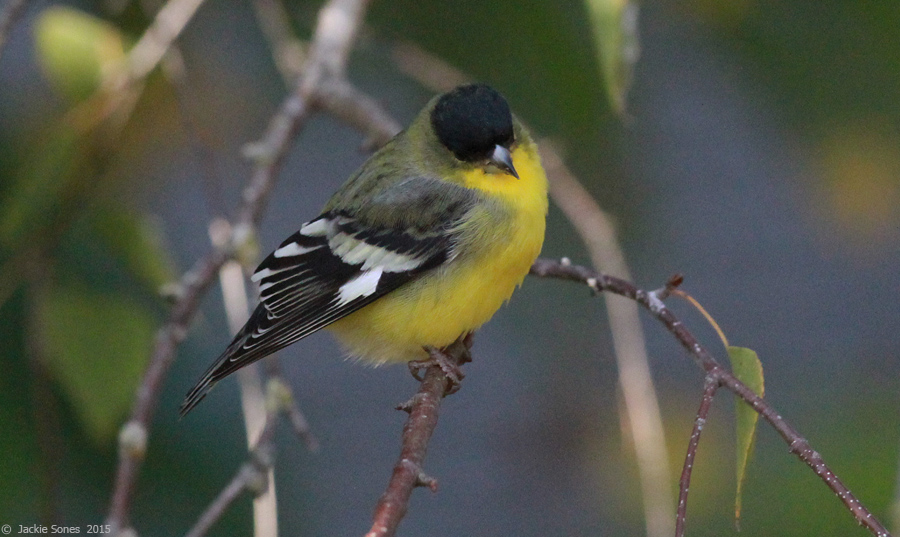
Lesser Goldfinch (Spinus psaltria) near the Lydia Park Community Garden in Rohnert Park on 22 November 2015.

A male is above, while a much paler female is below.


The "Lesser" in their common name refers to their small size — about 1/2" smaller (in length) than an American Goldfinch. 

Someday I'll have to record the intricate song of Lesser Goldfinches.  Their species name, "psaltria", means "singer."

Sunday, April 22, 2012

Black and gold


American Goldfinches (Spinus tristis) are molting into breeding plumage at this time of year.  Pictured above are three males and two females. 

Below are two males (note the black caps).  I'm guessing that the paler bird is still in the process of molting and will become brighter yellow.  Alternatively, color saturation in goldfinches is linked to their diet.  They acquire carotenoids (lutein and zeaxanthin) from seeds.


P.S.  A Game 6 win today for the Black and Gold from Beantown!  Go B's!