If you're interested in using any of these photographs or this content in any way, please contact me. Send an e-mail to naturalhistoryphotos(at)gmail.com. Thanks!
Showing posts with label goose. Show all posts

Saturday, April 13, 2024

Birds of a different feather


A few more miscellaneous bird photos from Hawai'i for you...

Above, a kōlea, or Pacific Golden-Plover (Pluvialis fulva), all dressed up for the breeding season and departing soon for the Arctic tundra.


Close-up of a nēnē , or Hawaiian Goose (Branta sandvicensis), endemic to the Hawaiian Islands.


A distant photo, but these were my first kioea, or Bristle-thighed Curlews (Numenius tahitiensis).


Also distant, but fun to see a pueo, or Hawaiian Short-eared Owl (Asio flammeus sandwichensis).


An ūlili, or Wandering Tattler (Tringa incana) on a nice bed of limu kala. (I think this might be Sargassum aquifolium, formerly S. echinocarpum, but feel free to correct me!)  This endemic species is the state seaweed of Hawai'i and an important alga used in cultural practices by native Hawaiians.


Ā, or Brown Booby (Sula leucogaster).

Thanks for tuning in for some special guests from Hawai'i!

Wednesday, March 18, 2020

The Emperor

We had to make a run down to the post office today, and since word had been passed along that an Emperor Goose (Anser canagicus) had been spotted on the offshore rocks just off the Bodega Head parking lot, we swung by to take a quick look.  Luckily, it was still there!

Emperor Geese are more often associated with arctic and sub-arctic Alaska (and Russia).  It sounds like there are four prior records in Sonoma County (in 1978, 1994-1995, 1996-1997, and 2001).

Here are a few photos from different perspectives.

Sitting:


Watching the waves:


With Black Oystercatchers: 


Searching for food and eating some green algae:


Profile view:


Many thanks to Scott for spotting this goose and to Dea for passing along the sighting. 

P.S.  I was curious about the species name.  Apparently "canagicus" refers to the island of Kanaga or Kyktak (in the Aleutian Islands).

Monday, February 10, 2020

Sunset dinner


Sunset over Bodega Harbor, with Brant (Branta bernicla), various ducks, probably some American Coots (Fulica americana), and a Great Blue Heron (Ardea herodias) feeding among the Eelgrass (Zostera marina).

Saturday, November 9, 2019

On the pond


Recently Scott mentioned there was a Ross's Goose (Anser rossii) at the farm pond along the Bodega Highway just east of the town of Bodega.  So I pulled over on my way back from Santa Rosa on 7 November 2019 and scanned the pond from the side of the road.  The goose was on the far side of the pond, but here's a picture for the record.  Ross's Geese nest in the central Canadian Arctic and large numbers winter in the Sacramento Valley and San Joaquin Valley.
 

Monday, December 10, 2018

In the harbor


Brant (Branta bernicla), Bodega Harbor, 7 December 2018

P.S.  I first wrote about Brant ~5 years ago for more information about them (including an audio clip), see the post called "Do you like my necklace?" on 18 January 2013.

Thursday, November 21, 2013

High in the sky

I had to go home sick today, but I decided to make a quick stop at Doran Beach on the way (for a little fresh air and to get rid of all of those bad germs before being stuck indoors for the rest of the day!).

As soon as I stepped out of the car I knew it was "one of those days."  There are some days when you just can't miss...when it seems like everywhere you look there's something to see.  I was both excited and disappointed, as I was only going to be there for a short time.  But sometimes it only takes a few minutes to make a handful of interesting observations.

The first thing that happenedI heard a familiar call overhead, but one that I don't hear often in Bodega Bay.  Snow Geese!  The sky was blue, blue, blue today, and the birds were very, very high, which made it difficult to find them at first.  But I kept following the sound and searching the sky and eventually I located the flock:


I took a few different pictures and when I reviewed them and tried to count the number of individuals in the flock, I realized it was an interesting lesson in counting.  The configuration of the flock really makes a big difference in how easy it is to count.  Below are two more examples of this same flock.  

Try to count (using the photo above and the next two below — you can click on them for larger versions); consider which formation works best for you; and see how many Snow Geese you come up with (my answer is below the pictures).


I came up with 47 Snow Geese.  I liked the last configuration the best.  It was easy to count the front row of geese and then there were just a few isolated groups behind them.  The middle picture was second best for me as the flock was divided into smaller groups of geese that were relatively isolated and easy to count.  The first picture was the hardest.


The next thing that happened: I heard a high-pitched shriek and looked up to see two Peregrine Falcons diving at each other.  Fun!  And then something else caught my eye above them.  Swans!


Swans are rare in Bodega Bay.  Based on their long straight necks, black bills, and likelihood of occurrence, it's probable that these were Tundra Swans.  

Because this was a flyby sighting, it was hard to see field marks on the birds.  Size is a useful character when trying to separate Tundra and Trumpeter swans.  These swans were isolated in the sky and I didn't have anything to compare them with, so all I had to go on was my impression of their size in comparison to other familiar birds.

Tundra Swans have a wingspan of 66 inches, while Trumpeter Swans have a wingspan of 80 inches.  For comparison, the closest birds to Tundras in this area are Turkey Vultures (67 inches) and Osprey (63 inches).  At the other end, closer to Trumpeters, you could use Brown Pelicans (79 inches) and Bald Eagles (80 inches).

These swans didn't seem that large to me, so I'd lean towards calling them Tundra Swans.  But those of you who know me know how conservative I am when it comes to identifying things.  Unfortunately, although it's tempting to call them Tundra Swans, I'll have to say that I didn't see enough to identify them with 100% certainty.


Wednesday, October 23, 2013

Cackling Geese, Part 2

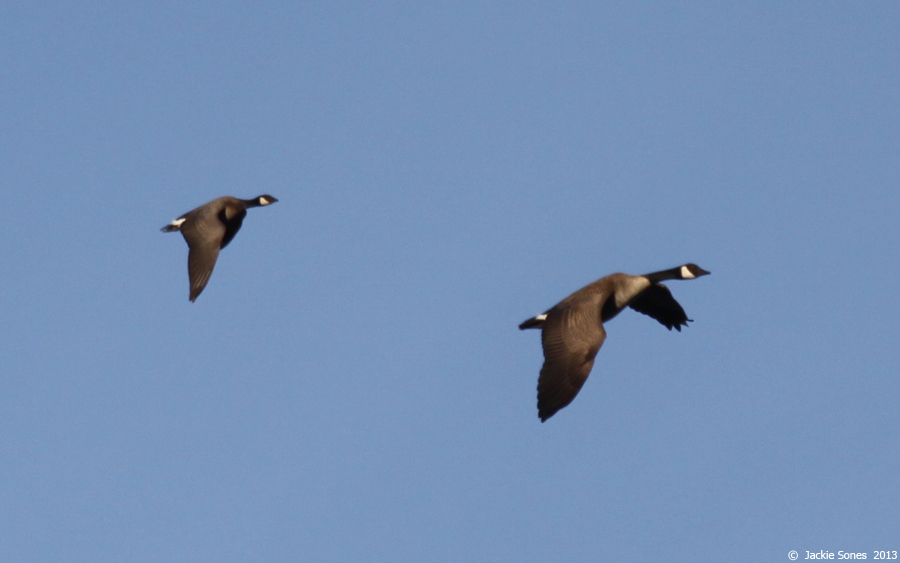
Last winter I introduced Cackling Geese (Branta hutchinsii) when I photographed a flyover in Bodega Harbor (see that post from 12 February 2013).

This morning I obtained closer photographs when I noticed two individuals in a small patch of grassland near the entrance to the Bodega Marine Laboratory.


Remember that these are basically smaller versions of Canada Geese.  They were officially split off as separate species in 2004.  Note that everything is smaller, and when a Canada Goose isn't nearby for comparison, it's the shorter bill that really stands out as being different.

It was interesting to see that these individuals had slightly different head shapes, with one being more rounded than the other.  Can you see that in the photo above?

Below are the two individuals in separate photos.  Can you pick out which one has the rounder head?


[The first photo shows the goose with the longer or flatter head, while the second photo shows the goose with the rounder head.]


The geese were walking through the grassland, searching for food (i.e., plants to graze on).

 
I was curious about which species of plants they preferred.  Generally it was too difficult to see what they were eating, but I photographed one of the geese with the green leaves of a native grass, California Brome (Bromus carinatus).


Warning: This next section is only for Bugs Bunny fans!

P.S. I know most of you will think I'm crazy, but I had a funny memory run through my head while watching these birds.  It had to do with a Bugs Bunny cartoon!  It might be hard to tell from the photos, but these geese are quite small, and their diminutive features make them quite "cute."  There was something about their appearance that almost made me want to pick them up...and that made me remember the Bugs Bunny episode with the Abominable Snowman when he picks up Daffy Duck and says, "Just what I always wanted, my own little bunny rabbit.  I will name him George...and I will hug him and pet him and squeeze him..."  If you remember that cartoon, I think you'll know what I mean.  If not, I apologize for the random and rambling story!  (By the way, you can watch The Abominable Snow Rabbit episode on the Internet.)

Tuesday, February 12, 2013

Number 354

It feels a little odd, but it's official.  This is the 354th bird species to be added to the list for Bodega Head, Bodega Harbor, and Bodega Dunes.

In the photo below, once again you're looking for one bird that's different from the others, in this case distinguished by its smaller size:


In 2004, the smaller-bodied subspecies of Canada Geese (Branta canadensis) were formally split off as a separate species.  They're now known as Cackling Geese (Branta hutchinsii).  [If you don't have a field guide published after 2004, this species won't appear in your book.]

On 19 January 2013, a small flock of geese flew over me while I was standing on the tidal flats in Bodega Harbor.  One goose was much smaller than the rest.


Along with the overall smaller size, note the more rounded head; stubbier bill; shorter neck; and darker breast.


I don't know a lot about Cackling Geese, but it seemed worth documenting their presence in Bodega Harbor and their addition to the local species list.

If you want to practice locating the Cackling Goose among the Canada Geese, here's a slightly different view:

[The Cackling Goose is the second bird from the right.]


ADDENDUM (13 February 2013): I should I have clarified that it's not necessarily the first time a Cackling Goose has been observed in Bodega Bay.  I would have to check, but I'm guessing others have probably identified them locally.  But this is the first time I've seen and photographed one in the harbor, and that I recognized we needed to add it to the local species list.  If you're interested in reviewing that list, it's posted online here: http://bml.ucdavis.edu/bmr/Bird_List.PDF

Friday, January 18, 2013

Do you like my necklace?

Brant (Branta bernicla), Bodega Harbor, 17 January 2013


This relatively small, dark goose overwinters in sheltered harbors and bays along the Pacific Coast where they feed on eelgrass (Zostera marina) and sea lettuce (Ulva spp.).  They nest much farther north, mainly in Alaska and the Northwest Territories of Canada.

The white stripes on the neck are sometimes referred to as a collar or necklace.  Interestingly, the amount of white in the necklace varies.  I'm not sure if this holds true for Brant on the West Coast, but a study on Brant nesting near Hudson Bay found that geese tended to choose mates with similar necklaces!

Most of these geese were actively preening. 


Some posturing was also evident.  Note the raised and arched necks.  I've read that Brant will defend both feeding and roosting sites.


Sometimes the posturing was fairly aggressive, with the neck being held low and horizontal and the bill open:


And occasionally there was a chase.  The next picture also reveals the tail pattern.  Note that Brant tail feathers are dark brown/black, but the uppertail coverts are very long and white, extending over the tail feathers and creating a bold white "V" pattern.


These handsome geese utter a distinctive call that is sometimes written as "rrronk."  When the wind is still, their collective calls can be heard across Bodega Harbor.  I don't have a great recording yet, but here's an example.  You can hear some chattering first, and then a couple of rolling, guttural rrronks.  I've repeated the recording once, so listen for the rrronks at ~4-5 seconds and again at ~10-11 seconds.