If you're interested in using any of these photographs or this content in any way, please contact me. Send an e-mail to naturalhistoryphotos(at)gmail.com. Thanks!
Showing posts with label mole. Show all posts

Saturday, January 10, 2015

The Digger

While wandering yesterday and encountering those Northern Flicker feathers, I also noticed a small mammal nearby that perhaps had been left behind by a predator.  It wasn't in the best condition, but you don't get to see this species very often because it spends most of its life underground (in fact, I think these are my first photographs of this species from Bodega Head), so I've decided to show a few images:

Have you seen this species before?  I'm guessing you've at least noticed evidence of its subterranean runways on the surface of the ground. 

There are four species of moles that live in California, two of which have been recorded on Bodega Head.  I showed one species, the American Shrew-Mole, on 9 February 2013 (review that post here).  The mole pictured above is a Broad-footed Mole (Scapanus latimanus).

I used the name "Broad-footed Mole" because that's the name commonly used by other sources.  But I was tempted to rebel and use "Broad-handed Mole" because the species name, "latimanus" translates directly into "broad hand."  And a broad hand it is!
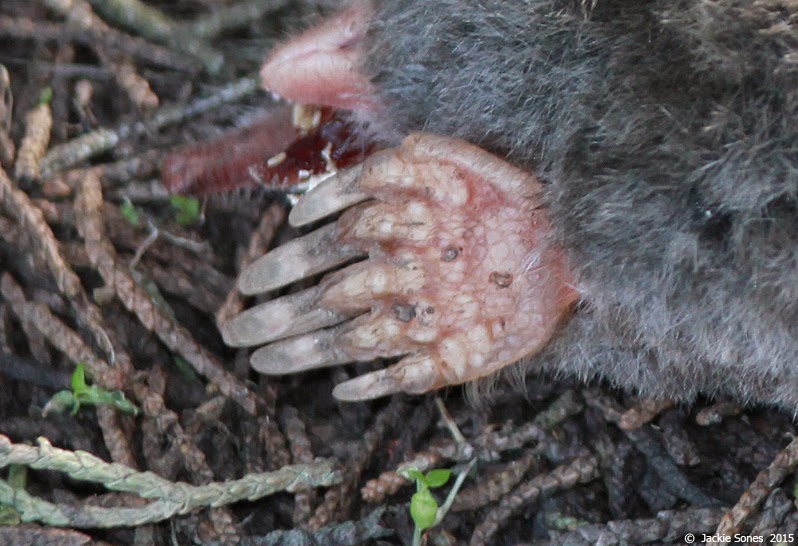

The entire mole was ~14 cm long.  The front "hand" was ~2 cm long and ~1.5 cm wide.  Note that the claws are quite long and take up ~50% of the hand!

On the opposite end, the hind feet are much, much smallernot so important for digging.


I'll point out one more important characteristic for nowthe tail.  If you review the first photo (I'll show it again below), note the length of the tail (is it short or long?) and whether it's covered with hairs or not.


The short, hairy tail helps identify this as a Broad-footed Mole.


P.S.  I know this might seem a little random, but whenever I see a mole I almost always think of two things from my past that triggered visualizations of what life might be like for a mole:

- A drawing by one of my favorite illustrators"Dead End Mole" by Peter Parnall.  You can see it here. (Click on the thumbnail to see the complete version.)

- A wonderful book that Julie recommended to me Duncton Wood by William Horwood.  It's written in the style of Watership Down, but with moles instead of rabbits. 
  

Saturday, February 9, 2013

Burrowers of the soft earth

I encountered this small mammal along a trail near the Bodega Dunes Campground today.  Perhaps it was dropped by a predator?  Although it wasn't alive, it was an opportunity to learn about and appreciate this seldom-seen animal.


This is the smallest mole in our area (most are less than 120 mm long).  Because of some similarities to shrews (e.g., its small size and a long, narrow snout), it's commonly called an American Shrew-Mole (Neurotrichus gibbsii).


Note the soft, dense fur and relatively broad front feet (although not as broad as the larger moles you're probably more familiar with). 

The eyes are tiny (rudimentary) and barely visible, but the whiskers are very long.  You can also see short bristles at the very tip of the nose.


The feet have very long, curved claws.  And I was curious about the tubercles (bumps) on the soles of the hind feet, but couldn't find any information about them or how they might be used.


The genus, Neurotrichus, means "no hair on the tail", and refers to the sparsely haired tail, although there's a nice tuft of fur at the tip of the tail.  (This photo is from March 2006.)


American Shrew-Moles occur from British Columbia to Monterey County, so Bodega Bay is near the southern end of their range.  They prefer moist habitats with soft soil and lots of leaf litter.  As you might expect, they burrow, but not as deeply as other species of moles.  Their preferred prey include earthworms, centipedes, snails, and slugs.

I've only seen a few shrew-moles since moving to California.  I still remember the first one, and puzzling over whether it was a shrew or a mole.  I feel lucky whenever I get to see one of these burrowers of the "soft earth."  

(Facts above from the Mammalian Species Account by Carraway and Verts published by The American Society of Mammalogists, 1991)