If you're interested in using any of these photographs or this content in any way, please contact me. Send an e-mail to naturalhistoryphotos(at)gmail.com. Thanks!

Wednesday, November 7, 2012

Not so itsy bitsy


I wish I had taken these photos in late October.  I was just a little late for Halloween!


I'll also admit that I'm a little squeamish around large spiders.  [This individual was ~2 cm (3/4 inch) long.]  But if I can watch them from a distance, I'm intrigued by their variety of shapes and sizes, color patterns and life histories.

This species is quite visible right now in low grassy areas on Bodega Head.  It creates a large orb web and tends to sit in the center or near the top edge. 

Some have very large, swollen orange abdomens (see next two photos). 


On the dorsal (upper) surface, there are noticeable white spots, some with pupil-like markings similar to cats' eyes.


Below, there is a beautiful combination of burnished orange bordering iridescent metallic purple.  (I'd like a sweater with those colors!)


In the photo above, note the spinnerets (silk-spinning structures) at the tip of the abdomen.  They are black with a yellow ring at the base and are arranged in a tight circle.

This might seem crazy, but they reminded me of sea urchin teeth!  Urchins have five pointed teeth that come together for grazing on algae (see below).  Drawing parallels between spider spinnerets and sea urchin teeth — see what happens when you spend time in both terrestrial and marine environments!

(This urchin skeleton, missing most of its spines, washed up on the beach in January 2009.)

Back to the spider...I tried to figure out which species it is, but so far I haven't had much luck.  I'm wondering if it's in the genus Araneus, but if anyone out there can help with an identification, I'd be grateful!


Tuesday, November 6, 2012

"Lord of the Flies"


Ash-throated Flycatcher (Myiarchus cinerascens) photographed on Bodega Head on 5 November 2012.

Although a common summer resident in eastern Sonoma County, most Ash-throated Flycatchers leave the United States by the end of August and winter from Mexico to Honduras.  They are only casual visitors to the Sonoma County coast in the fall and winter, including seven records: 2 in September, 2 in December, and 1 each in October, November, and February.

Above, note the medium size, medium-length bill, and short crest.  For a size comparison, the photo below shows the Ash-throated Flycatcher on the far right and Say's Phoebe on far left.


The throat is white or light gray and the belly and vent are pale yellow.


On the wings, note the two gray wing bars, and rusty edges on the primary feathers.


One of the most important characteristics is the pattern on the tail feathers.  Note that the tail is extensively rufous, true of juvenile birds.  And the central tail feathers (recently molted) have broad, dark brown tips extending across the entire feather.


The genus, Myiarchus, translates into "ruler of flies," which I've casually interpreted as "Lord of the Flies."  You may be able to get the sense that these birds perch at the tips of vegetation, actively scan, and make short flights to pursue their insect prey.

 
P.S.  This is the first Ash-throated Flycatcher I've seen on Bodega Head.  Because there are several other species that look similar, to confirm the identification I asked for and received help from local birders, for which I am very grateful!

Monday, November 5, 2012

East and west


10-15 mph east winds, 7-8 foot west swell, 5 November 2012

Sunday, November 4, 2012

Follow your ears

When I first started birding, one of the things I enjoyed most was learning to identify birds by their sounds.  I hoped that one day I could walk around and identify all of the species I was hearing without even seeing them.

I can still remember starting this process.  I would sit somewhere, pick out a sound and follow it until I found the bird.  Then I would go back to the original spot, pick out a different sound and do the same thing over and over until I could recognize all of the species I was hearing from that location.  Then I would move to another spot with different sounds and start again.  I was also very fortunate that many of the birders I was hanging out with at the time were excellent at birding-by-ear and unselfish in sharing their knowledge.

Following bird sounds is still one of my favorite things to do.  Today I followed a high-pitched wheezy zeee note coming from the coyote brush in the dunes.  I knew what it was, but I wouldn't have seen the bird if I hadn't been listening.


This is a Blue-Gray Gnatcatcher (Polioptila caerulea).  They're considered rare migrants on Bodega Head.  During the last few years it seems like one or two individuals have spent the winter on Bodega Head.

Blue-gray Gnatcatchers are small songbirds with very long tails.  The common name calls attention to their overall blue-gray coloration and their insect-eating habits.

Note the bold white eye-ring.  The tail is black with white outer feathers.  When folded (as in the first photo above), the white edges are just visible.  But gnatcatchers often fan or flare their tails (perhaps to flush their insect prey), revealing the contrasting back and white feathers.

This next flight shot provides a better view of the white outer tail feathers.


Gnatcatchers can be hard to follow.  They move among the branches of trees and shrubs, flitting here and there, and then fly off to the next clump of shrubs.  I lost this bird several times today, but listened carefully for the zeee call, relocated it, and finally ended up with a few photographs.


In non-breeding plumage, males and females are difficult to separate.  But if you see one in the spring, look for the strong black eyebrow stripes of the males.  The male below was photographed near Owl Canyon on 17 March 2012.


I didn't get a recording today, but here's a link to a Blue-gray Gnatcatcher calling and singing, thanks to the Cornell Lab of Ornithology's Macaulay Library.  If you hear these buzzy notes, follow your ears and you might catch a glimpse of this wonderful little songbird!

Saturday, November 3, 2012

Triggerfish in Tomales


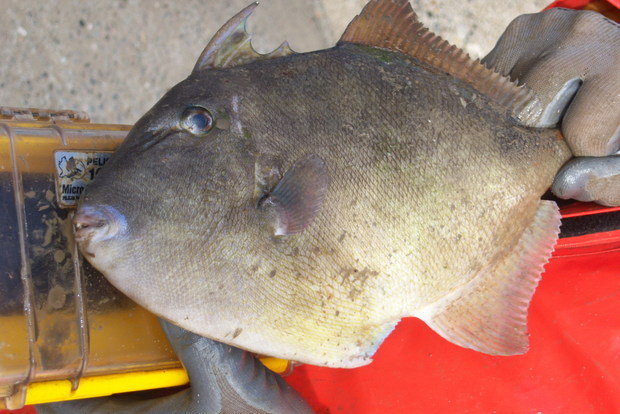
Finescale Triggerfish (Balistes polylepis) held by Chris Starbird.  He discovered it on 26 October 2012 in some oyster gear in Tomales Bay (near Marshall).  

Chris recognized this as an unusual find.  Finescale Triggerfish are subtropical species.  Although their range is listed as Point St. George (Del Norte County) to Peru, they're rare everywhere in California, especially north of Point Conception (range information from California Department of Fish and Game).

Below is a picture of Chris holding the fish (photo by Nicki Vogel).  In both photos, look for the following features (on the fish, not Chris!):

- strongly compressed body
- plate-like scales
- overall olive-brown to gray coloration, with hints of blue
- anterior dorsal fin with 3 spines
- only 1 gill slit (the vertical line just in front of the pectoral fin)
- small mouth with protruding teeth (used for crushing invertebrates such as sea urchins, crustaceans, and molluscs)


It's hard to know how this fish made it to Tomales Bay, but they may accompany warm water intrusions along the coast.  There's been some debate about whether this will be a strong El Niño year, but warm water anomalies have been recorded during the past few months.

I've been having trouble finding anyone who has seen a triggerfish in this area before.  If you have or know someone who has, I'd love to hear about other local triggerfish sightings (this year or in the past).

And keep an eye out for other species that signal possible warm water influxes!

Great find, Chris!  And thanks to Chris and Vicki for their generosity in sharing these photos and this intriguing story. 

Friday, November 2, 2012

Lounging

Sea lions lounging on Bodega Rock on 26 October 2012

This photo was taken from the boat on our way back to Bodega Harbor while passing between the southern end of Bodega Head and the small rocky islet offshore known as Bodega Rock.

Hope you enjoyed Pelagic Week #2!


P.S.  This is my 300th post!  Thanks so much for reading and providing feedback and support!  As Buzz Lightyear says, "To Infinity...and Beyond!"


Thursday, November 1, 2012

Humbling


The lingering spout of a Humpback Whale (Megaptera novaeanglieae) at Cordell Bank on 26 October 2012.  [A Black-footed Albatross is heading left above the horizon.]

We saw a few humpbacks and several Blue Whales offshore, and a couple of Gray Whales very close to Bodega Head.

Humpback Whale spouts have a bushy shape and reach ~2.5-3 meters high (8-10 feet).  Humpbacks may blow 4-8 times at 15-90 second intervals before a deeper dive.  Dives may last 3-15 minutes, or up to 40 minutes.
 
Humpbacks often appear black.   One individual revealed its arching back and knobby dorsal fin (next photo).  


I'm often asked how to tell Humpback Whales and Gray Whales apart.  To my eye, the spouts are fairly similar.  Gray Whale spouts are also bushy and reach up to 3-4 meters high (10-13 feet).  They average 3-6 blows at 15-30 second intervals before deeper dives, and their dives may last 3-10 minutes or up to 25 minutes. 

To compare, here are two pictures the first is a pair of Humpback Whale spouts from 26 October and the second is a Gray Whale spout seen from Bodega Head on 5 September.

If you see a spout like this, keep watching for the color of the back,  whether there is a dorsal fin, and if the flukes are lifted above the water.

- Humpbacks appear black, while Grays appear gray

- Humpbacks have dorsal fins, while Grays lack them

- Both species may lift their flukes about the surface when taking deeper dives, but Humpbacks lift them more frequently than Grays 

- Humpback flukes are broader, with pointed tips and a serrated edge, while Gray Whale flukes are more compact and rounded with a convex edge

- Gray Whales are often seen very close to shore, while Humpbacks are more common offshore


No matter what species you see or where you see them, it's always humbling to be in the presence of whales.


P.S.  The facts about spouts and dives came from one of my favorite field guides: Whales, Dolphins, and Other Marine Mammals of the World by Hadoram Shirihai and Brett Jarrett (2006).