If you're interested in using any of these photographs or this content in any way, please contact me. Send an e-mail to naturalhistoryphotos(at)gmail.com. Thanks!

Saturday, May 9, 2015

Feeling defensive


Close-up of a Sunburst Anemone (Anthopleura sola) with its acrorhagi extended.  The acrorhagi are the white-tipped structures along the perimeter of the anemone.  Normally, the acrorhagi are hidden beneath the ring of feeding tentacles.  You only see them occasionally, when the anemone is "feeling defensive."

Acrorhagi contain dense concentrations of nematocysts their toxins are capable of damaging neighboring anemones.  To maintain space around itself, an anemone will lean towards a neighbor, touching it with the tips of its acrorhagi, attempting to force the neighbor to move further away.

Here's most of the anemone with its ring of defensive acrorhagi:


If you'd like to see anemones "fighting" with their acrorhagi, watch this short video clip from The Shape of Life.

Thursday, May 7, 2015

A Hula Skirt!

We were walking Salmon Creek Beach on 26 April 2015, and Eric said, "What is this?"  When Eric asks that question, I know it's going to be something interesting.  I bent over to look at what he had noticed washed up in the wrack line, and I couldn't believe it.  I'd been wanting to see one, but I didn't think the chances were very good in northern California.  I had seen pictures of it online and in books.  It's a very distinctive animal, and easy to identify once you know what to look for — I was just surprised to see one!  I also warned him right away to be careful, as its sting can be very potent it's related to a Portuguese Man O' War.

Here's what he found:


This is Physophora hydrostatica, sometimes called a "Hula Skirt Siphonophore."  It was in rough shape after being washed up on the beach, but most of its parts were still visible.

In the photo above, you probably noticed the pneumatophore, or float, with the dark red pigment patch.  And the wonderful tentacle-like palpons — pink and orange in color with white tips.  The palpons had become detached, but I arranged them so you could visualize their position.  Normally there are many more palpons in a full whirl hanging like a skirt, which gives this siphonophore its informal common name.

Modified from A Synopsis of the Siphonophora (Totton 1965)

The pneumatophore helps with buoyancy.  The palpons are defensive (beware of powerful stings!).  The nectophores are swimming bells they were missing on this specimen, probably dislodged in the surf.  Gonophores are reproductive structures, whereas gastrozooids are involved with feeding.  The tentacles support smaller tentilla with capsules that contain cnidobands (see below).

Here's what one of the palpons looked like on the beach:


And below are two pictures of the siphonophore in a small bowl of water showing all of the various parts and a close-up of the separated palpons.


Because this is the first time we've seen this species here, I also took a few pictures under the microscope for documentation.  In the first image (below), you can see the gonophores (the grape-like clusters), and above them is the area where the palpons would have been attached.


The next image is a close-up of the tentilla with tightly coiled cnidobands they contain cnidocytes that will fire nematocysts to capture prey.


As far as I can tell, Physophora hydrostatica is uncommon in northern California.  And it usually occurs in deep water 700-1,000 meters so finding it near the surface or on the beach is probably unusual.

I found one useful video of Physophora swimming.  It's very helpful to watch the swimming behavior and to see the nectophores (swimming bells) in action! 

P.S.  Many thanks to Phil Pugh for helping to evaluate Physophora hydrostatica distribution and abundance in central and northern California.

P.P.S.  Aloha to our Hawaiian friends who also enjoy beautiful cnidarians!
 

Wednesday, May 6, 2015

Bouillabaisse?


Just a few quick photos of Surfbirds (Calidris virgata, formerly Aphriza virgata), feeding on the beach near Pinnacle Gulch.

Although Surfbirds are well known for feeding among rocks, they're less often seen foraging in soft sediments.


Eight birds were probing actively in the sand, feeding on small mole crabs (Emerita analoga).  Carolyn Connors documented this behavior in Bodega Bay in the 1970s.  It has also been observed in southern Chile.

The Surfbirds sometimes had their entire bills buried in the sand (see below)!


After feeding on mussels among the rocks, and then adding crabs from the beach, it's as if the Surfbirds were partaking in a bit of bouillabaisse!

Monday, May 4, 2015

Taiga bound


I haven't had a chance to post these pictures.  When leaving work on 28 April 2015, I noticed a large flock of Bonaparte's Gulls (Chroicocephalus philadelphia) on the tidal flats near Spud Point.  I stopped to take a few pictures not only because they're so handsome, but also to document the relatively high count.

Most of the gulls were adults in breeding plumage, with all dark hoods.  A smaller number were immature, with white or smudgy gray heads.


Since they were spread out, I couldn't get all of the birds in one photograph.  Here's the most I could fit in one frame.  Do you want to guess how many Bonaparte's Gulls there are in the picture below?  (If you want to try counting yourself, you can access the original full-size photo here.)


It's tough to separate individuals in a couple of spots, but my most consistent count was 89 Bonaparte's Gulls in the image above.  (I counted 94 individuals total on the tidal flats that day.)


Here are two images with other species present for comparison.

With California Gulls:


With Caspian Terns:


And when I was leaving, the Bonaparte's Gulls took off, too, so below is one flight shot:


This is a great time of year to see Bonaparte's Gulls passing by on their way north to breeding grounds in the taiga and boreal forests of Alaska and Canada, so keep an eye out for them when you're at the coast.

Sunday, May 3, 2015

Perched at the seep


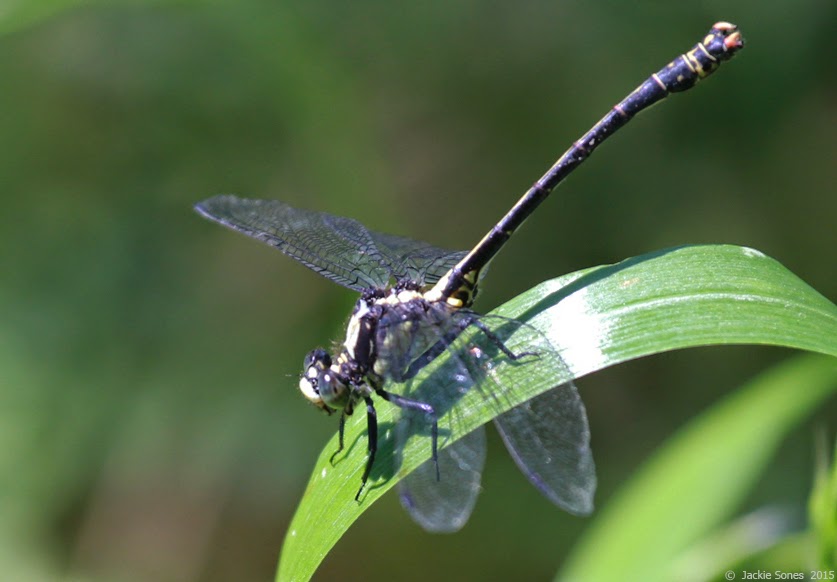
This is a dragonfly I had been wanting to see for a long time, and I finally got around to finding out where to look for them (thanks to David!).  Eric and I found a couple of sunny hours in between chores on Saturday and spotted these Grappletails (Octogomphus specularis) along Pine Flat Road in Healdsburg.

That's quite a name Grappletail.  It stands out, and so does the reason for it the male's abdominal appendages are large and forked like grappling hooks (he uses them to hold onto the female when mating):


Now that you know what the appendages look like up close, you'll be able to spot them on perched individuals:


For important field marks, along with the distinctive appendages, some people look for an urn-like marking on top of the thorax, and widely spaced greenish-black eyes.  These individuals also seemed to have quite a bit of blue-gray color in their eyes:


Although Grappletails are found in creeks and small rivers, Tim Manolis (Dragonflies and Damselflies of California) notes that females and nonbreeding males may be found away from the creeks at spring seeps, similar to where these individuals were photographed.  


One thing that surprised me during my first encounter with this species was its behavior.  I was glad that, when describing Grappletails, Sid Dunkle (Dragonflies through Binoculars) used the phrase "males perch unwarily..."  While many clubtails are quick to fly off, we could walk right up to these Grappletails.  In fact, you could easily walk by them without them flying — a very unusual behavior for a clubtail, in my experience.


I'm going to end with a quote by Clarence Hamilton Kennedy who wrote "Notes on the life history and ecology of the dragonflies (Odonata) of Central California and Nevada" published in the Proceedings of the U.S. National Museum (Volume 52) in 1917.  I always like going back to these early papers because they're so descriptive — it's as if you were there, standing in the stream, watching dragonflies with Kennedy himself.  You won't see writing like this in scientific articles or field guides now, but I'm glad it still exists in the early accounts:

"After having spent various days wading down mountain streams observing Octogomphus more often than catching them, I was rewarded on July 7 by seeing a female oviposit. She came volplaning down through an opening in the canopy of alders and, while going through evolutions involving several figures, 8's and S's, she touched the surface of the pool lightly with the tip of her abdomen at intervals of 2 to 6 feet. After 20 seconds of this, she airily spiraled up and out into the sunshine, where she alighted on a bush on the hillside above the creek."

We only observed male Grappletails this past weekend (as below), but now I can visualize the females, and hope to see them someday, too.


Saturday, May 2, 2015

Cruising


A male Western River Cruiser (Macromia magnifica) photographed on Pine Flat Road in Healdsburg, CA, on 2 May 2015.

I had a funny experience with this species today.  I was walking along Pine Flat Road when a dragonfly shadow passed by.  I looked up to see a very large dragonfly patrolling along the road.  It was so large that its size caught my attention.  I thought, "Well, that's larger than most darners so it's either a darner I don't see very often or it's something else."

Luckily, the dragonfly landed. I didn't have my binoculars or camera at the time, so I ran back to the car for the camera, ran back to the site where the dragonfly was perched, and snapped a few shots just before it flew off.

When I was taking the pictures, I could tell that it was a river cruiser   an exciting observation for me, as it's my first in Sonoma County, and this is one of my favorite groups of dragonflies.

There are only 7 species of river cruisers in North America, and this is the only species found west of the Rocky Mountains.

At home, I tried to learn a little more about Western River Cruisers online.  One of the first web pages I found was Don Roberson's where he said this:

"It is quite large — 3 inches long with a 4 inch wingspan — and thus is larger than all darners, except Giant Darner..."

Don's description made me smile because it was exactly what stood out to me upon first seeing a Western River Cruiser flying down the road.

Things to look for in the picture above: extremely long legs; large gray eyes; a single yellow stripe on the side of the thorax; pale leading edges of the wings; broad terminal abdominal segments, giving it a clubbed appearance; a slight arch to the abdomen.  These are elegant dragonflies!

Friday, May 1, 2015

Songs of The Cedars

We'll wrap up The Cedars Series with a few miscellaneous shots:


An ultrabasic spring (pH > 11) where calcium carbonate is a byproduct of serpentinization.  [Serpentinization as defined by Roger Raiche = "a process where igneous ultramafic mantle rock (peridotite) is metamorphosed into secondary serpentine minerals.]

A water strider (and its more obvious shadow) on the surface of the pool downstream from the spring:


Mineral Falls (~20-feet high):


At the top of the falls, I couldn't help exclaiming, "What sedge is that?" upon encountering this showy inflorescence:


When David answered that it was Cotton Grass, I smiled, and thought to myself, "Of course."  I recognized the genus from seeing it in New England and Canadian bogs, but hadn't seen it yet in California.  Be forewarned: the first half of the common name is accurate (it does look like cotton), but the second half is misleading, i.e., it's not a grass.  Perhaps it should be called Cotton Sedge?  [This is Calliscirpus criniger, formerly Eriophorum criniger.]


And one more image from The Cedars, although I wish I had an audio recording to share.  Some of you know how much I appreciate listening to the sounds of landscapes.  While listening to The Cedars, the sounds I will remember most will include the piercing scream of a Peregrine Falcon, the distant call of a raven...and the most common sounds running water, sometimes close, sometimes far, running over rocks...and singing Black-throated Gray Warblers (Setophaga nigrescens).  I like thinking about their songs carrying across that open landscape, connecting the stands of cypress trees on the slopes and in the ravines.