If you're interested in using any of these photographs or this content in any way, please contact me. Send an e-mail to naturalhistoryphotos(at)gmail.com. Thanks!

Monday, July 15, 2013

Sticky side arms

Last night I mentioned seeing ctenophores (or comb jellies) washing up on the beach.  Tonight I took a closer look at a few of them.  This is how they appeared on the sand.  They ranged in size from about 5 mm to 2 cm long.


I photographed several individuals in a small aquarium.  In the image below, the light is highlighting the comb rows used for propulsion.  The mouth is at the top.


In these individuals the long tentacles were noticeably pink.


The tentacles have numerous tentillae that can be extended like a cascading net for capturing prey.  Remember that ctenophores don't have stinging cells (nematocysts) like jellyfish, but instead have sticky cells (colloblasts) for capturing prey by adhesion.


The long tentacles can be completely withdrawn within sheaths inside the main body of the ctenophore.  Compare the two pictures below.  They show the same individual — the first with both tentacles extended and the second with the righthand tentacle mostly retracted. 


If you return to the second photo of this post, you can see the pink tentacles inside the ctenophore.

I think this is Pleurobrachia bachei, the same species we often encounter on local beaches in the winter and spring.  In my experience, it's somewhat unusual to see so many washing ashore in July.

P.S.  Pleurobrachia means "side arm" and refers to the position of the long feeding tentacles.
 

Sunday, July 14, 2013

Washing in with the waves

This was a working weekend for me, so I didn't have much time for pictures.  But I took a quick walk on the beach late this afternoon and noticed a few interesting gelatinous animals washing in with the waves.

I've come to expect Aglauropsis aeora during calm, warmer water conditions in the summer.  Today the ocean reached 14.5°C (58°F) , so I wasn't surprised to see this beautiful hydromedusa.  These images were taken quickly in a small field aquarium.


I posted better pictures of this species last August.  To see those and to learn a little more about Aglauropsis, click here.

Interestingly, there were quite a few ctenophores (comb jellies) washing in today.  They looked like sea gooseberries (Pleurobrachia sp.), but I'm not used to seeing them at this time of year.  I wondered if they might be a different species of sea gooseberry than the one we see during the winter/spring? 

For the record, I also saw a few large salps (Thetys vagina) and at least one large Giant Bell Jelly (Scrippsia pacifica).

Saturday, July 13, 2013

Rocky


Well, these aren't great photos, but one reason for this blog is to document events that stand out during the year.  I'll try to get better pictures of these fish, but for now I hope these images will serve as a record of a remarkable rockfish recruitment year.  

Right now there are amazing numbers of juvenile rockfish visible in small groups among the waving blades of surfgrass and seaweeds along the coast.  These fish were ~2 inches (5 cm) long.


Watch for them the next time you visit one of the local beaches!

Thursday, July 11, 2013

Clinging to the wall

Eric called me at the end of the day to say that he was looking at a dragonfly on the wall outside of his office.  I hadn't had a chance to take any pictures today, so I picked up my camera and went to take a look.


I had been seeing quite a few Spot-winged Gliders (Pantala hymenaea) around recently, so I thought this might be a possibility.  Sure enough, this female was clinging to the wall, and luckily she didn't fly off before I could snap a few photos.  (I wondered if she might try to spend the night there?)

Below is a close-up from the side.  Note the bi-colored eyes, red above and gray below.


The next image shows a close-up of the wing veins and the brown spots on the hindwings for which the species is named.


Although I've been familiar with this species for many years, I hadn't really focused on the white coloration of the veins within the brown spots.  As you can see, the veins are dark elsewhere in the wing...why are they white within the spots?  I can't really think of an obvious reason for this.  Can you?

I first wrote about Spot-winged Gliders last July, so for a few more pictures and background information about them, review that post here.

Wednesday, July 10, 2013

Red, red, red


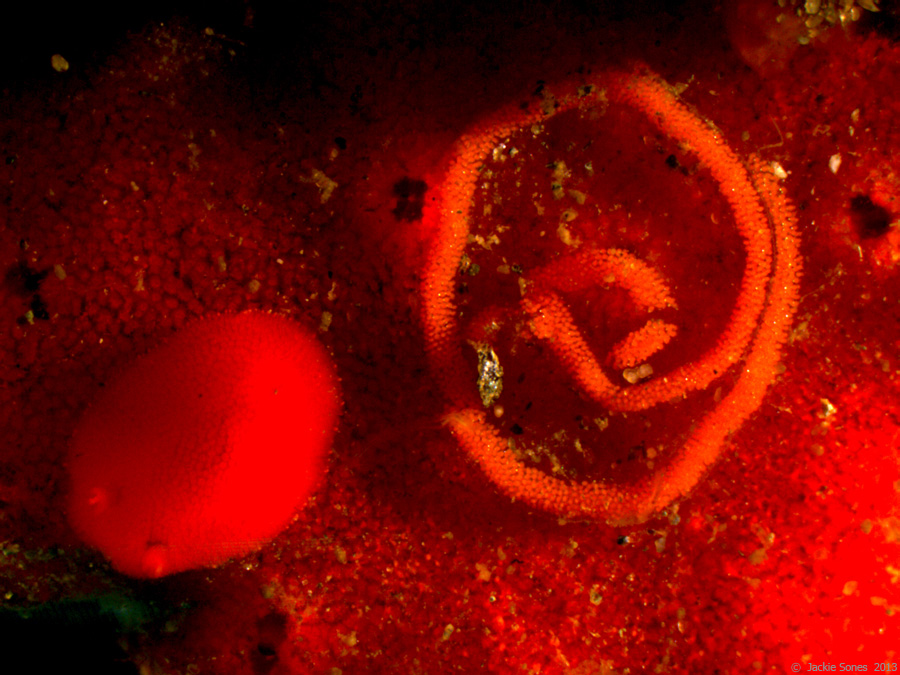
A red nudibranch that eats a red sponge and lays a ribbon of red eggs on the sponge.

Meet the Red Sponge Nudibranch, Rostanga pulchra!


Here's a close-up of the nudibranch, taken under a microscope, as this was a small individual (~5 mm long):


And an extreme close-up of the individual eggs (actually developing embryos at this stage) within the ribbon:


P.S.  I'm not sure if I'm interpreting the name correctly.  Pulchra means "beautiful".  Rostanga is more difficult.  Ros means "rose" or "red"...and tang might mean "touch."  So it's possible the entire scientific name could be translated as "a beautiful touch of red."

Tuesday, July 9, 2013

Looking up


I'll always wish I knew more about how to identify the sculpins that live in our local tidepools.  But I've decided not to let my lack of knowledge stop me from taking pictures of them!


This one was looking up from a pool filled with coralline algae.


Photographed on Bodega Head, 9 July 2013

Monday, July 8, 2013

Avocets in July

There have been a lot of nice shorebirds around Bodega Harbor recently.  I missed the Wilson's Phalaropes this weekend, but on the 4th of July I photographed these three American Avocets on the tidal flats near Doran Beach:


These aren't the best shots, as the birds were somewhat distant.  But it's not as common to see avocets at the coast at this time of year, so the photos will serve as a record.

I started wondering if this might be an adult and two juveniles.  But I don't have any experience aging avocets.  If you have thoughts about this, I'd appreciate feedback!


The two smaller birds generally stayed close together and behaved in similar ways.  They seemed paler on the head, face, and breast.  And there were hints of white edges on some of the dark feathers (see picture below — I'm referring to the two birds that are preening).


It also seemed as though the larger bird was keeping a somewhat "watchful eye" on the smaller birds.


The larger bird occasionally called.  Most of the time it gave a clear, single note.  But occasionally it was two syllables.  Here's a rough recording if you'd like to hear an example.  It was windy at the time, but if you turn up your volume I think you'll be able to hear the avocet just fine.  Listen for two single notes, then a two-syllable phrase, then 3 single notes.  [If you're reading this in an e-mail, click on the title of the post above to see the sound file below.]


amav2 by nhbh


P.S.  On 7 July 2013, among the other shorebirds in Bodega Harbor, I also saw and heard a single Black-bellied Plover and two Greater Yellowlegs.