
Quick photo of a sculpin in the rocky intertidal zone after field work tonight (5 December 2025). Amazing how much it looks like the surrounding rock, gravel, and shells.
Quick photo of a sculpin in the rocky intertidal zone after field work tonight (5 December 2025). Amazing how much it looks like the surrounding rock, gravel, and shells.

Those sculpin eyes, they get me every time. (And that green and white patterning is magical!)
Photographed in the rocky intertidal zone along the Sonoma Coast in early January 2025.

Eric noticed this amazing sculpin recently -- the colors behind the eyes are a perfect match for orange sponge and pink coralline algae found in low rocky intertidal zone areas.
This might be a Smoothhead Sculpin (Artedius lateralis), but we'd love input about the identification.

We've been doing intertidal surveys this week, but last night we had a few minutes to look around a bit more. It was exciting to find a few beautiful green sculpins near some surfgrass. I'm always grateful for these sightings. Even when we're not out there, it's nice to imagine these amazing fish in the tidepools under the moonlight.
P.S. Thanks for the great photo, Eric!

Eric photographed some nice sculpins a few days ago. These two (above and below) were intriguing. Although at first glance these fish appear to be different, a closer look reveals quite a few similarities, e.g., the shape of the head, the red striping in their eyes, the shapes and sizes of some of the pale blue markings. So now I'm wondering if they're the same species? What do you think?


Juvenile Cabezon (Scorpaenichthys marmoratus) from the intertidal zone along the Sonoma Coast on 30 November 2024. This individual was pretty small, only ~3.5 inches (~9 cm) long. I loved the deep red color of this one!

After field work a couple of days ago, Eric caught up with a beautiful sculpin in the low intertidal zone. I love the patterning on the pectoral fin! Photographed along the Sonoma Coast on 12 May 2024. [You can click on the image for a larger version.]

Sculpin resting among blades of surfgrass (Phyllospadix sp.).
Thanks for the great photo, Eric!


Looks a bit like a marine iguana, doesn't it?
Eric snapped a few photos of this interesting sculpin in the low intertidal zone last month. Here's a view of most of the fish (below). I love the banding and mottled patterns in shades of gray and green!

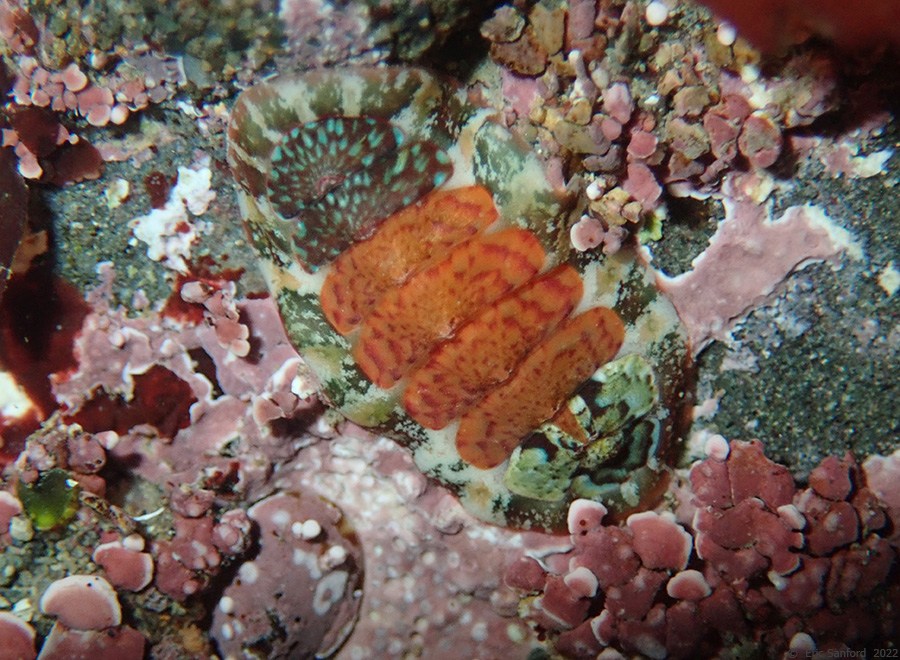
One of the most impressive features of many animals in the intertidal zone is the way their color patterns match their surroundings. It makes it challenging for visual predators to spot them. And it also requires an observer to slow down and let their eyes and mind adjust to the setting in the tidepool. (Maybe we need a new phrase ="slow tidepooling"?)
We thought it would be fun to show some examples. Above is a chiton (perhaps Lepidozona radians) — note there are eight plates, but the middle four plates are orange, the front two plates near (head end) are flecked with brown and green, and the back two plates (tail end) are mottled. These varied colors make it hard to identify this as a chiton at first.
Below is a small sculpin. Check out the way the pink stripe running across its body matches the coralline algae patches on the rock. And the other colors look like the surrounding rocks (grays and greens) and encrusting algae (deep maroon). It also helps that sculpins often stay very still — the lack of movement makes it less likely that they'll catch your eye:

The camouflage abilities of octopus are well known — they can settle on a new substrate and blend in within seconds by adjusting pigment cells (chromatophores) in their skin. Here's one looking a lot like a rock — but also note how well the arms/tentacles on either side of the body have a different color and pattern than the main portion of the body. It's hard to make them out! (If you look closely sometimes you can spot the suckers on the underside of the tentacles.)

And here's one more — an intriguing shrimp called a Deep-blade Shrimp (Spirontocaris prionota). (Hint: Look for the shrimp's eyes in the center of the photo.) Not only do the colors of the shrimp match the coralline algae, but the shrimp also has small hairs (setae) that accumulate bits of debris that help it look "messy", making it less clear that this is a shrimp.

ADDENDUM (31 December 2022) — P.S. To make it easier to find the octopus, here's an edited photo showing the outline and main features:


While tidepooling last week I looked down to see a rippling movement below me and soon realized it was the undulating fin of a fish.
The fish was swimming towards a ledge, but before it disappeared I took two quick shots for the record.
Meet the Sailfin Sculpin (Nautichthys oculofasciatus)!
The scientific name is very descriptive — "Nautichthys" means sailor fish, and "oculofasciatus" means eye-banded. Below you can see both features — a very tall fin extending over the head (like a sail) and a dark stripe running vertically through the eye:


Photographed in Mendocino County on 12 September 2022.
P.S. I'm going to be giving an online presentation on Thursday night (15 September 2022) for the Stewards of the Coast and Redwoods. I'll be telling four tidepool stories. Everyone is welcome to join (via Zoom) — you can register here if interested:
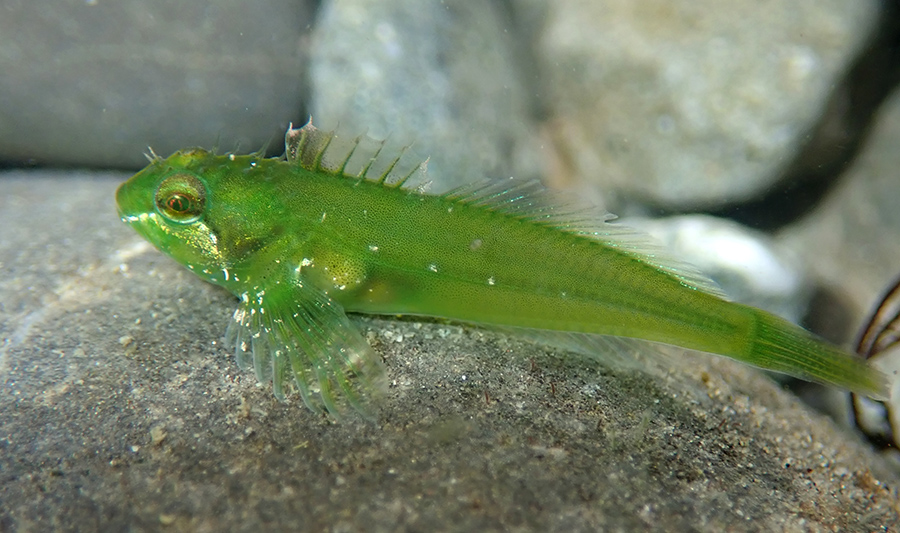
Recently we were noticing some beautiful green sculpins hanging out near some green algae in a high intertidal zone pool.
After looking around a bit, I think we found three different ages. Below are two more individuals that I think are likely the same species, an older and younger individual:


An amazing sculpin resting on a pale purple sponge. Photographed in the low intertidal zone on 17 June 2022.

Happy World Oceans Day!
Above, view looking south along the Sonoma Coast.
Below, a sculpin photographed recently in a tidepool near Point Arena.


I was helping Jacquie look for sea anemones this morning, when we encountered this gorgeous juvenile fish. It was only ~1.5 inches (~3.5 cm) long. For scale, the fish was resting on a Feather Boa Kelp.
I was drawn to the green and black patterning and the silvery coloration on the sides. (This coloration reminded me of Atlantic Mackerel, which we used for bait while fishing for lobster when I was young.)
Here's a view from above:


