
Here's the broader setting:

And a close-up of the moth:
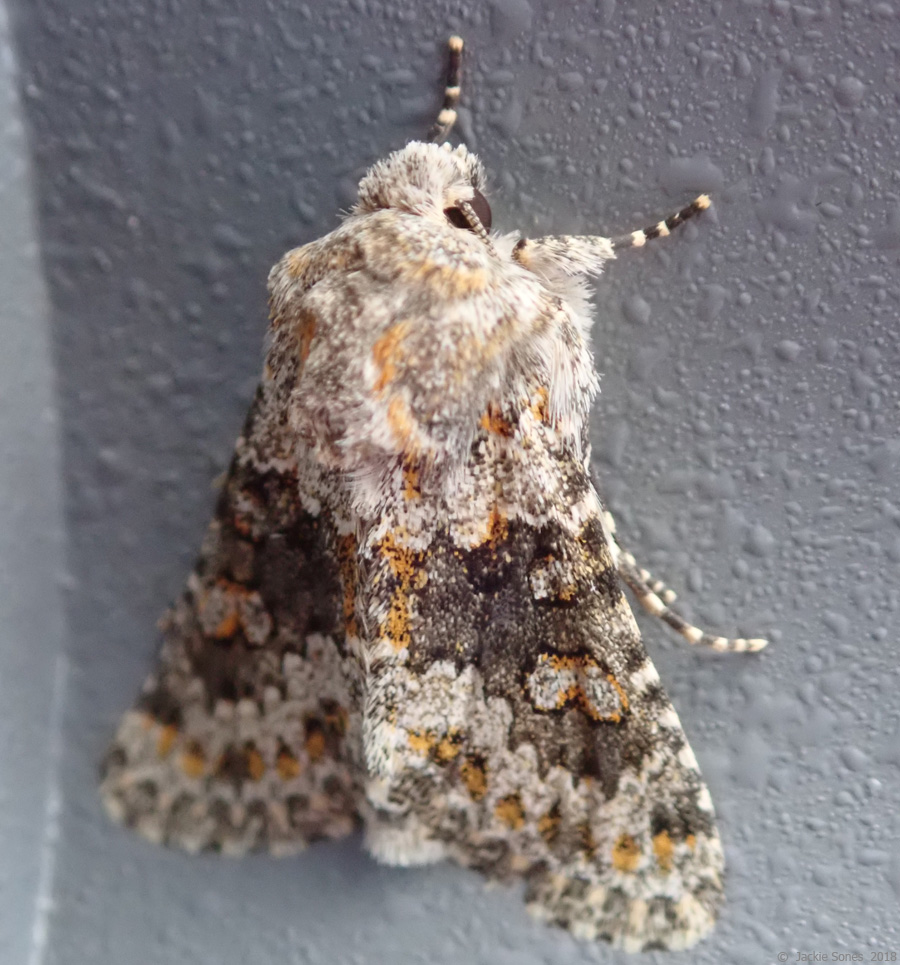
Later, I first tried to identify the moth with an Internet search. I lucked out because it showed up in Google Images when I searched for something like, "california moth with gray and gold markings." I was a little concerned that I didn't have the correct species at first, because most of the images were from Europe. But I checked the identification on the Moth Photographers Group and Butterflies and Moths of North America web sites and it looked like a match.
Hecatera dysodea has been documented in Oregon, Washington, and Idaho, but it's a fairly recent introduction to this part of the U.S. (first documented in Oregon in 2003). It appears that there are at least a couple of California records (with one in 2015), but I'm not sure how common it is in California at this time.
This individual eventually flew off onto a nearby leaf, so here's a photo for the record from Cotati, CA, on 24 June 2018:

P.S. In the caterpillar stage, Hecatera dysodea eats lettuces (e.g., Lactuca spp.), so it makes sense that it would show up in agricultural or perhaps urban settings.
P.P.S. I'm glad I found photographs of this species on the Internet. It wasn't included in the Moths of Western North America (Powell and Opler 2009), so it would have been challenging to identify with that book alone.

1 comment:
Found one of these last night in my garden, I have a bunch of lettuces and cabbages and I let the caterpillars go wild (as I do with all the wildlife), little guy was still unfurling his underwings and wasn't able to fly so he hung from the edge of my cowboy hat for an hour before finally flapping off clumsily.
Post a Comment