If you're interested in using any of these photographs or this content in any way, please contact me. Send an e-mail to naturalhistoryphotos(at)gmail.com. Thanks!
Showing posts with label cormorant. Show all posts

Wednesday, June 26, 2024

Cobalt!


Displaying Brandt's Cormorants (Urile penicillatus).  Their cobalt blue throat pouches were so bright in the morning sun!  Photographed on Bodega Head on 26 June 2024.

Thursday, June 22, 2023

Glossy

 
Nesting Pelagic Cormorant (Urile pelagicus), 21 June 2023
 
The smallest of the local cormorant species. From a distance they look black, but in the right light, their feathers look glossy green, purple, and bronze.  Also note the red near the base of the bill.

Monday, September 13, 2021

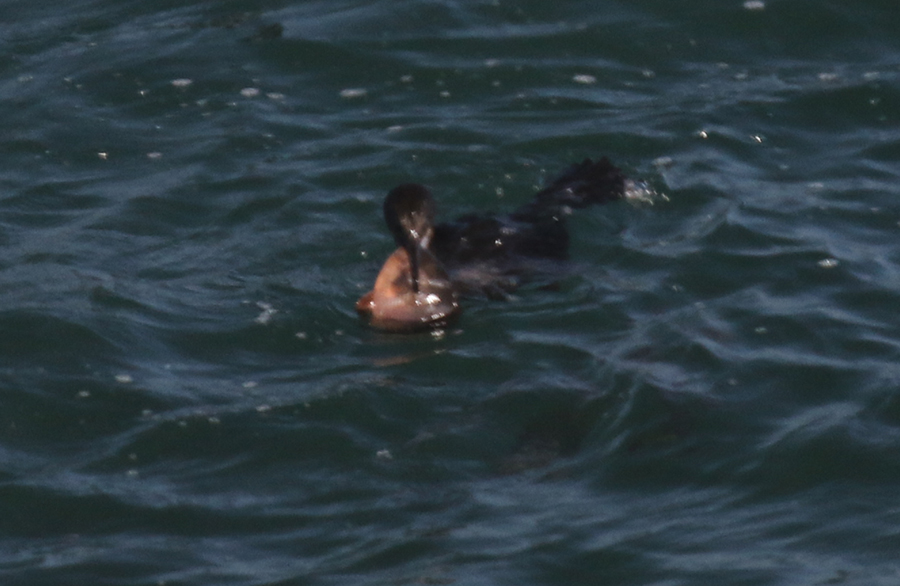
Orange mystery fish


A couple of days ago I noticed a large group of cormorants, gulls, and pelicans just offshore from Salmon Creek Beach.  It appeared to be a feeding flock (lots of diving and splashing), but I couldn't tell what they were catching at first.  Then I started noticing some birds with fairly good-sized orange-colored fish.  

I've been having some trouble with my camera lens not focusing properly, and this flock was distant, but I'm hoping the photos might still be good enough to identify the fish they were eating.

Other times when I've seen flocks like this, they've been eating smaller silvery bait fish, so I'm not used to seeing them catch a larger orange fish.  Although they caught a lot of these fish, they seemed to have trouble swallowing them.

I'm not sure about the identification of this fish, but my first guess is Striped Surfperch (Embiotoca lateralis).  If you can help with the i.d., I'd appreciate it!


Tuesday, June 1, 2021

Passing by Bodega Rock


To end this edition of pelagic week, a couple of photos of Bodega Rock as we made our way back in to Bodega Harbor on 23 May 2021.


Friday, May 14, 2021

8 years ago


Not much time tonight, but here's an older photo of Bodega Rock from 14 May 2013 8 years ago today!  (This is the island off the southern end of Bodega Head home to many sea lions and cormorants.)

Monday, September 10, 2018

Group swim


Recently there have been some very large flocks of Brandt's Cormorants feeding off of Bodega Head.  This photo is from 9 September 2018.

And just for fun, here's a recent picture of three different species of cormorants:


Brandt's Cormorant (Phalacrocorax penicillatus) on the left, Double-crested Cormorant (Phalacrocorax auritus) in the center, and Pelagic Cormorant (Phalacrocorax pelagicus) on the right.  Photographed on 25 August 2018.

ADDENDUM (11 September 2018): Someone noticed that the cormorants didn't appear to be diving in the group photo above.  I was curious about that, too!  Eventually I did see some of the birds diving.  It was subtle and hard to capture in a photo, but here's an example with two birds diving:


Thursday, July 23, 2015

Island of activity


I haven't shown a picture of Bodega Rock in a while.  This picture was taken from the southern end of Bodega Head on 18 July 2015.  There was lots of sea lion and cormorant activity.  You might be able to spot some pelicans, too.  I wished I had had my audio recorder, as I could hear a Wandering Tattler over there!

Thursday, June 20, 2013

Mystery on the Rock


Bodega Rock, off the southern end of Bodega Head, on 20 June 2013.  On the far horizon, from left to right, are the sand dunes of Dillon Beach, the entrance to Tomales Bay, and the high bluffs of Tomales Point.

A little bit closer:


And even closer, so you can now see the nesting colony of Brandt's Cormorants on the upper right (west) side of the island:


I'll zoom in even a bit more for a view of the cormorants sitting on their mounded nests.  And also because there's a mystery object that I've been wondering about (see arrow in next image).  


There's a relatively obvious human-made object on the island — it's gray, somewhat rectangular, appears to made of concrete or something similar, and as you can see above, it's about as tall as a cormorant.  It seems like this is as good a place as any to ask if anyone knows the story behind this object.  Do you know what it used to be?  Who installed it and when?  Feel free to write in if you know anything about it, or can suggest any leads for me to follow. 

P.S.  And yes, those are California Sea Lions (brown) and Harbor Seals (gray) lounging on the rocks near the water line.

P.P.S.  Happy Solstice!

Monday, March 5, 2012

Pelagic Cormorant

Some people don't look twice at cormorants, but when viewed up close in good light, they can be spectacular.

The Pelagic Cormorant (Phalacrocorax pelagicus) is the smallest cormorant on the West Coast.  They roost and nest on the outer cliffs of Bodega Head, and may be seen diving and feeding near shore.  (The name "pelagic" is misleading as this species spends more time in the coastal zone than offshore.)

In general they are very slender, with a small head, a long, thin bill, and a long tail.  In breeding plumage, which they are attaining now, they show greenish-bronze iridescence on the back and purplish iridescence on the neck.  With a good view, you can also see red facial skin near the base of the bill, and scattered white plumes on the neck.  

I'm still working on getting good photos of this species, but these are the best so far.


Note the large totipalmate webbed feet all four toes are connected by webbing (also true for pelicans). They roost and nest on very narrow ledges and are strong swimmers (dives may last up to a minute).

In flight, two large white flank patches are visible.


Here's one more photo.  It includes both Pelagic Cormorants and Brandt's Cormorants.  Remember that the Pelagics are much smaller, more slender, with thinner necks and much thinner bills.  The Brandt's are much more robust, and sometimes show a buffy colored patch on their throats.

  
There are three Brandt's Cormorants in the center of the photo; the rest (four on the left, four on the right) appear to be Pelagics.