If you're interested in using any of these photographs or this content in any way, please contact me. Send an e-mail to naturalhistoryphotos(at)gmail.com. Thanks!
Showing posts with label nest. Show all posts

Monday, February 16, 2026

Shades of green


This is an older photo, but I came across it the other day and was intrigued.  Common Raven (Corvus corax) nest with two eggs photographed on Bodega Head on 14 May 2016. 

Thursday, June 12, 2025

Nestled among the granite


Black Oystercatcher nest, 12 June 2025

(Photo taken with a zoom lens from a distance and then cropped.) 
Monday, April 7, 2025

Up, up...and away!


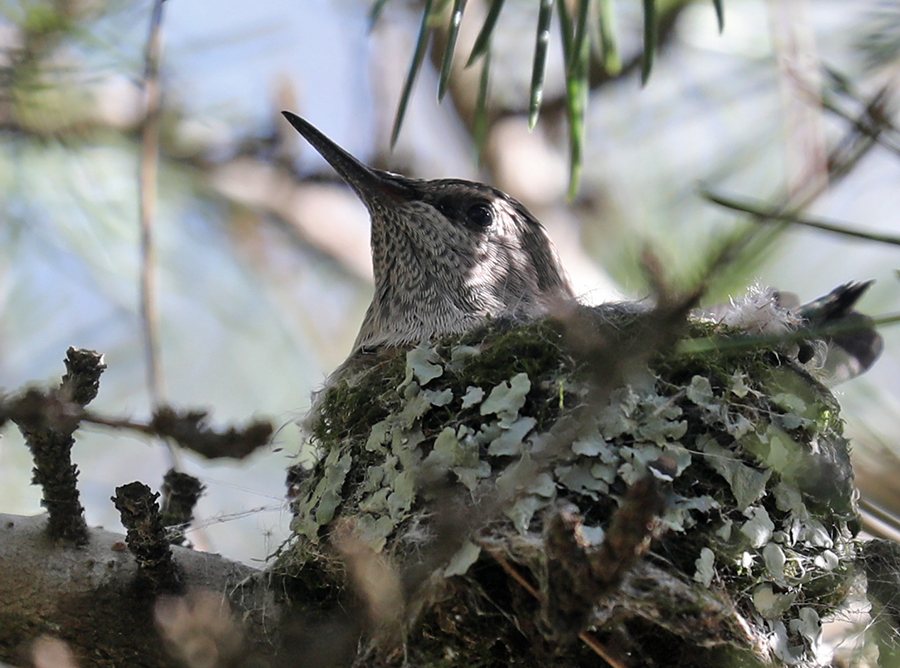
Well, my last estimate of when the hummingbird chick might fledge was off.  Yesterday (6 April 2025), this was the view of the chick in the nest (above).  

And here's what we saw today(7 April 2025):

 
The chick was taking short flights among the tree branches near the nest.
 
Up close, you could see some of the feather details, including a few downy feathers still visible on the back:


And here's a nice view of the fledgling from below:
 
 
Way to go, everyone!

Thursday, April 3, 2025

Growing up fast


A quick hummingbird update (3 April 2025): In the nest we've been following, the chick has grown a lot during the last couple of weeks.  (Compare tonight's photo to the one on 20 March 2025.)  I'm guessing it will be another 7-10 days before the chick is ready to leave the nest.

Thursday, March 20, 2025

Feeding time


A quick update on the Anna's Hummingbird nest (20 March 2025): Tonight we saw the female feeding a small chick.  In the photo above, you can see the nestling's bill and mouth opened wide, highlighted by orange color.  Just in time for spring!

Monday, March 17, 2025

Clearing showers


Clearing showers at the end of the day today (17 March 2025) produced a beautiful rainbow to the east.  And who was at the end of that rainbow?

The Anna's Hummingbird on her nest -- a little green (and a pot of gold?) for St. Patrick's Day!  ;)


Thursday, March 13, 2025

Looking out from the nest


Some of you might recall when we followed a couple of Anna's Hummingbird (Calypte anna) nests last winter.  Well, we've been checking the same area during the last few weeks and tonight (13 March 2025) we spotted a female incubating in the exact same spot as the first nest last year!

The timing is later than last year, but we'll check on her every now and then to see what happens.

Last year's nest had lost a lot of material during the past year and it was barely visible.  But recently I noticed the nest cup was being built up and renovated with more mosses and lichens, so it was clear a hummingbird had decided to use the site again.

Here's another view from a different angle:

 
We'll keep our eyes open for any signs of chicks!

P.S.  You have probably noticed that I'm not posting as often right now.  A few things have come up that make posting a little more challenging, so I'm just including a reminder that you can sign up to receive e-mails when a new post is available (so you don't have to keep checking the website).  No pressure at all, but if you'd like to receive NHBH e-mails, just go directly to the NHBH website here, scroll down to the very bottom of the page, and then enter your address to subscribe.

Tuesday, March 26, 2024

Update on nest #2


Okay, hummingbird fans, here you go -- an update on nest #2!  

On 23 March 2024, we checked in to see whether the female was still sitting on the second nest.  Here she is from one side (above)...and below is the view from the other side showing the general setting.

 
She appears to be actively incubating.
 
While in the area, we also heard one of the juveniles from the first nest calling from a little farther away.  And a different hummingbird flew in and gave the more typical Anna's Hummingbird call notes (see below), but it looks like it could be one of the juveniles that has been out of the first nest for 10-11 days now.  I haven't aged Anna's Hummingbirds, so if you can confirm this is a juvenile (or not), let me know!


Sunday, March 17, 2024

Round two


Well, I wasn't sure we'd see the juvenile Anna's Hummingbirds (Calypte anna) again, but we were in the area this afternoon and started to hear the begging call.  Eric was able to locate one of the fledglings as mom flew in for a feeding (above).  The juveniles have been out of the nest for 4-5 days now, but apparently the mother keeps feeding them for 1-2 weeks after they leave the nest.

I watched the fledgling for a little while.  Fun to see the juvenile probing some leaves/buds while sitting on a branch.  I had been wondering how they start to feed on flowers and this view provided a clue:


And also fun to see the juvenile take short flights.  Here's a takeoff and a landing:


Thanks to Eric's sharp eyes, we also observed something today that surprised me at first.  The female already has a second nest in progress, in the same tree!  

It sounds like two broods per season are typical in Anna's Hummingbirds, but I didn't know she would start again so soon...or while she was still feeding the fledglings from the first nest.  The Birds of the World species account reports several records of this, with females feeding young that are 3-5 days out of the nest while also incubating a second clutch of eggs.

Here's mom on the new nest (below).  I don't know if she's incubating yet.  It looked like she was still gathering nest material (including from the original nest), but she was also spending quite a bit of time on the nest:
 
 
Time will tell how the second nest attempt turns out!  If it's successful, fledging could occur in late April/early May.
 

Wednesday, March 13, 2024

Time to fly!


Well, I was on the fence about checking the hummingbird nest tonight.  I was running a little late, and I thought perhaps they'd still be in the nest tomorrow.  But then I thought...what if they aren't?  So I swung down to check on them after work.

When I first approached, I could see one juvenile in the nest...but only one.  I tried to scan different branches in the vicinity of the nest to see if I could find the second juvenile, but I wasn't having much luck.  Then I heard mom calling and she flew in to the nest:


After the feeding, I followed her as she flew to a second spot about 8 feet away from the nest...to the second juvenile!


She fed the second one and then flew off.  I watched the newly fledged juvenile for a few minutes.  Occasionally it would try out its wings:


But mostly it sat very still, looking around and listening to the early evening sounds:
 
 
Adventure awaits!

Saturday, March 9, 2024

Hummingbird update


Just a quick Anna's Hummingbird (Calypte anna) update.  The two juveniles in the nest I've been checking on in our neighborhood have grown quite a bit.  

This morning I saw the female come in to feed the little ones:


I'm not sure how much longer they'll be in the nest (another week or so?), but it's great to see them doing so well. 
 
P.S.  Earlier posts about this nest are here:
 

Tuesday, February 13, 2024

Weathering the storm


A short story about a hummingbird and her nest.  Before the storm on 4 February 2024, I had photographed this Anna's Hummingbird (Calypte anna) on a nest.  During the storm, I wondered how she was faring and if the nest would survive the storm.  I hadn't had a chance to go back until this past weekend, but here she is on 10 February 2024:

 
The nest made it just fine, and it looks like she might be incubating now.  [Anna's Hummingbirds generally lay two eggs, each ~12 mm (~0.5") long.]

Somewhat surprisingly, while I was walking towards this area I was listening for hummingbirds in case she had moved to a different location when I heard a hummingbird calling and followed it to a different nest location.  Then I checked the original site and found that nest intact, too.  So here's a second Anna's at a nest:

 
I love how the greens of the hummingbird feathers match the greens of the moss in the nest.

Thursday, June 22, 2023

Glossy

 
Nesting Pelagic Cormorant (Urile pelagicus), 21 June 2023
 
The smallest of the local cormorant species. From a distance they look black, but in the right light, their feathers look glossy green, purple, and bronze.  Also note the red near the base of the bill.

Monday, June 6, 2022

In a wilderness of stones


On our way out to a field site recently we came across a Black Oystercatcher (Haematopus bachmani) nest.  We moved on so as not to disturb the birds, but I took a quick photo with my telephoto lens.  It is such a beautifully constructed nest!  Hundreds of rock chips gathered to produce a shallow bowl.

Later I was reading a short story by A.S. Byatt and was struck by the phrase "in a wilderness of stones."  She was writing about "moor birds" (perhaps grouse in Great Britain?), but my mind went immediately to this oystercatcher nest.  Looking at the photo we were struck by the number of stones used to make this nest, and the phrasing seemed just right, describing both the eggs surrounded by stones as well as the world of Black Oystercatchers.

With thanks to A.S. Byatt, the oystercatchers, and the stones, and the elements that shape them.
Wednesday, June 1, 2022

Rooms with a view


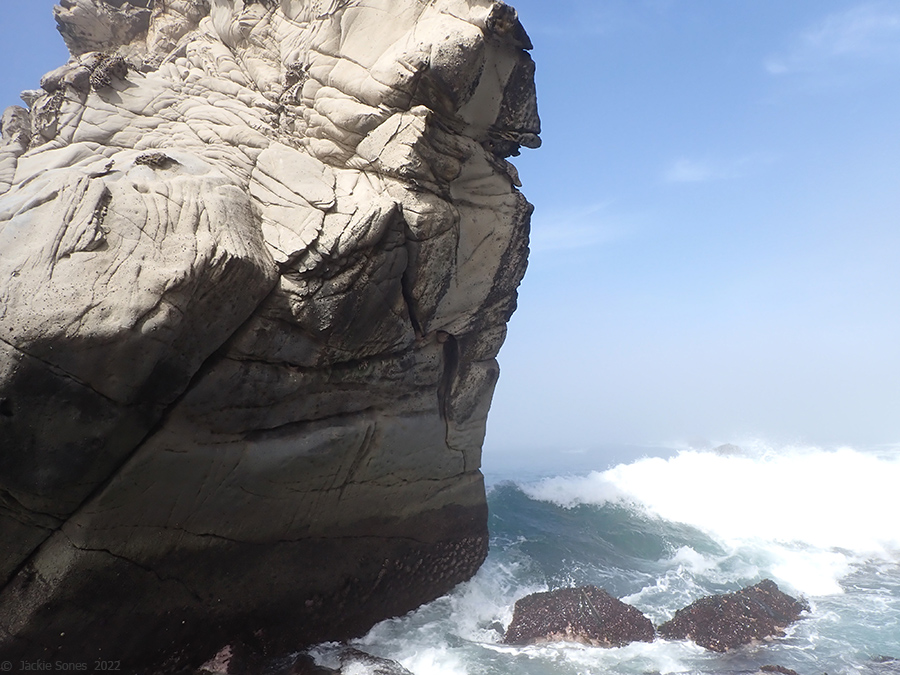
After field work this morning, I was hearing some Cliff Swallows (Petrochelidon pyrrhonota) calling and was wondering where the swallows were.  In trying to locate the birds, I was puzzled at first the my ears were leading me to an offshore sea stack.  But then a few birds appeared and swooped up into a groove in the rock!  I'm probably not in the right places often enough to see this, but I couldn't recall observing them nesting on a sea stack before.  Looking more closely, I eventually found a few nests.

Above is a view of the sea stack.  The nests are in two locations next to the jagged notch (cut-out) at the upper right corner of the rock, and along the dark groove that curves down vertically at the lower right corner of the rock.  Below is a closer view where you can look for the rounded mud nests attached to the rock:


If you couldn't see the nests in the photo above, here are two even closer views.  The first shows the upper notch (with a bird looking out from the opening), and the second with a few nests at the top of the curved groove:


Now that's a room with an ocean view!

Monday, May 4, 2020

A mouthful

Back in March, I mentioned that I had located a Bushtit nest in a neighbor's yardsee the post called "Nest building" on 19 March 2020.

The Bushtits have been actively foraging in our yard, so I went out to see if I could snap a few pictures of them bringing food to the nest.

Sure enough, both the male (dark eyes) and female (pale eyes) were arriving with bills overflowing with insects.  Here are a few examples:


A few fun facts about Bushtit nesting behavior: (1) Their eggs are tiny, only ~13.7 mm x 10 mm; (2) their average clutch size (number of eggs in the nest) is ~6 (range from ~4-10); (3) the incubation period is ~12-13 days; (4) and the time to fledging (when the young leave the nest) is ~18 days.

Bushtits are primarily foliage gleaners, snatching invertebrates off of leaves and branches.  They're known to feed their young lots of caterpillars, along with beetles, wasps, bugs, and spiders.  Good job, everyone!


Tuesday, April 7, 2020

Anna continues

During a neighborhood walk this afternoon, we paused briefly to check on the Anna's Hummingbird (Calypte anna) that had started to build a nest.  She's done very well! 


[For a comparison, see the post called "Anna begins" on 1 April 2020.]

Below is a view from a different angle.  She's used some interesting bits of lichen and moss:


An Anna's Hummingbird usually lays two eggs.  The incubation period is ~16 days.  We don't want to disturb her, so we'll wait a little while, but we'll try to check in again later.
 

Wednesday, April 1, 2020

Anna begins


During a neighborhood walk this afternoon (1 April 2020), we noticed this female Anna's Hummingbird (Calypte anna) just starting to build a nest.  They can complete a nest in ~1 week (but it could take up to ~1 month), so we'll try to check on her again in a few days.

Thursday, March 19, 2020

Nest building

During the last couple of days while working near a window that provides a view of our backyard, some Bushtit (Psaltriparus minimus) behavior caught my eye.  The Bushtits weren't coming to the water bath, and it didn't look like they were searching for food.  My guess was that they were gathering nesting material, e.g, bits of bark and lichens.  

I kept an eye on their flight direction.  Eventually, after several tries, I spotted the nest in a neighbor's yard:


Bushtits build a long, pendulous nest, primarily of plant materials.  (This one has some strips of white, human-made material, too.)  You can see the small entrance near the top.

I watched for a little while, but didn't see any Bushtits near the nest.  I went back to work, but then heard the Bushtits calling, so went out to check again.  They were very busy for a few minutes, so I took a few photos from a distance:


I hope the Bushtits continue building their nest.  I really appreciate an occasional backyard wildlife distraction right now!
 

Friday, June 26, 2015

Gargoyles by the sea

 
In 1945, Tyrrell wrote "The young, when hatched or only a day or two old, are not things of joy and beauty.  In fact, they reminded us of grotesque gargoyles."  I suppose it's true that raven nestlings are not quite as regal as their parents it takes a few weeks until they're fully feathered.  But look at that mouth!  I was impressed with both the width and the color.  Even without an adult nearby, these chicks were reaching around with their bills wide open, waiting for a delivery of food.

I'm guessing these raven nestlings are about 2 weeks old.  (They'll leave the nest after 5-7 weeks.)  They were photographed on Bodega Head on 25 June 2015.  I was far away from this nest, but cropped the picture later to view the number and condition of the nestlings.  How many can you find?