If you're interested in using any of these photographs or this content in any way, please contact me. Send an e-mail to naturalhistoryphotos(at)gmail.com. Thanks!
Showing posts with label fish egg. Show all posts

Sunday, May 26, 2024

Golden eggs and purple pores


Sometimes when we're doing surveys, Eric has the camera while I'm writing field notes.  So when I download the photos later, they mostly show the species we're monitoring, but every now and then Eric sneaks in a different photo (and doesn't tell me)...so it's a surprise!

Here's a fun one -- a cluster of golden fish eggs on the left side, and a pretty purple sponge with prominent excurrent pores on the right side (the excurrent pores are the large diameter holes where water is pushed out after being filtered for food).

Thanks for the colorful photo, Eric! 

Photographed in the rocky intertidal zone in northern Sonoma County on 26 May 2024.

Monday, February 5, 2024

Bronze sculpture?


A very large egg case, probably from a Big Skate (Raja binoculata), washed up on the beach on 5 February 2024.

Such an interesting design with those long curved ridges. Here are a couple more views:


And if you'd like to learn more, I wrote a longer post about a Big Skate egg case back in 2012 see "Just in case" on 7 March 2012.

Tuesday, November 30, 2021

Green Eggs and Sand


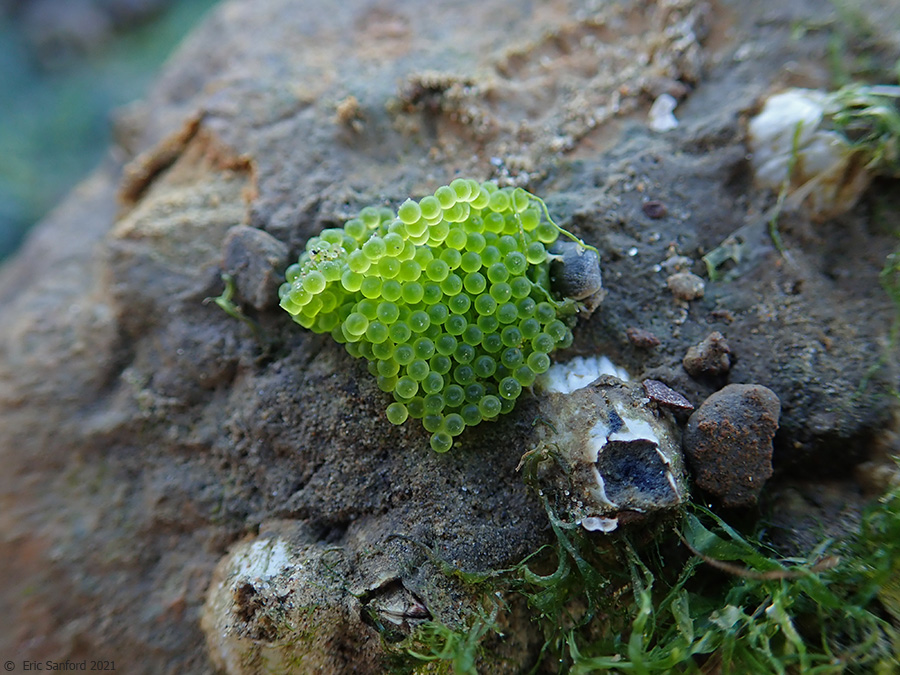
Eric spotted these amazingly green fish eggs last week.  They were on the side of a boulder in the intertidal zone along the shoreline of Drakes Estero.  I'm not sure which species of fish laid them, so if you have any thoughts about that, I'd love to learn more!

Here's a close-up so you can appreciate the color:


And here's a photo of sand from 2008.  I'll admit, there's no real connection to the green eggs above, except that it lets me use the title "Green Eggs and Sand"...which sounds a little like Dr. Seuss's "Green Eggs and Ham".   :)


Thursday, May 4, 2017

Three golds

Old gold:


Five-ribbed Kelp (Costaria costata), Mendocino coast, 2 May 2017


Green gold:
 

Fish embryos, Sonoma coast, 30 April 2017  (They were in single layer on the underside of a small boulder.  Let me know if you can identify the species!) 


Rose gold:


Johnny-tuck (Triphysaria eriantha ssp. rosea) and Coastal Goldfields (Lasthenia minor), Mendocino coast, 2 May 2017
 

Thursday, February 21, 2013

eyePods?

Here's another discovery from the kelp holdfast last weekend.  Can you tell what's attached to the branches of the holdfast in the center of the photo below?


Because they would have dried up on the beach, we removed a few to take a closer look and to try to identify them.  Here's a small cluster in Eric's hand:


If you think you're seeing eyes, you are!  These are small fish eggs that were attached to the kelp.  Many of the tiny fish embryos appeared to be in the later stages of development — every now and then they would wriggle around inside of their clear, rounded capsules or pods.

Many details were visible under the microscope:


We're not sure what type of fish these are.  They appeared to be very long, with a dark checkerboard pattern running along the back.  


If you have experience identifying local fish eggs or fish embryos and have thoughts about what species of fish this might be, we'd be very interested in hearing about it!


Wednesday, August 1, 2012

What's in YOUR whiskers?


Today, out of the corner of my eye, I caught a glimpse of something unfamiliar near the face of this harbor seal (Phoca vitulina).  Can you see the small, oblong, yellowish capsule-like objects dangling below its chin?

Here's another view:


Do you have any guesses about what they could be?  I have one, but I'd be interested in other ideas if you have them.

My guess is that they're the eggs of a Pacific Hagfish (Eptatretus stoutii).  Before today, I wouldn't have thought that harbor seals eat hagfish eggs.  But after this sighting, I reviewed some information online and found several references to harbor seals eating them.

Here's a close-up of a hagfish egg found in 2006 (thanks to Jim Carlton for helping us identify it at that time):


Note the wiry, thread-like structures on both ends.  These allow the eggs to "stick" together in a cluster.  Hagfish lay 20-30 eggs at one time.

This is a cluster of empty hagfish egg cases that we encountered washed up on a beach in April 2012:


And a close-up of the central area so that you can see the threads and the way they are tangled together.


I'm imagining that the harbor seal ate a cluster of hagfish eggs and a few got caught on its whiskers!  In the next photo, it's almost as if the seal is dreaming about how good they tasted.


P.S.  If you haven't yet heard of hagfish, also known as "slime eels," check out this well done article about them.