If you're interested in using any of these photographs or this content in any way, please contact me. Send an e-mail to naturalhistoryphotos(at)gmail.com. Thanks!
Showing posts with label marin. Show all posts

Sunday, March 9, 2014

Look, but don't eat!


Another lily from our walk in Marin County yesterday.  Although it can be found not too far away from Bodega Head, Death Camas, also known as Fremont's Star Lily (Toxicoscordion fremontii, formerly Zigadenus fremontii), hasn't been recorded on Bodega Head that I know of.

Death Camas grows in a variety of habitats — grassland, chaparral, and mixed evergreen forest — from Oregon to Baja California.  It flowers from February to June.

The name refers to the potential effects of the highly toxic alkaloids found throughout the plant, but especially concentrated in the bulbs.  Serious symptoms result from ingestion: hypotension (low blood pressure), bradycardia (reduced heart rate), gastrointestinal distress (nausea, vomiting, diarrhea, abdominal pain), central nervous system depression, and even death (from Medical Toxicology of Natural Substances by Donald Barceloux, 2008).

Here's a closer view of a few plants and one of the 6-parted flowers:


It would be hard to tell from its appearance alone that this flower could be so deadly.

Saturday, March 8, 2014

Dark chocolate


Today Kyle and Michelle treated me to a walk in Marin County.  One of the highlights was this beautiful lily — a rare, dark variety of the Chocolate Lily (Fritillaria affinis var. tristulis).

Chocolate Lilies (also known as Checker Lilies) are found in coastal prairie and coastal scrub habitats along the West Coast from British Columbia to California, but this variety is almost restricted to Marin County.

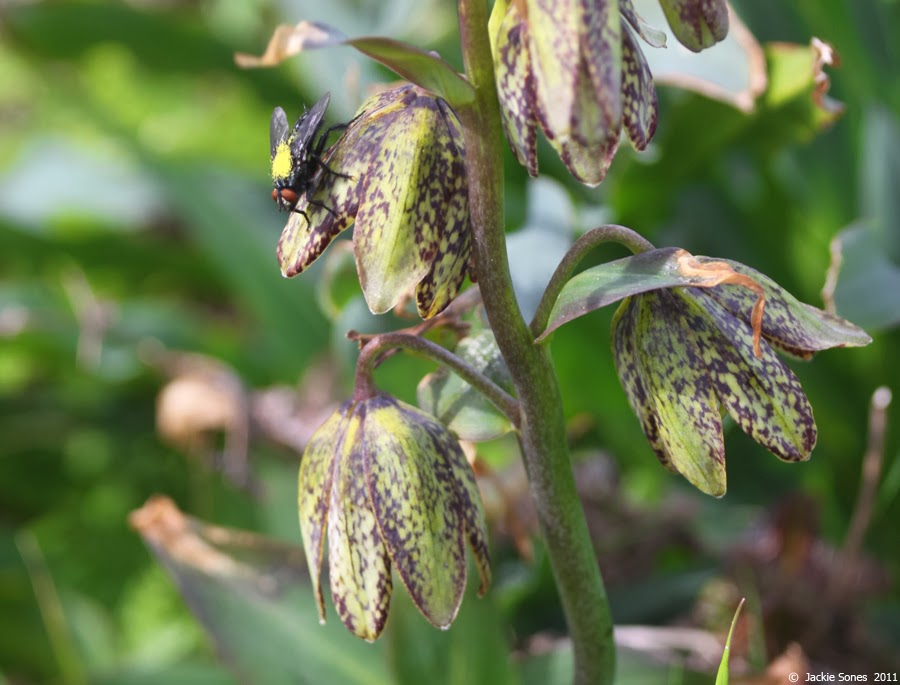
One of the most distinctive characteristics of this variety is the very dark flower coloration, with scarce yellow/green mottling that is more common in other Chocolate Lilies.  For comparison, here's a photo of a Chocolate Lily taken on Bodega Head in April 2011 (below).


Along the with abundant mottling of the flowers, did you notice the large fly with pollen on its thorax?  The fly had been visiting the flowers, so it was serving as a pollinator that day.

Today we also noticed some visitors to the lilies.  Here are a couple of examples:

A small bee.

Some large ants!


I'm grateful to Michelle and Kyle for sharing this wonderful spring wildflower!