If you're interested in using any of these photographs or this content in any way, please contact me. Send an e-mail to naturalhistoryphotos(at)gmail.com. Thanks!
Showing posts with label lily. Show all posts

Thursday, May 26, 2022

Orange beauties


We noticed these beautiful lilies along the side of the road recently and I couldn't resist stopping for a few quick photos.


Perhaps a botanist can help with the i.d.?  Are these Coast Lilies (Lilium maritimum)?


Tuesday, March 23, 2021

The lily and the fly

 
Eric and I came across a nice patch of Death Camas or Fremont's Star Lily (Toxicoscordion fremontii, formerly Zigadenus fremontii) recently.  Eric wondered what might pollinate them.  I wasn't sure, but I had seen flies pollinating other lilies, so we started to look around.  

As we kneeled down for a closer view, we started noticing some small flies nestled among the petals of the lilies, and sometimes they'd rest out towards the tips:


With a zoomed in view, you could really see the pollen grains on the flies, especially on the thorax and the eyes:

 
Eric did a little research and narrowed down the identification to a group of hoverflies, perhaps in the genus Cheilosia.  These flies are sometimes referred to as "blacklets."  [If anyone knows more about these flies and can confirm the i.d., we'd appreciate any assistance.]

Here's another view, this time from the side.  It's fun to think about what a nice spot these flies have for feeding and resting as well as the assistance they provide to the lilies!

Sunday, March 21, 2021

Chocolate bells


 Chocolate Lilies (Fritillaria affinis) photographed in Marin County on 21 March 2021


Saturday, March 26, 2016

Purplish pink


Blue Dicks (Dichelostemma capitatum) in Petaluma, CA, on 26 March 2016

Tuesday, February 23, 2016

Spring beauties


Fetid Adder's Tongue (Scoliopus bigelovii)


Western Trillium (Trillium ovatum)


Both of these photos were taken in Guerneville on 21 February 2016.

For a little more information about these wonderful spring wildflowers (and additional photos), see the Fetid Adder's Tongue post from 28 February 2013 and the Western Trillium post from 18 March 2015.

Monday, April 20, 2015

Lurker in the lily

On Sunday, we were enjoying the variation in Calochortus tolmiei, moving from flower to flower, pausing at each one, looking down and wondering what pattern we would see.


I heard Peter say that I had to come over to photograph one.  I didn't know that he had found something lurking inside the lily!


That's a somewhat scary view of a crab spider, Misumena vatia scary if you're potential prey, such as a bee or a fly.

At one point I was on the other side of the flower and the spider was moving around on the petal, so the next picture shows a nice view of the spider from above:


I was intrigued to see this spider "in white."  I have seen this species in Bodega Bay before, but previously it was predominantly yellow.  We wondered if white forms were more common on white flowers?

We looked around at more flowers and spotted this next:


Hmmm...a bright yellow crab spider in a lily!  So they're not always white when lurking in these lilies.  Next I thought perhaps the color didn't matter and maybe both strategies would work, i.e., a spider could be cryptic in different ways white like the lily, or yellow like the center of a "generic flower," e.g., the Blue-eyed Grass in the background of the picture above.

Doing more research at home tonight I learned some things that made me think about this again.

The spiders can change color!  They're typically white, but when on a yellow substrate they're triggered to release a yellow pigment and then become yellow.  When on a white substrate, the yellow pigment is moved below the surface or degrades, and then the spider looks white again.  [Interestingly, it takes longer to turn yellow (10-25 days) than to turn white (only 6 days).]

Another study found that insects may see this whole scene differently than we do.  It turns out that what we see as a cryptic pairing (white spider on white flower) may really stand out to an insect.  Researchers found that a white crab spider camouflaged on a white daisy was highly conspicuous to honeybees sensitive to ultraviolet light.  And even though a predator was lurking, the bees still visited the flowers because they were attracted to high contrast color patterns!

One more interesting picture to share with you tonight:


Yes!  That's a small crab spider holding onto prey at the base of the lily.  I think the prey might be a syrphid fly, also known as a hoverfly or flower fly.  You can see the yellow-brown legs of the fly below its abdomen, and at least two legs of the spider (lighter yellow) held up above the abdomen and the wing of the fly.

P.S.  The ultraviolet light research mentioned above is from Heiling, A.M., M.E. Herberstein, and L. Chittka. 2003.  Crab-spiders manipulate flower signals.  Nature 421: 334.

Sunday, April 19, 2015

Is it a cat, a tulip, a grass, or a lily?


I'm very grateful to Peter and Carolyn for taking the time to show me this beautiful wildflower today.  All of these pictures are from Bodega Bay on 19 April 2015.

This is Calochortus tolmiei.  It has several common names you might see it called Pussy Ears, Hairy Star Tulip, or Tolmie's Star Tulip.  

I'm guessing you can see how the extremely dense hairs on the petals led to a couple of those common names:


And if you view these flowers from the side, you'll see why "tulip" has sometimes been used in their common name even though they're not tulips!  (Calochortus and tulips are both in the Lily family.)


I was also intrigued by the scientific name.  "Calochortus" means "beautiful grass."  I just mentioned that this wildflower is a type of lily (not a grass).  I don't have great pictures of the leaves, but they are very simple, elongate leaves that are grass-like.  Still, it would be interesting to know the story behind the naming of this genus because it seems a little puzzling that these striking flowers are named after their leaves!

The species "tolmiei" is named after William Fraser Tolmie.  Wikipedia describes Tolmie as a surgeon, fur trader, scientist, and politician (read more here).  He was born in Inverness, Scotland, moved to Washington in 1833 and worked for the Hudson Bay Company there (and then in British Columbia) until 1871.  [MacGillivray's Warbler (Oporornis tolmiei) is also named after him.]

I know that was a lot of wondering about the names of these petite white-and-purple lilies.  Here's one more picture to enjoy!


Sunday, March 9, 2014

Look, but don't eat!


Another lily from our walk in Marin County yesterday.  Although it can be found not too far away from Bodega Head, Death Camas, also known as Fremont's Star Lily (Toxicoscordion fremontii, formerly Zigadenus fremontii), hasn't been recorded on Bodega Head that I know of.

Death Camas grows in a variety of habitats grassland, chaparral, and mixed evergreen forest — from Oregon to Baja California.  It flowers from February to June.

The name refers to the potential effects of the highly toxic alkaloids found throughout the plant, but especially concentrated in the bulbs.  Serious symptoms result from ingestion: hypotension (low blood pressure), bradycardia (reduced heart rate), gastrointestinal distress (nausea, vomiting, diarrhea, abdominal pain), central nervous system depression, and even death (from Medical Toxicology of Natural Substances by Donald Barceloux, 2008).

Here's a closer view of a few plants and one of the 6-parted flowers:


It would be hard to tell from its appearance alone that this flower could be so deadly.

Saturday, March 8, 2014

Dark chocolate


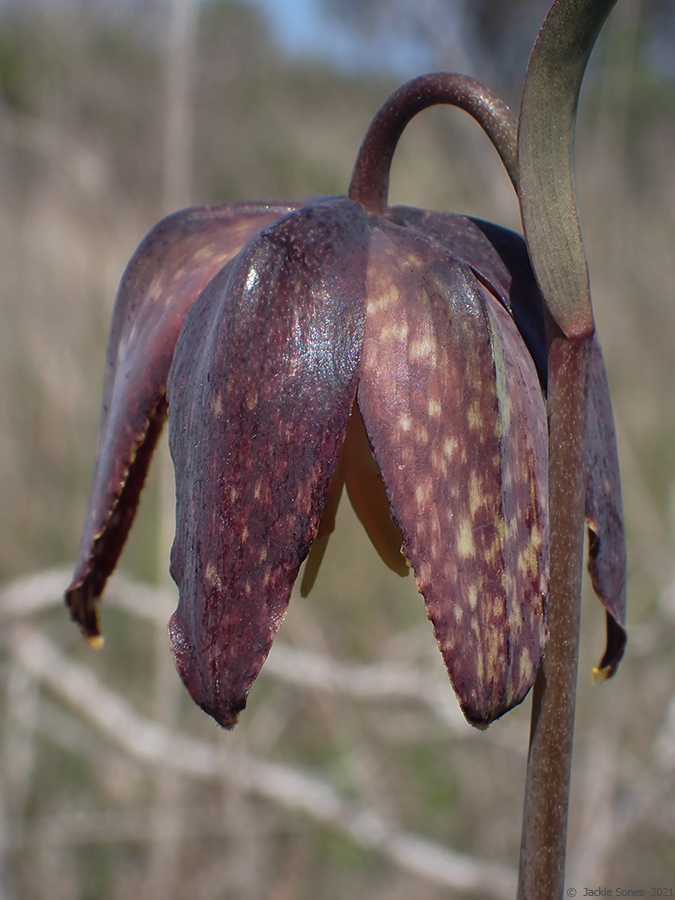
Today Kyle and Michelle treated me to a walk in Marin County.  One of the highlights was this beautiful lily a rare, dark variety of the Chocolate Lily (Fritillaria affinis var. tristulis).

Chocolate Lilies (also known as Checker Lilies) are found in coastal prairie and coastal scrub habitats along the West Coast from British Columbia to California, but this variety is almost restricted to Marin County.

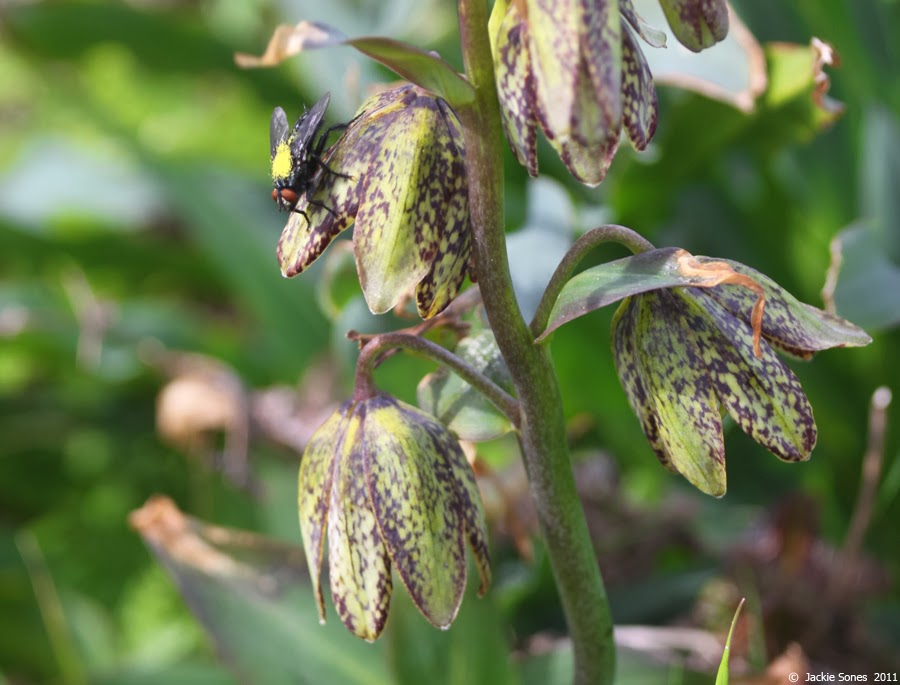
One of the most distinctive characteristics of this variety is the very dark flower coloration, with scarce yellow/green mottling that is more common in other Chocolate Lilies.  For comparison, here's a photo of a Chocolate Lily taken on Bodega Head in April 2011 (below).


Along the with abundant mottling of the flowers, did you notice the large fly with pollen on its thorax?  The fly had been visiting the flowers, so it was serving as a pollinator that day.

Today we also noticed some visitors to the lilies.  Here are a couple of examples:

A small bee.

Some large ants!


I'm grateful to Michelle and Kyle for sharing this wonderful spring wildflower!


Thursday, February 28, 2013

Is an adder acceptable?

This is a very special local wildflower that is primarily found along the northern California coast.


Scoliopus bigelovii is a member of the Lily Family.  It has an unusual common name — Fetid Adder's Tongue. 

"Fetid" because it has a disagreeable odor (to attract fungus gnats to pollinate its flowers).  At this time I'm not quite sure about the origin of "Adder's Tongue."  [An adder is a type of snake.]  One source said it had to do with the appearance of the leaves.  The oblong leaves with prominent veins and dark purple mottling will remain visible long after the flowers have disappeared.  But other sources mentioned different ideas about why it might be called Adder's Tongue, so I'll have to do more research.  If you can provide some insight about the true origin of the name, I'd love to know more!

Here's another view looking down at a plant, showing a flower at the tip of a long stalk (pedicel) emerging from between the leaves.


The image below shows the flower from the side.  It's a good view of the different parts of the flower.  First look at the broad white ribbon-like structures with dark parallel stripes — although they look like petals, these are called sepals.  It might seem surprising, but the three slender, upright structures with dark purple tips are the petals.


You can also see the male and female reproductive parts.  In the center look for the green structure with downward curving branches — this is the style (female part) that along with the ovary will eventually become a capsule that contains the seeds.  Lower down at the bases of the sepals look for the rounded lavender and green structures that look a bit inflated.  These are the stamens (male parts) that will release pollen.  I think you can see some pollen on them (and on the sepals) in the photo below.


Fetid Adder's Tongue is sometimes called Slinkpod.  This name comes from the way the flower stalk twists and droops until the seed pod touches the ground (see below).


Fetid Adder's Tongue flowers early in the season, so look for it now in coastal coniferous forests, along mossy stream banks, and on shaded slopes.  It hasn't been recorded on Bodega Head, but it's nearby.  These photos were taken in Occidental on 28 February 2013.


P.S.  Okay, I know it's not a snake, but until I can find a real snake in 2013, I'm hoping Fetid Adder's Tongue might be an acceptable candidate for celebrating the Year of the Snake!