If you're interested in using any of these photographs or this content in any way, please contact me. Send an e-mail to naturalhistoryphotos(at)gmail.com. Thanks!
Showing posts with label rabbit. Show all posts

Thursday, January 15, 2026

The hunter at dusk

 
Leaving work just after sunset tonight (15 January 2026), I caught a glimpse of a Long-tailed Weasel (Mustela frenata) bounding across the road.  I pulled over to see if it would appear again, and it did.  In fact, it kept running back and forth from one side of the road to the other.  It was getting dark, so a photo was difficult, but I kept watching because the weasel was so active:
 
 
And then I saw another flash and I realized that another animal was involved.  The weasel was chasing a Brush Rabbit (Sylvilagus bachmani).
 
The next sequence was amazing -- the rabbit would dash out from the bushes and start running down the road, and then the weasel would appear and start to chase after the rabbit.  This happened at least 4-6 times!  Here's a sample:
 
 
I wasn't sure what was going to happen, but in the end, the weasel ended up capturing the rabbit!  I've never seen a weasel subdue prey before.  It felt like it took longer, but according to my camera time stamps, the weasel subdued the rabbit in about 1 minute:
 
 
Wow!

Saturday, August 2, 2025

Bounding

I stepped outside to stretch and to think about a presentation I'll be giving soon, when movement caught my eye.  First, a very small rabbit emerged from the shrubs and went bounding along to the right at a very fast pace and then dove under a different shrub.  Hmmph, I thought, I don't often see Brush Rabbits that small, and it was really moving quickly.  

I had just started to ponder it, but then another movement caught my eye in the first location...a weasel!  The weasel appeared where I had first seen the rabbit, then went bounding along the exact same route, paused, and then dove into the same bush as the rabbit!  Now what was going to happen?  

Out burst the rabbit, running back in the opposite direction (to the left).  And you guessed it, the weasel followed again.  But it didn't seem to know where the rabbit had ended up.  The weasel kept hunting around the bushes, so although I didn't have a camera with me at first, I still managed two quick photos when I returned.  And then both the weasel (and the rabbit) disappeared.  

A few moments of excitement!  It made me laugh a bit, as it was almost like a cartoon...although maybe not as funny for the bunny, although it did escape!  (I'm wondering if this was a juvenile weasel?  It looked a little smaller and paler than usual.)


Sunday, June 1, 2025

Siblings

 
A couple of young Brush Rabbits (Sylvilagus bachmani) resting at the end of the day today (1 June 2025).  (There was a bit of a breeze ruffling the fur of the rabbit in the foreground.)
 

Tuesday, April 30, 2024

Morning light


Morning light and Black-tailed Jackrabbit (Lepus californicus), 30 April 2024

Saturday, June 24, 2023

A fluffle?

 
We've been seeing a *lot* of Brush Rabbits (Sylvilagus bachmani) recently, and have been wondering if the timing of this winter's rain contributed to their high numbers this year.  Have you been seeing Brush Rabbits, too?
 
P.S.  I read that a group of rabbits is sometimes called a "fluffle."  I'm not sure how often that word is used, but I was intrigued enough to include it.

Sunday, July 19, 2020

Jack is back?


It's been a while since Black-tailed Jackrabbits (Lepus californicus) have been sighted more frequently in the Bodega Head area.  One guess was that Bobcats and Coyotes might have reduced their local population.  However, I've heard about several observations of jackrabbits this summer, and I finally caught up with one when I had a camera nearby.  Photographed on Bodega Head on 19 July 2020.

Saturday, March 31, 2018

Pastels

You might remember when I was photographing colors in spider webs last summer (see posts from 17 July 2017 and 31 July 2017 for examples).

I walked around the backyard yesterday (30 March 2018) and found a few colorful strands, including one with some of the pastel colors I often associate with Easter.  This spider web was built along an old fence.  I found the resulting photo somewhat reminiscent of a paper collage:


Black-tailed Jackrabbits (Lepus californicus) have been uncommon on Bodega Head for years now.  But here's a fun look back at an older Easter-related post called "Special delivery" from 7 April 2012.


Happy Easter!  Happy Passover!  Happy Blue Moon!  Happy April Fools' Day!  (Happy Birthday, Jen!)
 

Sunday, August 28, 2016

Watchful


Eastern Cottontail (Sylvilagus floridanus), Walpole, MA,  28 August 2016
 

Thursday, September 4, 2014

Checking in


Adult Brush Rabbit (Sylvilagus bachmani) with young (on left), 24 August 2014

Saturday, November 30, 2013

Silflay


We came upon this Brush Rabbit (Sylvilagus bachmani) feeding along the edge of the Pinnacle Gulch Trail during the late afternoon on 30 November 2013.  Although I've thought about posting about this species before, I haven't managed a good picture yet.  Today I can't resist for a few reasons.

(1) I learned something about what Brush Rabbits eat.  I mentioned the rabbit was feeding.  We could see that it was nibbling on something.  After it had hopped away into the vegetation, I went over to evaluate what it had been eating.  I wasn't certain, but it looked like the grass blades had been clipped.  Later I read this about Brush Rabbits:

"Edible grasses are by far the most important food for the Brush Rabbit throughout most of its range." (Orr 1940, as quoted in Chapman 1974) 

The article went on to say that when clovers were available, they were preferred more than all other plants.


(2) I learned that Brush Rabbits are crepuscular.  They're most active between ~6 a.m. and 10:30 a.m. and then between sunset and 2 a.m.  When they're not active, they spend a lot of time resting or basking in their forms (a form is a cleared shelter in the brush about the same size as the rabbit). 

(3) Tomorrow is the first day of December, and in some places it's a tradition to say "Rabbit, rabbit, rabbit" out loud upon waking to bring good luck for the rest of the month.  So, here's a reminder to say your rabbits!

 
P.S. Do you know how a book sometimes stays with you forever?  Watership Down comes up in my life frequently.  Whenever I see a rabbit feeding like this, the word "silflay" is the first thing I think of.  In Watership Down, silflay is a term used to describe when the rabbits leave their burrows to feed; it can also be translated as "to eat outside."  I had a friend who also knew this book well and we would enjoy picnics together, so we would say to each other, "Want to silflay?" 

Saturday, April 7, 2012

Special delivery

You may have caught glimpses of this animal last night or early this morning.


Black-tailed Jackrabbits (Lepus californicus) are large hares.  One of the main differences between hares and rabbits is that hares give birth to precocial young the young (called leverets) are fully furred, their eyes are wide open, and they're ready to hop within a few hours of their birth.  In contrast, newborn rabbits are naked, blind, and cannot leave the nest right away.

Jackrabbits have very large eyes, very long ears, and very long hind feet (see next two photos).  They can run at speeds up to 35 mph and cover 2-3 meters with each bound.

The long ears (up to 8 inches) aid in hearing and in temperature regulation.  Jackrabbits can increase blood flow to arteries in their ears to dissipate heat (via convection and radiation).

Researchers have used infrared images to document jackrabbit ear temperatures before and after exercise (see diagrams below).  The first shows the ears at rest with temperatures less than 10°C.  The second shows the change in ear temperature after exercise (such as a long night of delivering Easter eggs).  Notice the much higher ear temperatures, up to about 35°C. 

Figures adapted from Hill, R.W., D.P. Christian, and J.H. Veghte.  1980.  Pinna temperature in exercising jackrabbits, Lepus californicus.  Journal of Mammalogy 61: 30-38.


After being active through the night and early morning, Black-tailed Jackrabbits will rest in forms (shallow depression under shrubs) during the day.  (Note the black dorsal stripe on the tail.)

Tuesday, February 28, 2012

The rabbit and the barnacle

Can you guess what these two species have in common?

Black-tailed Jackrabbit (Lepus californicus).  Found in both grassland/shrubland and dune habitats.  Their numbers seem relatively low on Bodega Head right now.


Pelagic Gooseneck Barnacle (Lepas anatifera).  After strong winds in spring, found washed in on beaches attached to various floating objects, e.g., wood, seaweed, and plastic (even toy dinosaurs!).


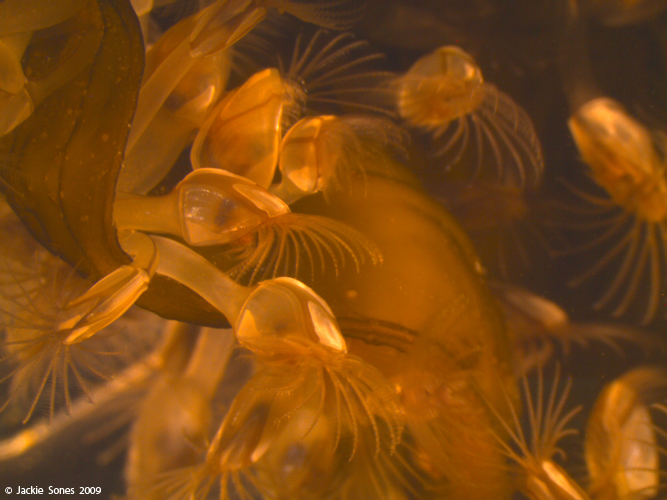
Here are a few close-ups taken under a microscope.  Notice the long fan-like cirri (legs) expanded for feeding, the long peduncles (stalks), and the delicate shell plates.


And I can't resist including a couple of photos of the cyprids, the stage between the early larval form (nauplius) and the sessile adult form.  They are small (but relatively large for barnacle cyprids), blue, and teardrop shaped.  The cyprids attach to an object head first, and then metamorphose into juvenile barnacles.


So what do a rabbit and a barnacle have in common?  Both of these species have very similar latin names Lepus and Lepas (both basically pronounced Leap'-us).

Happy Leap Year! 
 

Tuesday, January 17, 2012

Crossroads

Open sand in the dunes is wonderful for revealing animal tracks.

Here two animals crossed paths — a small mammal with sets of four small circular depressions (probably a mouse) and a bird (probably California Quail).  Did the mouse pass by at night, and the quail during the day?


And here's a typical rabbit track the two larger hind feet are in front placed side-by-side (upper left), and the two smaller front feet are in back, one in front of the other (lower right).