If you're interested in using any of these photographs or this content in any way, please contact me. Send an e-mail to naturalhistoryphotos(at)gmail.com. Thanks!
Showing posts with label scyphozoa. Show all posts

Sunday, August 27, 2023

Washing up

 
With ocean temperatures quite warm recently (in the 17-18°C or 62-64°F range) and with El Niño conditions present in the Pacific Ocean, we're keeping an eye out for more southern/warm-water species.
 
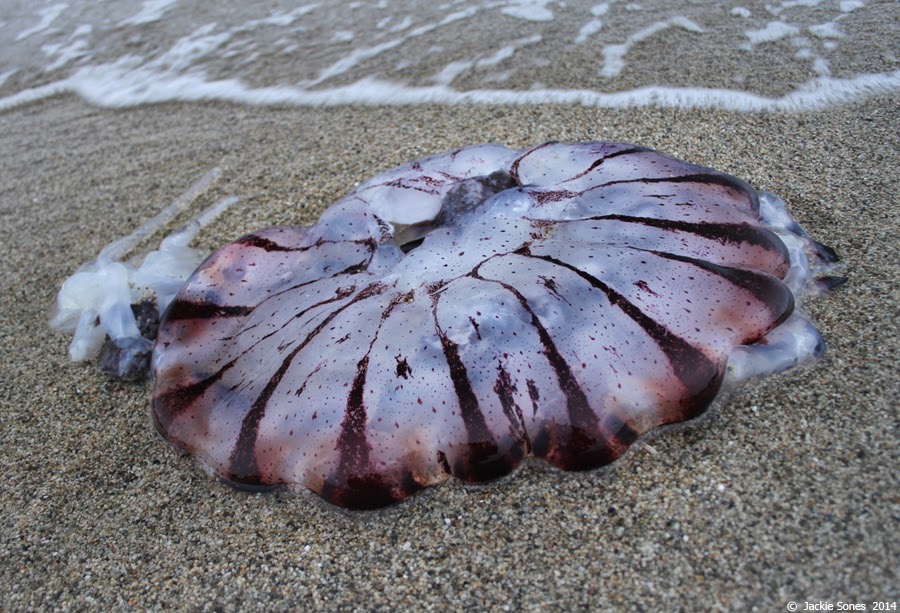
Above is a piece of a Purple-striped Jelly (Chrysaora colorata) that we encountered at Limantour Beach on 26 August 2023.  (To see an entire individual, see the post called "Southern drifter?" on 27 July 2014.

We also came across this wooden pallet covered with pelagic gooseneck barnacles (Lepas sp.).  These barnacles aren't necessarily associated with warm water, but they are typically found offshore, so seeing them on the beach indicates that offshore species are appearing closer to the coast.


Thursday, August 10, 2023

On the half shell

 
So we were walking at Dillon Beach this week and Eric looked down to see this large clam shell wedged in the sand under water.  It wasn't completely white inside, so he was curious about what looked like tiny yellowish dots in the center of the shell.
 
He picked up the shell and I took a look with my hand lens, but I couldn't tell what they were.  I couldn't even tell if they were hard (with a shell) or soft (gelatinous).  But Eric wiped his finger over a few of them and realized they were soft.  Hmmm...were they egg masses of some sort?
 
But because we couldn't see any detail, we decided to scoop up some seawater to fill the clam shell and see if any other hints would be revealed.
 
We were a little surprised, but here's what we saw next:

 
Tentacles!  It might be hard to tell from the photo, but we actually couldn't see the tentacles themselves.  They were too small and didn't stand out from the white shell in the background.  It was the shadows cast by the tentacles that were most apparent.  Here's a closer view:
 
 
The tentacles made the answer easier.  These are tiny jellyfish polyps.  You might remember that I posted about some different polyps on the docks in Bodega Harbor in late June see "Soon to be jellies?" on 29 June 2023.

This is the first time we've observed jellyfish polyps on a clam shell.  It's likely we've just missed them, but now we'll know to watch for them.

 
The polyps need to attach to a hard surface, so on a long sandy beach, a clam shell might be prime real estate!

Thursday, June 29, 2023

Soon to be jellies?

 
Once again Eric and his summer students found some beautiful jellyfish polyps in Bodega Harbor.  This photo is from 28 June 2023.
 
I shared more information about these polyps and an example of a jellyfish life cycle back in 2020.  Check out the post called "The polyp that packs a wallop".

Sunday, October 2, 2022

Mauve Stingers


Last week we observed many of these colorful jellyfish washed up on beaches in Truro and Provincetown, MA.  It looks like this is Pelagia noctiluca, sometimes known as the Mauve Stinger.

The pink/purple coloration was noticeable:


As was the dark spotting pattern (at least on some individuals).  A warning: This species is known to have a severe sting.  The dark spots might be clusters of stinging cells, so be careful if you encounter this jellyfish.

 
I'm not sure how common this species is on the Outer Cape, so am posting photos for the record.  (There were also thousands of salps, Thalia democratica, washed ashore on 28 September 2022.)

Wednesday, March 9, 2022

Ethereal


It's a good time of year for jellyfish polyps in Bodega Harbor.  Eric captured these ethereal images on 6 March 2022.  

To learn more about these polyps and how they fit within the jellyfish life cycle, check out the post called "The polyp that packs a wallop" on 25 February 2020.


 Many thanks to Eric for sharing these beautiful images!

Monday, August 9, 2021

Reaching out


I'm running out of time tonight, but here's a nice photo that Eric took tonight a microscope view.  

For a hint about what these are, check out this post from 25 February 2020.

Saturday, March 20, 2021

Cast ashore

Spring winds pushed some gelatinous animals on shore yesterday.  Here are some examples, shown in order from the animals we encountered most frequently to those that were less common during a walk on Salmon Creek Beach on 19 March 2021:

 
Giant Bell Jelly (Scrippsia pacifica)


By-the-wind Sailor (Velella velella) most of these were small, only ~5-6 mm long


Nectophore of the siphonophore, Hippopodius hippopus


Comb jelly, or sea gooseberry (Pleurobrachia bachei)


Moon jelly (Aurelia sp.)
 

Tuesday, February 25, 2020

The polyp that packs a wallop

Okay, here's the follow-up to last night's post, "The little one with the long tentacles."  

Below is another photo showing a different individual, but the same type of animal:


And here are two close-ups showing the stinging tentacles, and a view of the mouth area in the middle of the ring of tentacles:


The stinging tentacles are a clue that this is a cnidarian (i.e., the group that contains jellyfish, sea anemones, corals, etc.).  But which one is it?

Because this stage of the life cycle is so small (only a few millimeters long), many people haven't seen it before.

These are jellyfish polyps (also known as scyphistomae)!  Eric found them growing on sea squirts at the Spud Point Marina docks.  

Referring to the diagram below, the basic life cycle goes like this: free-swimming adult medusae release gametes (eggs or sperm); a fertilized egg develops into a planula larva; the planula eventually settles and undergoes metamorphosis into a benthic (bottom-dwelling) polyp; the polyp eventually undergoes fissioni.e., it buds off tiny juvenile medusae (called ephyrae) that eventually grow into the adults to complete the life cycle.

Modified from:  Living Invertebrates by Vicki Pearse, John Pearse, Mildred Buchsbaum, and Ralph Buchsbaum.  1987.  Blackwell Sci. Pub. and Boxwood Press.


In the image below, the polyp might be in the early stages of strobilation (note the banding pattern in the polyp):


And here's one more showing the beautiful but deadly tentacles (at least to tiny, microscopic prey):


P.S.  I'm not sure which species of jellyfish this is, but perhaps someone will recognize it and let us know.

Thursday, June 20, 2019

Question: "Are jellyfish edible?"


 Answer: "Why, yes!" replied the sea anemone.
 

This Giant Green Anemone (Anthopleura xanthogrammica) appeared to be ingesting a Pacific Sea Nettle (Chrysaora fuscescens).  Photographed on 20 June 2019.

P.S.  Happy Summer Solstice!

Thursday, July 12, 2018

Local jellies

A few nights ago, I promised to show a few more examples of the gelatinous animals that might wash ashore on local beaches at this time of year.  So...here you go!

Two jellyfish:

 
Pacific Sea Nettle (Chrysaora fuscescens) — note the golden brown color (beware, sea nettles can cause painful stings)
 

Moon Jelly (Aurelia sp.) — note the pale purple color


Now, two different hydromedusae:

 
Giant Bell Jelly (Scrippsia pacifica)note the red eye spots


Aglauropsis aeora — note the faint pink and blue coloration


And the swimming bell of a siphonophore:


Probably Praya sp. — note that in this species the "jelly" material retains its form, and overall this swimming bell has a shape somewhat like a large tooth, i.e., squared off at one end and with two pointed tips at the opposite end.


P.S.  I think I've written a little bit about all of these species before, so if you'd like to learn more about them, scroll to the bottom of the NHBH web page and use the "Search This blog" function.

Sunday, August 6, 2017

Blueberry jelly


Stephanie sent some gorgeous pictures from Dillon Beach today, and she kindly allowed me to share them with you.


This is a Purple-striped Jelly (Chrysaora colorata).  It's a more southern species and is rare north of San Francisco.  I'm not sure if they've been documented at Dillon Beach before? 

Here's another view:


Stephanie spotted this jelly in an isolated pool on Sand Point (at the southern end of Dillon Beach).  She captured a beautiful photo of the setting this morning:


You might recall that I posted about this species a few years agosee "Southern drifter?" from 27 July 2014.

For additional information about this handsome jellyfish, visit The Jellies Zone page

P.S.  Many thanks to Stephanie for sharing these wonderful images! 

P.P.S.  If you see a Purple-striped Jelly, take a photo and send me a message.  I'd love to hear about any additional observations.

P.P.P.S.  One name for the August full moon (according to the Ojibwe) is the Blueberry Moon.  Since the moon is full on August 7th, this seemed like good timing to honor both the jelly — with its dark purple stripes — and the full moon.

Sunday, September 4, 2016

Spotted stripes

Last week, while walking a beach in Chatham, MA, Eric and I came upon a mystery blob on the sand:


Luckily, Eric soon discovered a few others in the water:


We could tell it was a jellyfish, with noticeable reddish-brown stripes made up of leopard-like spots.  However, I was having trouble identifying the species at first. (I suppose this shows that I've been away from the Cape for too long!)

Eventually we found one in a little better shape, showing some of the frilly underparts and a few tentacles:


When we reviewed possibilities in a field guide, we still weren't totally certain about its identification.  But after searching the Internet for photographs, and comparing it with similar species, we feel good about these being Atlantic Sea Nettles (Chrysaora quinquecirrha).

Apparently, they tend to have darker patterning like this when living in high salinity water; they tend to be paler (and plainer) when living in more estuarine conditions.

Here's one more picture that I took with one of the jellies in a plastic bag filled with water.  You can see the leopard-like spots and the granular texture on the bell.


Atlantic Sea Nettles are generally a more southern species.  Cape Cod is their northern range limit.

P.S.  Note that Atlantic Sea Nettles are known for painful stings, so if you see one, be careful not to handle it directly.

Thursday, August 4, 2016

Lounging lions and drifting bells

Two more images from the boat trip on 30 July 2016:


We had nice views of a large male Steller Sea Lion (Eumetopias jubata) among the much more common California Sea Lions on Bodega Rock (off the southern tip of Bodega Head).  Look for the larger, paler individual (with short snout) in the photo above.  (Male Steller Sea Lions can reach lengths of ~3 meters (~10 feet).


And there were quite a few large Egg-yolk Jellies (Phacellophora camtschatica) offshore.  Some of these jellies looked like they were reaching maximum size with bell diameters of ~60 cm (~2 feet).

Monday, August 24, 2015

Sunny Side Up

Yesterday afternoon, while looking offshore from Bodega Head, I noticed a few light-colored animals near the surface.  At first I thought they were sunfish, but I couldn't see the typical fins.  I continued to watch, and eventually realized they were large jellyfish.  

Here's an example, with a Brandt's Cormorant for scale:


Later I saw a few of these jellies close to shore:


I like the picture above because you can tell how this jelly got its common name.  This is an Egg-yolk Jelly (Phacellophora camtschatica).  

Egg-yolk Jellies are large, with bell diameters up to 60 cm (24 inches) across.  The yellow color in the middle of the clear bell is gonadal tissue.

Harder to see are the many dozens of thin white tentacles hanging from the perimeter of the bell (look for a hint of them below):


Egg-yolk Jellies can extend their tentacles 3-6 meters (10-20 feet), creating a net to capture other jellies (which they eat).

The genus, Phacellophora, means "bearing bundles," although I'm not sure if that refers to the tentacles or the oral arms.  The oral arms are visible from below (see next picture) note the distinctive folded or convoluted texture.


Egg-yolk Jellies are relatively easy to identify, but I don't see them washing up on beaches as often as Sea Nettles or Moon Jellies.

Monday, August 17, 2015

You know it's hot when...

...jellyfish are washing up on the beach?

Stranded jellyfish aren't necessarily directly related to hot air temperatures, although we often see jellies washing up in mid-late summer.  

I heard some heat records were set yesterday, so I was trying to come up with a picture that could represent how hot it was.  I'm afraid I failed, but I can show a nice Moon Jelly (Aurelia sp.) that I photographed on 15 August 2015.  [It reminded me of a fried egg, and the accompanying saying, "It's so hot outside, you could fry an egg."]


And the following image is a Sea Nettle (Chrysaora fuscescens) from 5 August 2015.  These are the two most common jellyfish that was ashore during summer.

P.S.  I'll wrap up with a bonus question for Dave Matthews Band enthusiasts.  Can you name the song that has the fried egg saying mentioned above in the lyrics?  The answer is below the picture.


P.P.S.  The DMB song is "Stay (Wasting Time)."  Stay cool! 
 

Sunday, July 27, 2014

Southern drifter?

I haven't started with a mystery close-up in a while, so here you go.  Can you guess what type of animal this is?


Here's another perspective (below).  This view is of the underside:


Any guesses yet?  I'll zoom out a bit more and show about half of the animal:


Okay, now here's the entire thing:


Did you guess jellyfish?  This is a Purple-striped Jelly (Chrysaora colorata, formerly Pelagia colorata).

According to the Light & Smith Manual (2007), this species "regularly washes ashore on the beaches of Southern California and is occasionally found as far north as San Francisco and Bodega Bay."

From a distance, when I saw a large jelly washing up on the beach, my first thought was that it was going to be a sea nettle (Chrysaora fuscescens).  Sea nettles are the most common of the large jellies in this area, but they are more brownish overall and lack the dramatic purple stripes of this species.

The bell of this Purple-striped Jelly was ~15-18 inches across.  I didn't have a ruler at the time, but here's a picture with my Xtratuf boot (size 6.5) for scale.


I'm wondering if this Purple-striped Jelly might have drifted north with some of the warm ocean water that we've been experiencing recently?

It looks like there's warm water to our south and offshore.  You can look at sea surface temperature maps at different web sites.  Here are two examples:


Have you seen Purple-striped Jellies in Bodega Bay before?  If so, I'd love to hear more about your observations.