If you're interested in using any of these photographs or this content in any way, please contact me. Send an e-mail to naturalhistoryphotos(at)gmail.com. Thanks!
Showing posts with label dillon beach. Show all posts

Thursday, August 10, 2023

On the half shell

 
So we were walking at Dillon Beach this week and Eric looked down to see this large clam shell wedged in the sand under water.  It wasn't completely white inside, so he was curious about what looked like tiny yellowish dots in the center of the shell.
 
He picked up the shell and I took a look with my hand lens, but I couldn't tell what they were.  I couldn't even tell if they were hard (with a shell) or soft (gelatinous).  But Eric wiped his finger over a few of them and realized they were soft.  Hmmm...were they egg masses of some sort?
 
But because we couldn't see any detail, we decided to scoop up some seawater to fill the clam shell and see if any other hints would be revealed.
 
We were a little surprised, but here's what we saw next:

 
Tentacles!  It might be hard to tell from the photo, but we actually couldn't see the tentacles themselves.  They were too small and didn't stand out from the white shell in the background.  It was the shadows cast by the tentacles that were most apparent.  Here's a closer view:
 
 
The tentacles made the answer easier.  These are tiny jellyfish polyps.  You might remember that I posted about some different polyps on the docks in Bodega Harbor in late June see "Soon to be jellies?" on 29 June 2023.

This is the first time we've observed jellyfish polyps on a clam shell.  It's likely we've just missed them, but now we'll know to watch for them.

 
The polyps need to attach to a hard surface, so on a long sandy beach, a clam shell might be prime real estate!

Thursday, February 2, 2023

Ferocious

 
Whoa, now that's an impressive set of teeth!
 
Stephanie photographed this Longnose Lancetfish (Alepisaurus ferox) washed ashore at Dillon Beach today (2 February 2023).   
 
And here's the entire fish:
 
 
This is a deep water species that occasionally washes ashore.

I like this description from Deep-water Fishes of California (Fitch and Lavenberg 1968):
 
"Although the barracuda-like body topped with a sailfish-like fin distinguishes the lancetfish from all other denizens of the deep, the longnose lancetfish received its common name from its lancetlike fangs."
 
[In case you're wondering, the dorsal fin is folded down in the photo, so it is not visible.]
 
Also:
 
"One of the most interesting features of the lancetfish is its voracious appetite.  In spite of their impressive dentures, lancetfish seldom mutilate their prey, the fishes and other creatures found in their stomachs are usually in near-perfect condition.  Many descriptions of new (to science) fish, octopus, and squid species have been based upon items found in lancetfish stomachs."

P.S.  The scientific name is informative
"Alepisaurus" means scale-less and lizard-like, while "ferox" means ferocious.  Watch out!

Thursday, December 30, 2021

In the late afternoon


Roosting Sanderlings (Calidris alba) above, and a Snowy Plover (Charadrius nivosus) below, sheltering behind a small mound of sand. Both photographs from 25 December 2021.


Saturday, December 25, 2021

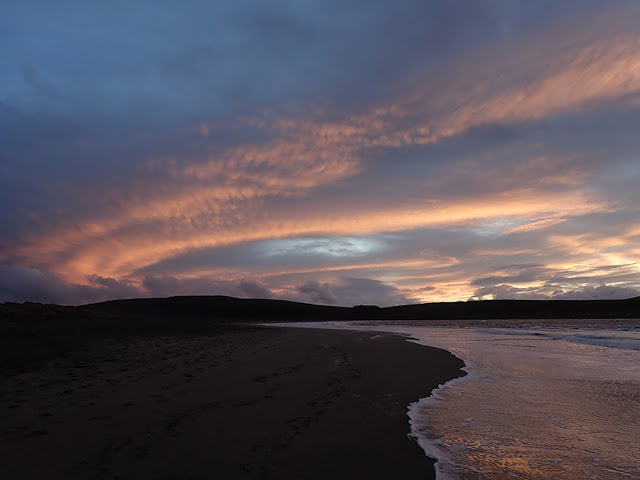
Sunset spiral


Cloud spiral, Dillon Beach, 25 December 2021

Tuesday, May 18, 2021

Knot variations

 
Well, I had some trouble deciding which Red Knot photos to share, so here's a selection:


Feather details and variations:


Actively feeding:


A small flock, with a few dowitchers.  The dowitchers are on the left and right sides of the photo, and there's also one dowitcher mixed in with the knots (in the back row, with a browner head and back):


One more photo, showing a banded bird.  I've reported it and made some inquiries, so perhaps we'll find out where this knot was banded (Alaska?  Washington?).  Banded birds can help identify migration routes, which in the case of Red Knots can include ~8,000 km (~5,000 mile) non-stop flights!
 
 
ADDENDUM (22 May 2021):  I submitted this record of a banded Red Knot to the Bird Banding Lab and a few people who might have connections to knot researchers.  Nils Warnock (from Audubon Canyon Ranch) wrote back that Jim Johnson (from USFWS) responded that this bird had been banded on the Seward Peninsula near Nome, Alaska!

Monday, May 17, 2021

Knot too shabby


When I went to photograph the turnstones at Dillon Beach this past weekend, I was also lucky enough to run into a small flock of Red Knots (Calidris canutus).  I'm still sorting through pictures, but here are a couple of teasers!  [You can click on them for larger versions.]


Sunday, May 16, 2021

Fueling up for a long journey

Okay, here you go, a few more Ruddy Turnstone (Arenaria interpres) photos from Dillon Beach yesterday (15 May 2021).  

First, a few while the turnstones were feeding looking for juvenile mole crabs just beneath the surface of the sand:


Although the turnstones look bright and colorful against the sand, you can see how their varied plumage works well to camouflage them against rocky habitats mixed with sand and seaweeds:


And one more, just for fun — a close-up with seaweed and fog:
 
 
Wish them luck on their journey to the Arctic!

Saturday, May 15, 2021

On the way to the tundra


After field work yesterday we caught a glimpse of a small group of six Ruddy Turnstones (Arenaria interpres) at Dillon Beach.  I only had a point-and-shoot camera at the time, and was disappointed not to have a larger camera and lens because the turnstones were quite striking in nearly full breeding plumage.  So I made another run to the beach early this morning (15 May 2021) to see if they were still around.  

I'll be sharing some more photos, but here's one to start.  The turnstones (and other shorebirds) were feeding on small mole crabs (Emerita analoga).  I was glad to see them before they depart for the Arctic Ruddy Turnstones are one of the most northerly breeding shorebirds!

Saturday, February 13, 2021

Kiting into the wind


Several days ago I posted a photo of a Ferruginous Hawk (Buteo regalis) perched in a grassland in Mendocino County.  This one was photographed "kiting" into the strong northwest winds near Dillon Beach today (13 February 2021).

Sunday, March 15, 2020

Reflective


During these anxious times, I couldn't be more grateful for a walk by the ocean.  View from Dillon Beach, 15 March 2020.

Thursday, November 28, 2019

Snowy in the mountains and snowy on the beach


Snowy Plover (Charadrius nivosus), Dillon Beach, 28 November 2019
 

Tuesday, March 5, 2019

Look what turned up!


Stephanie very kindly wrote to share this photo of American Avocets (Recurvirostra americana) from Dillon Beach.  She observed three individuals at Sand Point on 5 March 2019.   We don't often get to see avocets on the outer coasts of Sonoma and Marin counties, so this is a nice sighting.

Note that females tend to have shorter and more strongly recurved (turned upward) bills.

I think I last posted about avocets almost six years ago check out the post called "Avocets in July" on 8 July 2013.

Many thanks to Stephanie for sharing her photo!

Sunday, August 6, 2017

Blueberry jelly


Stephanie sent some gorgeous pictures from Dillon Beach today, and she kindly allowed me to share them with you.


This is a Purple-striped Jelly (Chrysaora colorata).  It's a more southern species and is rare north of San Francisco.  I'm not sure if they've been documented at Dillon Beach before? 

Here's another view:


Stephanie spotted this jelly in an isolated pool on Sand Point (at the southern end of Dillon Beach).  She captured a beautiful photo of the setting this morning:


You might recall that I posted about this species a few years agosee "Southern drifter?" from 27 July 2014.

For additional information about this handsome jellyfish, visit The Jellies Zone page

P.S.  Many thanks to Stephanie for sharing these wonderful images! 

P.P.S.  If you see a Purple-striped Jelly, take a photo and send me a message.  I'd love to hear about any additional observations.

P.P.P.S.  One name for the August full moon (according to the Ojibwe) is the Blueberry Moon.  Since the moon is full on August 7th, this seemed like good timing to honor both the jelly — with its dark purple stripes — and the full moon.

Wednesday, March 8, 2017

Rolling in


Fog rolling in during the late afternoon.  Photographed from Dillon Beach on 8 March 2017.
 

Sunday, November 27, 2016

Help with a mystery object?

Okay, this one is a true mystery.  We found this object while walking Dillon Beach on 25 November 2016:


Our best guess right now is that it's the periostracum (outer covering) from a large bivalve.  (It measured ~6.5 cm long by ~5 cm wide.) 

However, the material and its transparency seem different than other bivalve coverings that we've seen, so we're open to any other thoughts or suggestions.  The inner surface appeared to have a chalky white residue (perhaps from the middle shell layer of a clam?).

And even if it is the outer covering of a clam, we are uncertain about which species it's from.

Here's another view, this time from the side:


Let me know if you have any ideas about its identity.  I'm still working on it, but it would great to solve this mystery!

ADDENDUM (28 November 2016): Several people have suggested this could be the operculum ("trap-door") of a large snail, e.g., a whelk.  That's a strong possibility, and at this time I think I'm leaning that way.

ADDENDUM (1 December 2016): For the identity of this mystery object, see the post on 28 November 2016.

Tuesday, October 4, 2016

Light and water


I've always loved the interplay of light and water.  

Ripples along shore at Dillon Beach, 2 October 2016.

Wednesday, September 28, 2016

Noodles!

Stephanie has been finding these washed up on Dillon Beach.  Do you have a guess about what they are?

That's an impressive tangle of "noodles"!

Here's a close-up that might provide some more clues:


If you look closely at the individual strands, you'll see small whitish compartments in a regular pattern.  Each of these is a cluster of embryos.  There can be 10s to 100s of embryos per cluster (depending on the size of the female laying the eggs)...and up to ~1 million embryos per string!

Here's another view.  The animal responsible for these will be revealed below the photo: 


And the answer is...these are egg strings of a California Sea Hare (Aplysia californica)!

Stephanie also documented a few adults washing up on the beach:


The embryos will take a little over 1 week to develop.  Then the free-swimming larvae (veligers) will spend ~1 month in the plankton before undergoing metamorphosis to become tiny sea hares.  

California Sea Hares are uncommon in this region (they're generally a more southern species), so let us know if you spot any and if they're laying eggs.

P.S.  Many thanks to Stephanie for sharing these great photos! 

P.P.S.  For a few other sea hare pictures from Miwok Beach in May 2015, see the post called "Munching at Miwok."

Saturday, December 5, 2015

Gray and white


Snowy Plover, Dillon Beach, 5 December 2015