If you're interested in using any of these photographs or this content in any way, please contact me. Send an e-mail to naturalhistoryphotos(at)gmail.com. Thanks!
Showing posts with label sea hare. Show all posts

Tuesday, August 22, 2023

Blondie


During a field trip to Tomales Bay on 17 August 2023, Melissa spotted this small yellowish-green sea hare crawling on some eelgrass (Zostera marina).  At first I wasn't sure about the identity of this sea hare, but after looking more closely I believe it's a Hedgpeth's Sea Hare (Elysia hedgpethi).  (Those small bright blue spots helped with the i.d.)

I've mostly encountered this species on rocky shores where they are a deep green color (see "Not a flatworm!" on 25 June 2013 and "Magic cape" on 17 August 2022).  So the paler "blonde" color was confusing until I read that this species can be yellowish or brownish, too.  Is the color driven by what they are eating?  Or related to the condition of the chloroplasts they ingest?

Eric was able to get a few nice video clips, too, so check out the video below.  Watch for the rolled rhinophores, the two dark eye spots behind the rhinophores, the wide flaps held upright on either side of the body, and the scattered blue spots.  [If you can't see the video player in your e-mail, click on the title of the post above to watch the video on the NHBH website.]


Many thanks to Melissa for spotting this sea hare and to Eric for putting together the video!


Wednesday, August 17, 2022

Magic cape


I love seeing this sea hare, especially up close, when you can see the bright blue-green spots (and tiny orange dots, too, if you look carefully).  Meet Hedgpeth's Sea Hare (Elysia hedgpethi)!  [I posted about this species a few years agosee "Not a flatworm!" on 26 June 2013.]

Last week, my first view of this individual was very different.  Under water, they are transformed into the beautiful sea hare in the first photo. But out of water, they look like a flattened green/black blob on the rock:

 
I was curious about finding the sea hare on the rock wall.  In the past I've found them near their food, e.g., a green seaweed called Bryopsis corticulans.  So I started scanning and soon located a clump of Bryopsis:
 
 
I kept searching and eventually found even more Bryopsis (below).  And this time there were a couple of patches that looked suspicious.  Can you spot the sea hares in the photo below?
 
 
Yes!  There's a large individual on the lower left side, and a smaller individual on the lower right side.  They look so much like the Bryopsis! But you can see that they're a little smoother and shinier.  Here's a closer view of the larger individual:

 
Their wonderful green lateral flaps with scattered spots always makes me think of a magic cape!
 
 
Photographed in Monterey County on 13 August 2022.

Monday, October 21, 2019

Striped mystery revealed

Okay, remember last night's mystery photo?  

Here's another view:


Meet Taylor's Sea Hare (Phyllaplysia taylori), a wonderful marine mollusc that lives in local Eelgrass (Zostera marina) beds.

This one washed up along the shoreline of Bodega Harbor, but I moved it to a small pool on the tidal flats:


Although this sea hare stands out against the gray/brown background of the mud, they're usually found living on blades of Eelgrass, so the green coloration with black and white stripes is excellent camouflage in its typical habitat.

P.S.  If you're wondering, the flap on the back right side is the opening to the gill cavity.

Monday, November 28, 2016

Hide nor hare

I'm excited to share an update about the identity of last night's mystery object!  Here's a reminder of the object that I wasn't sure about:


I had wondered about a bivalve periostracum (the outermost layer)...and also about a snail's operculum (the "trap door"), as had a few other folks.  But I wasn't satisfied with either possibility.

For example, after checking various books, I couldn't find any clam with this shape.  And, although I started looking at snail opercula, and some of them were closer in shape, the material (very thin and flexible), the chalky layer, and an odd twist along one side of the shell, didn't match with any operculum I was familiar with.  Here's a picture of the twist that puzzled me:


However, a breakthrough came today via a Twitter exchange!  Annaliese (at Oregon State University) sent out a request for assistance and Rebecca (at the California Academy of Sciences) responded with an identification, including a photo! 

Here's the photo of a dried specimen from the California Academy of Sciences:


Compare that with my mystery specimen from Dillon Beach (now dried out, see below):


You can see how similar the shape and texture are.

I agree with Rebecca that this is a good match with her sample which is the *internal* shell of a California Sea Hare (Aplysia californica)!  I'll admit that I hadn't known (or had forgotten) that Aplysia had an internal shell, and I've certainly never seen hide nor hare of such a shell.  ;)

I know that this phenomenon might be confusing at first, but there are some snail relatives (like sea hares) that have internal shells that aren't visible from the outside.  Here's a link to a diagram showing the development of a California Sea Hare (see Research study 2).  Note that they have an external shell when very young, but the shell becomes internal in the adults.

Many thanks to Rebecca and Annaliese for solving the mystery!

P.S.  Adult California Sea Hares were observed in Sonoma and Marin counties in 2015 and 2016.  To review what the adults look like, see the posts from 28 September 2016 and 23 May 2015.

Wednesday, September 28, 2016

Noodles!

Stephanie has been finding these washed up on Dillon Beach.  Do you have a guess about what they are?

That's an impressive tangle of "noodles"!

Here's a close-up that might provide some more clues:


If you look closely at the individual strands, you'll see small whitish compartments in a regular pattern.  Each of these is a cluster of embryos.  There can be 10s to 100s of embryos per cluster (depending on the size of the female laying the eggs)...and up to ~1 million embryos per string!

Here's another view.  The animal responsible for these will be revealed below the photo: 


And the answer is...these are egg strings of a California Sea Hare (Aplysia californica)!

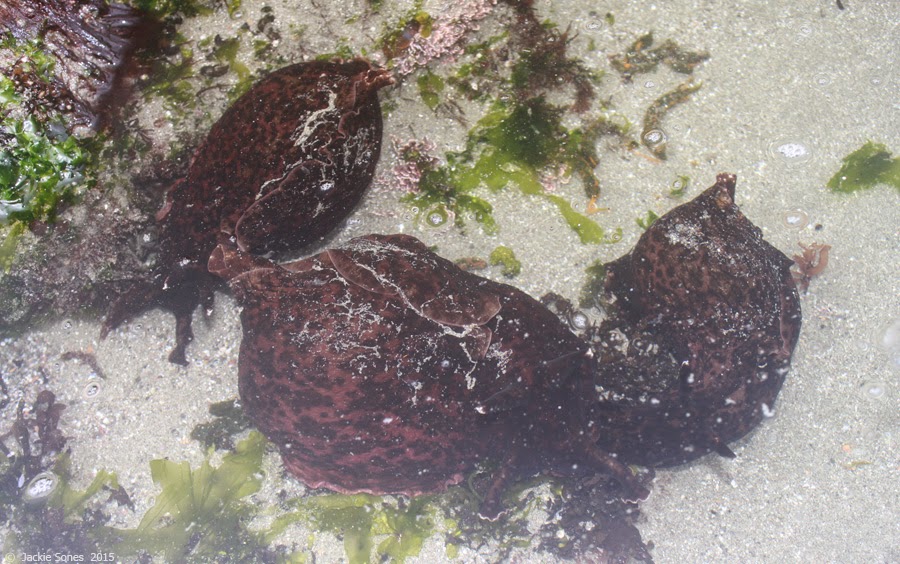
Stephanie also documented a few adults washing up on the beach:


The embryos will take a little over 1 week to develop.  Then the free-swimming larvae (veligers) will spend ~1 month in the plankton before undergoing metamorphosis to become tiny sea hares.  

California Sea Hares are uncommon in this region (they're generally a more southern species), so let us know if you spot any and if they're laying eggs.

P.S.  Many thanks to Stephanie for sharing these great photos! 

P.P.S.  For a few other sea hare pictures from Miwok Beach in May 2015, see the post called "Munching at Miwok."

Saturday, May 23, 2015

Munching at Miwok


Do you recognize this animal?  The picture above is a head-on close-up.

Here's a view from the side (a different individual):


Note the two rolled rhinophores (sense organs) sticking up, and the two flap-like oral tentacles extending forward.  The overall coloration is also distinctive blotches of red, brown, green and gold...and a network of dark lines (reminiscent of the crackle of raku pottery!).

Here's an entire animal viewed from the side:


This is a California Sea Hare (Aplysia californica).  We had heard that some had been observed at Miwok Beach (along the Sonoma Coast just north of Bodega Bay), so we stopped there this morning to take a look.

California Sea Hares are rare in northern California.  It's likely their presence here this year is due to the warmer water temperatures during the past year.

Although it's hard to tell from the pictures, they're quite large!  The maximum recorded size is ~75 cm (30 inches) long, and up to 15 lbs (7 kg).  Most are smaller, but still substantial.  The individuals we documented today were ~20-25 cm long.  Here's a picture with my boot for scale (this sea hare had been stranded out of water at low tide, but was just waiting for the tide to return):


Why are they called sea hares?  Well, if you return to the first picture of this post, you might be able to see a resemblance between this snail and a hare because of the way the rhinophores look like the tall ears of a hare.  And similar to rabbits, sea hares are herbivores in this case, grazing on a variety of seaweeds and sometimes seagrass.  Also, although it's probably not related to their name, sea hares move fairly fast relative to other snails.  [If you're wondering, sea hares are gastropods a group of molluscs that includes snails, limpets, nudibranchs, and sea hares.]

There were at least 50, and perhaps as many as 100 or so, California Sea Hares at Miwok Beach today.  It's not a species we see in this area very often, so if you find them this year, I'd love to hear about it!


P.S.  I've heard of reports of California Sea Hares in Tomales Bay this year, but I'm not sure of the exact locations.

Tuesday, June 25, 2013

Not a flatworm!

When the low tides are this good, it's sometimes hard to stop looking.  On 23 June, I checked one more site and noticed something unusual.  It was relatively small (~2 cm long), oval, with an undulating edge, and a handsome dark green color.  The shape made me think of a flatworm, but I hadn't seen a local flatworm that color before.

I took a picture and then zoomed in to see more detail.  This is where digital cameras come in handy!  Here's what I saw in the field:


The distinct head and tentacles (rolled rhinophores) told me this wasn't a flatworm but rather a gastropod or sea slug.  I knew I hadn't seen this species yet, but I had a guess about what it could be.  I'd been wanting to see one for years!

I brought it into the lab for a few microscope pictures for documentation.  Here's one of the first photographs under magnification:


This is a Hedgpeth's Sea Hare (Elysia hedgpethi).  Note the beautiful blue spots scattered across the lateral flaps on either side of the body.  There were tiny orange spots, too, but they're harder to see because of their smaller size.

Hedgpeth's Sea Hares are known to feed on two species of green algae: Codium fragile and Bryopsis corticulans.  The sea hare is able to retain the algal chloroplasts which continue to photosynthesize for at least 10 days after they've been ingested!

Although this individual was quite active under the microscope, I managed a few more pictures:


I wish I had more time to write about Joel Hedgpeth, for whom this sea hare was named.  I'll have to do that another night.  For now, if you'd like to read more about him, I think you can still access a short NY Times obituary here.  And there's a much more complete article in the Journal of Crustacean Biology here.  Among many (many!) other things, Joel was a marine biologist, a local Santa Rosa resident, editor of Between Pacific Tides, and well known for protesting the PG&E attempt to build a nuclear power plant on Bodega Head.


Joel also wrote an Introduction to Seashore Life of the San Francisco Bay Region and the Coast of Northern California.  I laughed when I read this passage about Hedgpeth's Sea Hare in that book: "...at first glance may be confused with a large flatworm, but the rolled structure of the head tentacles clearly separates it from flatworms..."  As mentioned in the very beginning of this post, this was my experience exactly!