If you're interested in using any of these photographs or this content in any way, please contact me. Send an e-mail to naturalhistoryphotos(at)gmail.com. Thanks!
Showing posts with label seastar. Show all posts

Saturday, June 18, 2022

Reaching

 
Leather Stars (Dermasterias imbricata) haven't been common in our area during the last few years, so it was nice to catch up with a few this past week.

Monday, December 4, 2017

Another little one


Juvenile Bat Star (Patiria miniata)only ~2 cm across at its widest.  This individual is regrowing two of its arms (the top two in this photo) that were apparently damaged previously.

Monday, August 3, 2015

A new comet!

On 2 August 2015, Eric spotted something we'd never seen before — a new comet!


When a sea star has only one arm remaining (and often a portion of the central disc), and it regrows all of its other arms, it's called a "comet" because the original arm is so much larger and appears similar to the tail of a true comet traveling across the sky.

Sea stars in the genus Linckia are famous for this type of regeneration from a single arm, but we had never seen it in Pisaster ochraceus.

We searched the Internet for other photos of Pisaster ochraceus comets, but could only find one picture of a Pisaster giganteus comet to see it, click here.

It's likely that comets in Pisaster ochraceus are rare.  We're guessing that the juvenile Pisaster in this photo lost four arms due to Sea Star Wasting Syndrome and it's now regenerating them.  Never give up!

Saturday, March 2, 2013

Who, me?

"Who, me?  Nah, I didn't eat that sea star.  Must have been that other gull."

A Western Gull (Larus occidentalis) caught in the act — trying to swallow a large Ochre Sea Star (Pisaster ochraceus).


Monday, October 22, 2012

Giant!


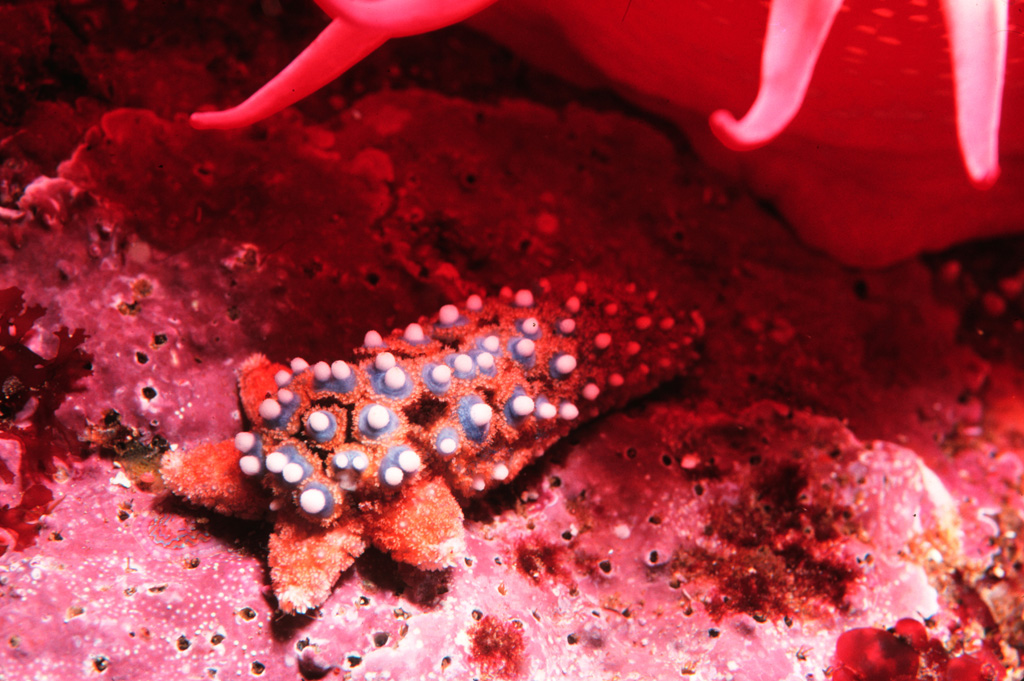
In previous posts, I've mentioned the Ochre Seastar (Pisaster ochraceus) and Short-spined Seastar (Pisaster brevispinus).  The other seastar in this genus found in the Bodega Head region is the Giant Seastar (Pisaster giganteus).

The species name, giganteus, refers to the size.  Each ray or arm of this seastar can be more than 30 cm (12 inches) long!  The individual in this photo measured >70 cm (27.5 inches) across from tip to tip!
  

Compared to the more common Ochre Seastar, the spines of the Giant Seastar are less numerous, longer, and more uniformly distributed across the upper surface (rather than being clustered or forming patterns).  The spines may be white, pink, violet, or blue. There is often a blue ring around the base of each spine (not as visible in these images).


 All of these photos were taken at the Spud Point Marina in June 2008.


For some reason, students have a tendency to put seastars on their heads.

I'm wondering if Chris had the same expression on his face tonight when the Giants won Game 7?  

A giant win for San Francisco!

Friday, June 8, 2012

Go Green!

Short-spined Seastar (Pisaster brevispinus)

Photo taken on Bodega Head, 7 June 2012.  Note the pink coloration.  Each arm of a seastar is called a RAY.


Giant Green Anemone (Anthopleura xanthogrammica)

A close-up of the tentacles.  Each tentacle is armed with nematocysts, small harpoon-like structures that can PIERCE the anemone's prey.


Sometimes darker sands can appear on Bodega Head beaches.  Among other minerals, they often contain magnetite and GARNET.


Bodega Head sunsets may make you think of RA, the Egyptian sun god.

 
What do all of these photos have in common?  

They're all associated with a certain basketball team that's playing Game 7 on Saturday night.

Let's go, Celtics!

(RAY Allen, Paul PIERCE, Kevin GARNETT, RAjon Rondo, and the rest of the team!)
 

Saturday, May 12, 2012

Seeing stars

Four different species of seastars observed during the past two days in Oregon.  All four are also found on Bodega Head.

Six-armed Seastar (Leptasterias sp.)

The Six-armed Seastar pictured above was a large specimen, ~6 cm across.  (It's more common to see Six-armed Seastars ~2-3 cm across.) Photo taken at Cape Arago, OR, on 11 May 2012.


Bat Star (Patiria miniata)

Bat Stars are rare in Oregon and Washington.  We found a few individuals at Cape Arago, OR, on 11 May 2012.  All were a handsome slate blue color; two with narrow orange borders along the arms; the third with some white mottling.  

Below, note the intricate braided pattern created by the crescent-shaped ossicles (calcareous plates) on the upper surface.


Sunflower Star (Pycnopodia helianthoides)

Sunflower Stars are among the world's largest (and fastest) seastars.  They can reach a diameter of 3 feet across.  The individual above was ~2 feet across.

The arms of Sunflower Stars are softer and less rigid than other seastars.  Here's a close-up of several arms and a portion of the central disc.


The white and brown finger-like projections are papulae, sites used for gas exchange.  The purple clusters with white tips are pedicellariae, pincers used for defense.  They often surround white calcareous spines.  

If you look closely (see below), you can also see larger isolated pedicellariae on stalks emerging among the papulae.

 
These stalked pedicellariae were large enough (at least 1 mm long) that you could see their pincer-like structure (see below).

The lavender-colored hearts are the gaps in between the two halves of the pincer (imagine them opening and closing like scissors).


Ochre Seastar (Pisaster ochraceus)

Like many seastars, Ochre Seastars are broadcast spawners, with spawning occurring primarily in May in Oregon.  Most echinoderms have separate sexes.  The individuals pictured here (above and below) are males in the process of releasing sperm.


We couldn't find any females releasing eggs today, but the eggs would be orange rather than the white of the sperm.  After the eggs are fertilized, the planktonic larvae swim in the open ocean for ~6-8 weeks or longer before undergoing metamorphosis into a benthic (bottom-dwelling) juvenile seastars.

Thursday, April 26, 2012

Reds and purples

Sometimes there seems to be a color scheme for the day.  Today I helped Eric with field work at Van Damme State Park in Mendocino County.  Between tasks I took a few photos, where reds and purples kept appearing.

Red Urchin (Strongylocentrotus franciscanus) among Purple Urchins (S. purpuratus)


Close-up of a Gumboot Chiton (Cryptochiton stelleri)


A very small (~1 cm across) Ochre Seastar (Pisaster ochraceus)


 An elegant scale worm in a shallow pool (not certain of the species)


The day started with an intense squall line approaching from the horizon.  It moved very quickly across the ocean towards land.  I barely had time to take this picture before it started to pour!

Wednesday, February 29, 2012

Four brooders in one

In the picture below there are four different invertebrates (in four different phyla) that brood their young.  This might be tricky, but can you find all four species?


(1) Proliferating Anemone (Epiactis prolifera).  Phylum Cnidaria.  Orange with white stripes (although color in this species is highly variable).  At least 8 young are being brooded by this adult.  Fertilized embryos are moved from the mouth across the oral disc and then down to a depression at the base of the column.  The mother broods the juveniles for about 3 months and then they depart to live independently.

(2) Six-armed Seastar (Leptasterias sp.).  Phylum Echinodermata.  Small pink seastar.  This individual was only about 1 cm across, but maximum size for this species is about 5 cm.  Females brood clusters of eggs under their bodies for about 6 weeks and then the tiny juvenile seastars crawl away from the mother.  (See more photos below.)

(3) Spirorbid tube worm.  Phylum Annelida.  Small white coiled tubes (see post on 6 February 2012).  Fertilized embryos are retained and brooded either along the abdomen, in a brood chamber, or within the operculum.  Planktonic larvae are released into the water, but settle after a very short time.

(4) Tube snail (Petaloconchus montereyensis).  Phylum Mollusca.  Purple-orange tube on the upper left side of the photo.  This is a vermetid gastropod that builds calcareous worm-like tubes and lives cemented to the rock.  Eggs are brooded within capsules inside the tube, juveniles complete their development within the capsules and then emerge from the tube as small snails and attach to a nearby rock.


Six-armed Seastar with eggs.  Their main brooding season is winter and spring.


Six-armed Seastar adult with many tiny juveniles in the lower right corner.  How many can you find?


Different eyes might find different individuals, but I found at least 15 juveniles.

The first photo was taken at The Great Tidepool in Pacific Grove, but all four species are also found on Bodega Head.  The second and third photos were taken on Bodega Head.