If you're interested in using any of these photographs or this content in any way, please contact me. Send an e-mail to naturalhistoryphotos(at)gmail.com. Thanks!
Showing posts with label wasp. Show all posts

Saturday, October 22, 2022

Wasp-catcher


Lots of wind on Bodega Head today (22 October 2022), but I caught up with a Tropical Kingbird (Tyrannus melancholicus) in the lee of some shrubs.

  
I spent a little time trying to figure out what the kingbird was feeding on.  Most of the time I couldn't quite tell, but in one photo it looked like it had caught a wasp:

 
Tropical Kingbirds are rare but regular fall vagrants to California, with 1-4 records/year in Sonoma County.

P.S.  For more photos from October 2021, see the post called "Tropical view".

Monday, March 18, 2019

Following footsteps

Earlier in March, I was watching some insects visit the flowers of Footsteps-of-spring (Sanicula arctopoides).  Check out this fly.  Hard to believe how thin its "neck" is:


I'm not sure if this next insect (below) is a wasp or a beemaybe a wasp?  Let me know if you can help with an identification:


And here's one of the flower:


Tuesday, July 24, 2018

Velvet aboveground


Thanks to Peter, I'm excited to share a velvet ant (Dasymutilla sp.) photo with you.  We were walking in the Bodega Dunes last weekend when this small orange and black insect went racing by us.  We caught up with it and I managed one photo for the record.

Velvet ants aren't really ants.  Although they look hairy and have an ant-like appearance, they're actually wasps!  The females (as above) don't have wings.  They run over the sand in search of an underground bee or wasp nest to parasitize.  (If you encounter a velvet ant, beware, their sting is very painful.)

P.S.  For more information about velvet ants, check out this story from the BBC.

Sunday, August 27, 2017

Foraging among the flowers

A few visitors to the Seaside Wild Buckwheat flowers (Eriogonum latifolium) in the Bodega Dunes on 26 August 2017:


Male Acmon Blue (Plebejus acmon) from below


Female Acmon Blue (Plebejus acmon) from above


A small wasp with big green eyes, possibly a bee hunter (Philanthus sp.)?


A beautiful iridescent blue wasp, possibly a spider wasp (Psorthaspsis sp.)?


If you can assist with the wasp identifications, let me know!


Saturday, May 28, 2016

Busy

I went out this morning to try to photograph wasps, but I was having a hard time.  Then I noticed these wonderful bees:


The bees quickly entered burrows, so they were difficult to photograph.  Eventually I found one digging, and caught a glimpse of its beautiful green eyes:


And then I spotted a female outside of a burrow:


And a male perched on a flower stem (below).  Note his bright yellow face (it made the male easy to follow even when it was flying):


I'm pretty sure this is Anthophora californica.  It's the first time I've photographed this bee.  [You might remember that I showed a different species of Anthophora in 2013 see the post called "Turrets and Tongues".]


Eventually, I also managed to photograph the wasp.  I need to ask for some help with the identification, but I think it might be a "cutworm wasp," perhaps Podalonia (argentifrons?)?  Impressively, the wasp was carrying a large caterpillar (perhaps a cutworm!):


And here's one more bonus picture.  I'm not sure about the identity of this pretty little bee, but I'm wondering if it's a species of Andrena?  This bee was so small and so fast, and the pollen on its legs was so dense and so bright, it looked as if a clump of pollen was flying among the vegetation!  UPDATE (30 May 2016): Robbin Thorp has confirmed this as Lasioglossum sp. 


Friday, August 31, 2012

Purple wings and orange feet


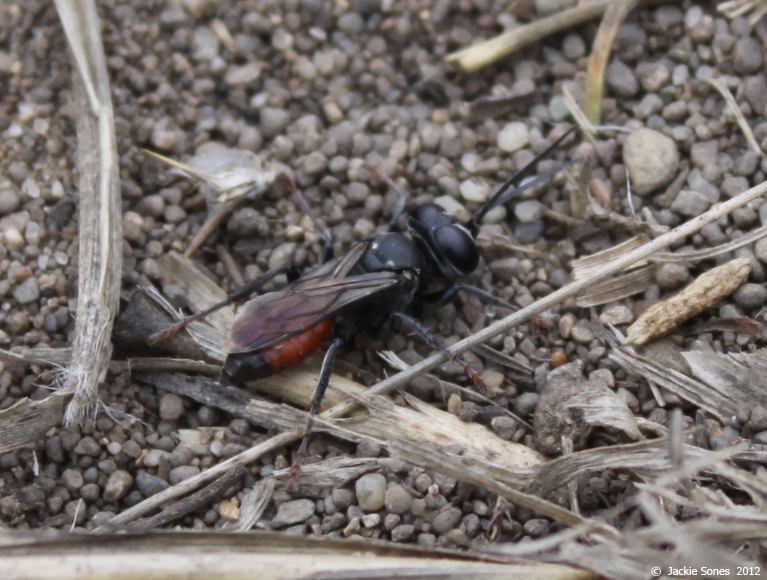
Here's one I need help with.  I think this is a wasp, and my best guess after looking around a bit is that it's a type of square-headed wasp (possibly in the Tribe Larrini).  But I don't have any experience identifying wasps, so if someone can assist with an identification, I'd greatly appreciate it!  It was photographed on 31 August 2012 along a dirt path through a coastal grassland on Bodega Head.

Note the purplish tinge to the wings (the wasp would occasionally flick them) and the complementary orange coloration near the "feet."

Below you can see that most of the abdomen is orange-red.  The wasp had a distinctive way of pressing its antennae together and holding them still for a while, and then tapping or feeling with them rapidly.


I liked the white stripes on the inner edges of the large eyes.


ADDENDUM (2 September 2012): Thanks to Lynn Kimsey at UC Davis' Bohart Museum of Entomology for a possible identification.  She says that this is probably a species of Tachysphex in the family Crabronidae.

Saturday, June 9, 2012

Sand wasp

 Sand Wasp (Bembix sp.)  

A few photos of a striking wasp from the Bodega Dunes.  [This may be Bembix americana comata, but I don't have any experience identifying this group.]

Most individuals were black and yellow, but some had white stripes instead of yellow (see below).  Note the bright green eyes and dramatic yellow legs.


These solitary wasps are found in open sand areas.  Females dig burrows for raising their young.  The female captures and kills a fly, brings it to the burrow, and lays a single egg on the dead fly.  After the larva hatches the female continues to provision the young, bringing food to the developing larva.

Here's a photo of a female actively starting to dig a burrow.  Look for the sand flying backwards.


Here's a single burrow entrance.  Several burrows may be located adjacent to each other.


I'm not certain, but I think this is an old pupal case in which the larva undergoes metamorphosis into an adult.  I sometimes find these neat capsules on the surface of the sand.  Are they exposed by erosion?  Do predators dig them up?


P.S.  For any wasp enthusiasts who haven't already read Wasp Farm by Howard Evans, I highly recommend it!