If you're interested in using any of these photographs or this content in any way, please contact me. Send an e-mail to naturalhistoryphotos(at)gmail.com. Thanks!

Monday, June 17, 2013

Thick-headed

So there I was, looking at this insect, thinking it might be an interesting wasp.


I had seen the narrowed abdomen or thread-waisted appearance (typical of wasps), but upon closer inspection, I noticed the single pair of wings and the "beaters" or vestigial wings immediately behind the first pair of wings.  These rudimentary structures that no longer function as wings look like small yellow teardrops on either side of the thorax.  In the photo above, look for them just in front of the last pair of legs.  The "beaters" told me that this was a fly!

I started circling around to get a closer look.  The head and eyes were very large, and check out the very long forked antennae in the next image.  And what is that skinny black thing sticking up below the antennae?


Below is another view from the side.  Now you can see the pale yellow face.  And that skinny black thing appears to be a long narrow proboscis.


The fly took off, but landed again and I took one more picture before it disappeared.


I know hardly anything about flies, but I searched around on the Internet for some clues about the identity of this intriguing species.

I think it's a type of conopid fly.  These flies are sometimes known as thick-headed flies.  There's a good chance it's in the genus Physocephala.  In 1957,
Camras and Hurd wrote The Conopid Flies of California.  Here's an illustration from that publication of a species similar to the one in my photographs:


The basic life history of conopid flies goes something like this — they're internal parasites of bees and wasps.  This means that they lay eggs inside the abdomens of adult bees or wasps.  For example, the female fly pounces on the bee while in flight, inserts her ovipositor between the abdominal segments of the bee and deposits an egg.  The fly larva develops inside the bee's abdomen.  The bee is fine and continues to be active during the early stages of the fly's larval development.  However, just before the fly larva is ready to pupate, the host bee dies, and then the adult fly emerges from the bee's abdomen.

Whew!  I'm still curious about why they mimic wasps.  Is it to avoid predators (that aren't as interested in eating wasps)?  Or is it something completely different — does this body design work better for high speed aerial maneuvers?  What do you think?


P.S.  These photos were taken at the north end of Bodega Harbor near Whaleship Road.

Sunday, June 16, 2013

Of the meadows

Today I was very excited to catch up with an old friend.  


Before moving to California, I spent some time monitoring Grasshopper Sparrows (Ammodramus savannarum) in Rhode Island.  In 2005 I heard a Grasshopper Sparrow singing in a coastal grassland near Dillon Beach.  But today was the first time I've seen one in Sonoma County, very close to Bodega Head.

I was trying to photograph a butterfly in an open grassland and this sparrow flushed, flew to a nearby shrub, and started singing.  Although they breed along the West Coast from British Columbia to Baja California,  Grasshopper Sparrows are uncommon residents in Sonoma County, and they're currently listed as a Species of Special Concern in California. 

In the next photo, look for the following characteristics:  relatively small overall size, large bill, short tail, unstreaked breast, and yellow lores (patch between the bill and the eye).


The next two images were taken from farther away and are a bit out-of-focus, but they show a few more important field marks.  

Below, look for the bright yellow edge of the wing:


And with this next view, you can see the flattened head and pale central crown stripe:


The common name, Grasshopper Sparrow, comes from their song.  They sound a bit like a buzzy insect. (I started wondering if this is a general reference, or if there really is a certain grasshopper with a matching song?)

The scientific name reveals something about their habitat use.  "Ammodramus" means "to run on the sand" — I'm guessing this was not meant to be a strict interpretation, but a broader description of how these sparrows tend to run on the ground (and therefore are often found in grasslands that have scattered patches of bare ground).  The species name, "savannarum," means "of the meadows," and refers to their use of large open grasslands with sparse shrub cover.

Grasshopper Sparrows are just one of many reasons to preserve our native coastal prairies!

P.S.  If you'd like to hear it, the Cornell Lab of Ornithology has a good example of a Grasshopper Sparrow song.

Saturday, June 15, 2013

High-pitched begging

We're not surprised to encounter Pygmy Nuthatches in our yard in Sebastopol, but they are often less noticeable at this time of year and then return in late summer.  This year, however, a large flock is still visible and has been very active and vocal.  

Recently I've been hearing a very shrill high-pitched call that seemed different than the usual twittering and pipping notes.  I wondered if it was a fledgling begging from the adults.  But the only way to tell for sure was to follow the sound, find the bird that was making it, and look for either behavioral or plumage clues to confirm that it was a juvenile.

This morning I did that and after a few tries, my ears and eyes landed on this bird.


Note the posture — leaning forward, with wings held slightly out to the side.  And the yellow coloration at the gape and at the base of the lower bill.

Below is the same bird, just a few seconds later as it turned to the side.  It was quivering its wings and calling.


In general, juvenile birds often have paler colors near the base of their bills.  To be sure, I looked this up and confirmed this was true for Pygmy Nuthatches, too.  (Adults have all gray bills.)

So the calls I've been hearing are juveniles begging from adults.  There isn't too much written about these begging calls, although the Birds of North America account says that incubating females make similar calls when being fed by males.

Here's one more photo of a fledgling Pygmy Nuthatch.


If you'd like to hear an example of this begging call, I've included a short sound clip below.  Unfortunately, I've been having some technical difficulties with this audio file tonight, so I hope it works.  (If it doesn't, I'll try again another night.)  Listen for the high-pitched begging calls at about 6 seconds, 12 seconds, and 16 seconds.

pygmaea by nhbh

I read that fledglings may be fed by adults for up to 2 months after they leave the nest, so you'll probably be able to hear these calls for a while.

Thursday, June 13, 2013

Mellow yellow and evening elegance

It's been warm at night recently, so I thought it might be a good time to look for moths.  I left an outdoor light on for a few minutes once it got dark, and then started checking for visitors.  Here are two highlights:


I haven't seen this species before, but I'm pretty sure this is Neoterpes trianguliferata.  Note the pretty mellow yellow background color, and the brown triangles or wedges of color along the forewing margin.  I love the way the angled wings give it a very "wavy" look along the back edge.


In the Moths of Western North America, Powell and Opler (2009) say that this species ranges from southern British Columbia to California; adult moths fly from late March through July in California; eggs are laid on gooseberries (Ribes spp.); and their caterpillars are twig mimics.


The next species is more difficult to identify.  I haven't figured it out yet.  But it's too spectacular not to share.  If you have thoughts about the identification, let me know!


ADDENDUM (20 June 2013): Jerry Powell at UC Berkeley has kindly provided some assistance with identifying the second moth in this post.  It's an American Angle Shades Moth (Euplexia benesimilis).  Thank you, Jerry!

Tuesday, June 11, 2013

Color in the strand


Pink Sand Verbena (Abronia umbellata)
photographed in the coastal strand at Doran Beach, 10 June 2013


This species is uncommon in the Bodega Head area and only occurs at a couple of sites.

Monday, June 10, 2013

A visit from Thor

My family and friends on the East Coast might be surprised by this post, but we don't get thunderstorms here very often, so last night was a big deal.  The newspapers (Press Democrat, SF Chronicle) reported 400-500 lightning strikes in the North Bay area.

I had a funny experience with the thunder associated with this lightning.  For years I have been hoping to make an audio recording of thunder.  So when I awoke to hear the thunder early this morning, I thought to myself, "Now is your opportunity.  If the thunder comes closer, you should try to record it."  But my recorder was in the car.  Do I get out of bed and shuffle to the car in the dark to get the recorder or not?  

Well, thunder is rare enough here that I decided to go for it.  I got dressed, opened the door, took two steps outside, and the sky absolutely lit up as if it was daylight and the thunder crackled and roared like nothing I'd heard in years.  Okay, I said, the thunder is close enough to record!  And it's worth getting the recorder!

So here are a few recordings of thunder in our yard in Sebastopol at ~2:30 a.m. on 10 June 2013.  You may need to turn up your volume, as some of the rumblings are very low in pitch.  And remember to keep listening through the quieter moments.  One of the most dramatic things about thunder is not knowing when different sounds are going to form!  (If you have headphones available, I recommend listening with them.)


thunder1 by nhbh

thunder2 by nhbh

thunder3 by nhbh


P.S.  I read that in Norse mythology Thor is associated with thunder, hence the title of this post.

Sunday, June 9, 2013

Rough landing?

We were finishing up field work along the rocky shore early this morning and looked down to see this animal splayed out over a boulder:


We weren't sure if it was still alive, but we had a large plastic ziploc bag with us, so we filled the bag with seawater and gently placed the animal in the water.  This is the next view we had:


The waves were fairly large this morning (~9.5 feet), so perhaps this octopus was tossed up onto the rocks and was a bit shocked by a rough landing.  But once in the aquarium-like setting of the ziploc bag, its eyes opened, it started actively pumping water through its siphon, and it starting reaching around with its long arms. 

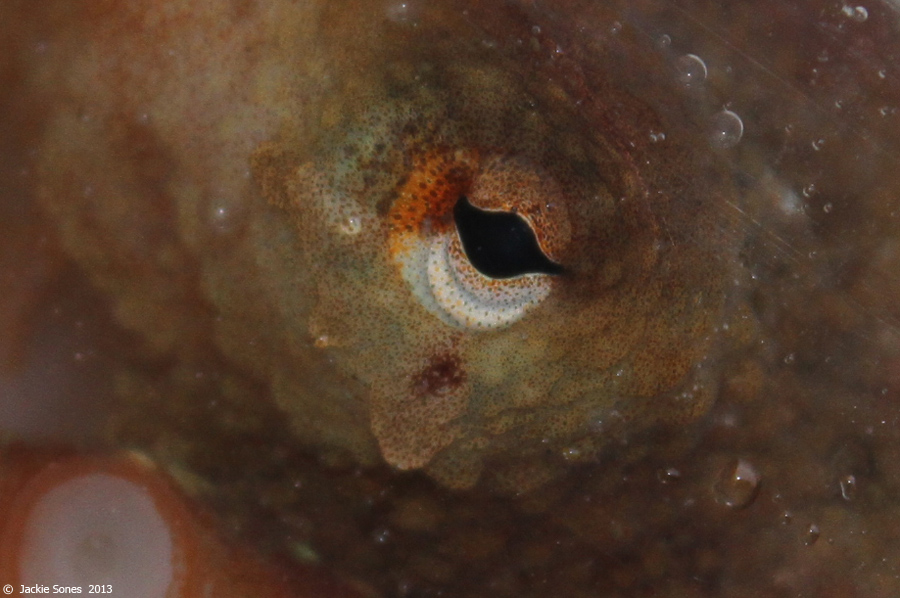
Here are two close-ups of several arms and an eye.


We were glad to see that the octopus appeared to be fine!  

Note the chromatophores surrounding the eye.  I introduced octopus chromatophores and showed some photos and videos of them in February.  If you haven't seen those yet, you can check them out here.

P.S.  I'm not certain, but it's possible that the octopus in this post is a juvenile Pacific Giant Octopus (Enteroctopus dofleini).