If you're interested in using any of these photographs or this content in any way, please contact me. Send an e-mail to naturalhistoryphotos(at)gmail.com. Thanks!
Showing posts with label octopus. Show all posts

Saturday, January 17, 2026

Hidden talent


Eric was doing some field work tonight (17 January 2026), but on the side he ended up with several great shots of an intriguing Red Octopus (Octopus rubescens).  

Above, note how well the octopus blends in with the background, matching the surrounding colors and textures. 

Below, a closer view from the side next to the sea anemone:


And a zoomed in view, highlighting that beautiful eye:


When the octopus changed position, it changed color and texture, this time matching some of the surrounding seaweeds and nearby animals.  And check out how it matched the color of the sponge in the upper right corner of the photo — the suckers are the same deep orange color as the sponge!
 
 
P.S.  With thanks to the octopus and to Eric for the great photos! 

Saturday, January 3, 2026

Shuttle service

 
We were working along the Bodega Harbor shoreline a couple of days ago when I noticed some movement out of the corner of my eye.  

Octopus!  

It was very high above the waterline, so Eric decided to pick it up and help it get closer to the water.

Two more views, including a close-up of the eye: 


I know most of 2026 is the Year of the Horse, but wouldn't it be fun if there was a Year of the Octopus?
 

Monday, September 29, 2025

Curiosity


Eye of an octopus 

Are you interested in the diversity of local marine invertebrates?  

If so, Eric is going to be giving a talk in the Science Uncorked series on Wednesday, October 1.

Come hear about "Spineless wonders: Exploring the tidepool animals of Bodega Bay" at Gourmet Au Bay in Bodega Bay at 6 p.m.

More info is available here.

Friday, July 11, 2025

Breathe in, breathe out


An unexpected surprise this morning (11 July 2025), a beautiful octopus in the low intertidal zone.  I only had a minute or two before it continued on, but it was a magical minute!

I managed a short video clip (see below, or click on the title of the post above to go to the NHBH web page to see the video player).  The octopus is drawing water into its mantle cavity (where it will then pass over the gills) and expelling water through its siphon.


Many thanks to Eric for editing the video clip!

Wednesday, June 25, 2025

Special find


Summer classes started at the Bodega Marine Laboratory this week, and with all of those keen eyes around, special things are bound to be found!  

Above, a small Red Octopus (Octopus rubescens) discovered this morning.

Thanks to James for spotting the octopus, which was observed for a short time in the field and then released. 

Sunday, January 12, 2025

Cephalopod break


We got lucky tonight -- we were busy doing surveys, but we heard someone nearby exclaim, "Octopus!"  So we took a short break and walked over to see this beautiful Red Octopus (Octopus rubescens).  

Love the green highlights!

And I'm always drawn to the spiraled arm tips and suckers.  So cool!

 
P.S.  Many thanks to the tidepoolers who alerted us to this octopus! 

Monday, April 1, 2024

Honu and he’e

Honu, or Green Sea Turtle (Chelonia mydas) photographed while snorkeling in Kaua’i on 1 April 2024.

Not only did Eric get lucky with a sea turtle today, he also photographed a beautiful he’e, or an octopus.  We’re not 100% sure, but it might be he’e mauli, or a Day Octopus (Octopus cyanea). Here’s a broad view showing the he’e under a ledge and an amazing close-up, highlighting the eye and the siphon:


With many thanks to honu and he’e, and to Eric for sharing such great photos!

Friday, January 12, 2024

Cephalopod surprise


We had to work late in the field tonight (time and tide wait for no one!), but we had a brief reward with an octopus sighting!  

P.S.  Thanks to the folks who spotted the octopus and to Eric for getting a photo!

Thursday, April 27, 2023

Octopus for lunch?


Octopus for lunch?  

A Turkey Vulture (Cathartes aura) feeding on a Giant Pacific Octopus (Enteroctopus dofleini) washed up on the beach on 25 April 2023.

Friday, December 30, 2022

Disappearing act


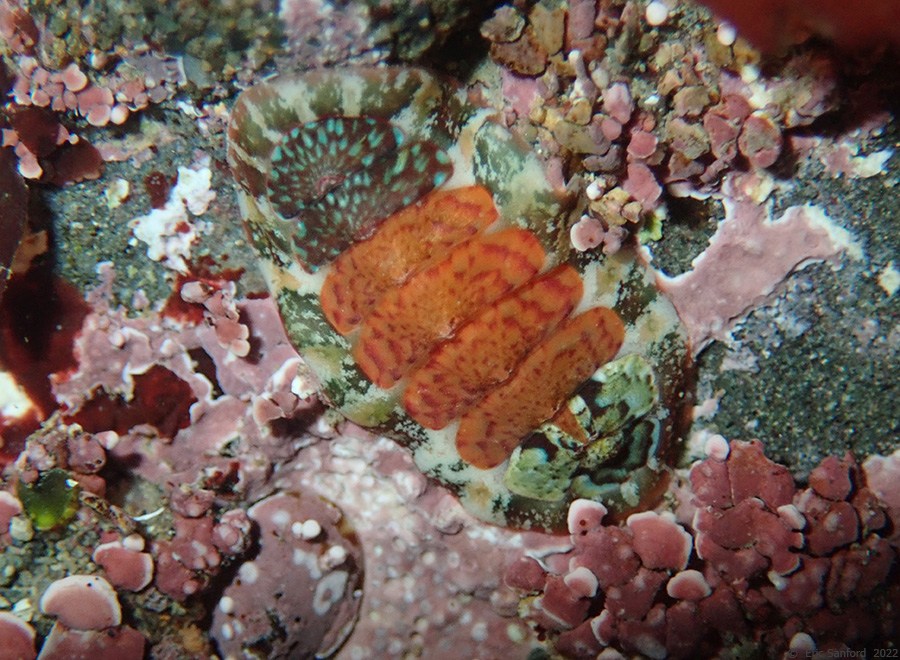
One of the most impressive features of many animals in the intertidal zone is the way their color patterns match their surroundings.  It makes it challenging for visual predators to spot them.  And it also requires an observer to slow down and let their eyes and mind adjust to the setting in the tidepool.  (Maybe we need a new phrase ="slow tidepooling"?)

We thought it would be fun to show some examples.  Above is a chiton (perhaps Lepidozona radians) note there are eight plates, but the middle four plates are orange, the front two plates near (head end) are flecked with brown and green, and the back two plates (tail end) are mottled.  These varied colors make it hard to identify this as a chiton at first.

Below is a small sculpin.  Check out the way the pink stripe running across its body matches the coralline algae patches on the rock.  And the other colors look like the surrounding rocks (grays and greens) and encrusting algae (deep maroon).  It also helps that sculpins often stay very still the lack of movement makes it less likely that they'll catch your eye:


The camouflage abilities of octopus are well known they can settle on a new substrate and blend in within seconds by adjusting pigment cells (chromatophores) in their skin.  Here's one looking a lot like a rock but also note how well the arms/tentacles on either side of the body have a different color and pattern than the main portion of the body.  It's hard to make them out!  (If you look closely sometimes you can spot the suckers on the underside of the tentacles.)


And here's one more an intriguing shrimp called a Deep-blade Shrimp (Spirontocaris prionota). (Hint: Look for the shrimp's eyes in the center of the photo.)  Not only do the colors of the shrimp match the coralline algae, but the shrimp also has small hairs (setae) that accumulate bits of debris that help it look "messy", making it less clear that this is a shrimp.

 
It takes some special attention to spot animals like this when they're so well camouflaged, but it's worth the extra time! 

ADDENDUM (31 December 2022) P.S.  To make it easier to find the octopus, here's an edited photo showing the outline and main features:


Thursday, December 22, 2022

Blue highlights


How lucky!  Eric found an octopus for my birthday!

Here's the entire animal from the other side.  Always amazing to see how well they blend in with the surrounding rocks and algae:


Tuesday, March 9, 2021

Surprise cephalopod


Yesterday (8 March 2021), Eric and I had to make a brief stop in Bodega Harbor (to look for a ribbon worm).  A family was nearby exploring the shoreline not too far away from us.  We could hear them talking about finding different animals like clams, snails, and sea squirts.  And then we heard one of them exclaim, "Octopus!"  

We paused our ribbon worm search and said a brief hello to the octopus that was walking across the mudflats and eelgrass towards the water.  We didn't expect to see an octopus that day, but were lucky when some fellow coastal adventurers spotted this wonderful cephalopod!

Thursday, October 15, 2020

Octopus as teacher


Recently, Paul passed along a movie recommendation.  I was so taken by the movie, that I'm passing along the recommendation to you!

If you haven't seen it yet, or if you'd like to see it again (because it's that good), check out "My Octopus Teacher."  [It's available online via Netflix.]


Friday, June 26, 2020

No octopus here

Okay, there's more to yesterday's octopus story.  After Eric spotted the first octopus, a few minutes later I looked down and noticed a second one!  The first octopus was fairly large for a Red Octopus, but the second one was quite small only ~2.5 cm across (with its arms pulled in).

Spread out on a cobble:


Among shells and stones:


Pretending to be a snail.  The octopus tucked in its arms, then crawled (slowly) across the rock, as if to say, "Nothing to see here...only a snail gliding along...no octopus in sight.  (Wink!)"


Thursday, June 25, 2020

Gr-eight-ful

After some field work this morning, Eric joined me at a different site, and no joke, within a minute he said, "Octopus!"  We hadn't seen an octopus since 2018, so we were excited to see one.  Below are several of my favorite shots from today (25 June 2020).  [You can click on the pictures for larger versions.]

Stretching out:


"Eye" see you (check out the beautiful chromatophores!):


Blending in (with coralline algae):


Tentacle spiral:


Suckers up-close (and once again, check out the amazing chromatophores just below the pink suckers they look like freckles in this photo): 


We are feeling very grateful for a few moments with a Red Octopus (Octopus rubescens) this morning.

Saturday, February 1, 2020

For 02/02/2020

Some sets of two for tomorrow's very special date02/02/2020.


Two Common Ravens (Corvus corvax)


Two Tolmie's Star Tulips (Calochortus tolmiei)


Two River Otters (Lontra canadensis


Two Red Octopus (Octopus rubescens) paralarvae 


Happy 2020 palindrome day!

Thursday, August 8, 2019

For 8/8


A small Red Octopus (Octopus rubescens), for 8/8!  This one was photographed back in February 2017.
 

Sunday, October 28, 2018

Let's go!


Okay, I can't help it, I have to help the home team celebrate.  Here's a photo for the 2018 World Series Championsthe Boston Red Sox!  

A red octopus with eight arms for a championship won on 28 October 2018. The Red Sox had 108 wins in the regular season.  And note that retired Red Sox great Carl Yastrzemski (#8) threw out the first pitch in Boston to start the 2018 series.

Yeah, Boston!  Let's go!

Tuesday, August 7, 2018

8 on the 8th

For everyone with an 8/8 birthday!

Close-up of an octopus eye:


And below is a short video clip that Eric took of the same octopus.  Watch for the following: a close-up of the octopus; then the octopus cleans its siphon with a tentacle (the siphon is a muscular tube that draws water into the mantle cavity for breathing); after that the octopus notices a crab nearby and then it jets across the tank and quickly envelops the crab with its eight tentacles and the webbing between the tentacles.  Throughout the video, watch for the flashing chromatophores (pigment cells) and striking color changes of this octopus!


Note: We're not totally sure about the identity of this octopus.  We think it might be a juvenile Pacific Giant Octopus (Enteroctopus dofleini).
 

Monday, July 2, 2018

Sitting on the doorstep


A tiny Red Octopus (Octopus rubescens) sitting at the entrance of an empty Brown Turban Snail (Tegula brunnea) shell.  It's hard to judge the size, but for perspective, the largest Brown Turban Snails are ~30 mm wide (~1 inch), which is a little larger than a quarter.  When curled up, this octopus was only about half that size!