If you're interested in using any of these photographs or this content in any way, please contact me. Send an e-mail to naturalhistoryphotos(at)gmail.com. Thanks!
Showing posts with label sparrow. Show all posts

Wednesday, February 19, 2025

White and gold


White-throated Sparrow (Zonotrichia albicollis) in our backyard in Cotati on 19 February 2025.

Tuesday, October 8, 2024

Nice red cap


Chipping Sparrow (Spizella passerina) on the University of Vermont campus on 7 October 2024.

Friday, December 11, 2020

My, what long toes!

 
A quick shot of a Fox Sparrow (Passerella iliaca) at our backyard bird bath.  I was struck by the length of its toes!
 

Wednesday, March 4, 2020

Have you been eating willow flowers?


Who me?

Golden-crowned Sparrow (Zonotrichia atricapilla), 4 March 2020
 

Tuesday, January 7, 2020

Vested


Lincoln's Sparrow (Melospiza lincolnii), an uncommon migrant and winter resident in the Bodega Bay area.  Note the narrow buffy "vest" and the relatively fine streaks on the upper breast and along the flanks.  Photographed on Bodega Head on 30 December 2019.

Saturday, November 17, 2018

Late afternoon baths

We haven't spent much time outside lately because of the wildfire smoke and poor air quality, but at times there have been quite a few birds visiting the water bath in our yard.  Here's a sampler (photos taken through the kitchen window on 17 November 2018).  [Click in the images for larger versions.]


Bushtit (Psaltriparus minimus)


Ruby-crowned Kinglet (Regulus calendula)


Townsend's Warbler (Setophaga townsendi)


Yellow-rumped Warbler (Setophaga coronata)


Fox Sparrow (Passerella iliaca)

Tuesday, October 2, 2018

With the passing rains

This morning I was interested to see that we received almost 2 inches of rain last night.  Some of the local birds took advantage of the puddles.  I was pleasantly surprised to see a Clay-colored Sparrow (Spizella pallida) among them:


Likely the same bird in a Coyote Brush shrub (Baccharis pilularis):


Not too far away, a Palm Warbler (Setophaga palmarum) was finding something to eat on the pavement:


And here's a view of the same bird on a nearby Bush Lupine (Lupinus arboreus):


Nice views during a brief walk through the parking lot!
 

Thursday, April 5, 2018

Welcome rain


White-crowned Sparrow (Zonotrichia leucophrys) bathing on 5 April 2018.  We often notice a lot of bird activity at the bird bath when it starts to rain.  I'm not exactly sure why?

Sounds like we're due for quite a bit of precipitation tomorrow.  We've received ~20 inches so far this winter, but the average annual rainfall total in this area is closer to ~31 inches, so a little more would be welcome!

Saturday, December 23, 2017

From Sable Island

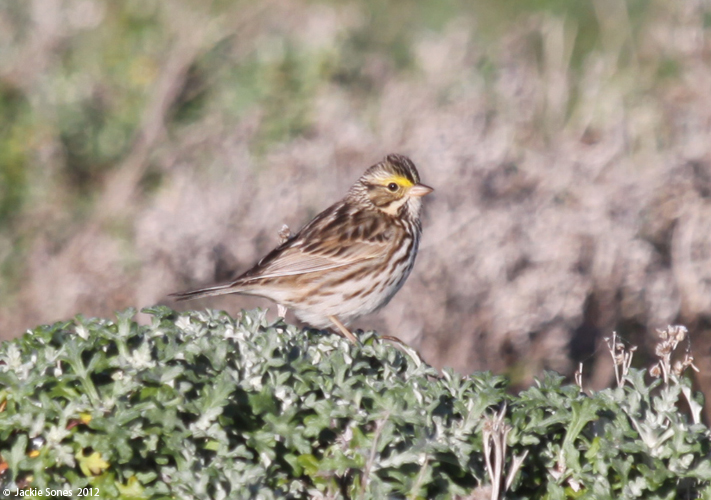
Just a few shots of "Ipswich Sparrows" (Passerculus sandwichensis princeps) at Duxbury Beach, Massachusetts, on 22 December 2017.

This is a subspecies of Savannah Sparrow that nests on Sable Island, Nova Scotia.  They winter in the Canadian Maritimes and along the East Coast (primarily in New England).  Note the relatively large size and pale coloration.


The sparrows were well camouflaged among the brown and gold salt marsh vegetation and silvery bits of ice:


We don't get to see "Ipswich Sparrows" in California, so I appreciated this opportunity to watch them for a little while.


Many thanks to Eric and my mom for spotting these sparrows along the shoreline!
 

Monday, November 27, 2017

Along the shoreline

A few more photos from Abbotts Lagoon on 24 November 2017:


Mixed flock of shorebirds (including Sanderling, Dunlin, Least Sandpiper, Western Sandpiper, and Long-billed Dowitcher)


Savannah Sparrow (Passerculus sandwichensis) blending in with the Jaumea (Jaumea carnosa) and Spike Grass (Distichlis spicata)


American Pipit (Anthus rubescens)
 

Monday, September 4, 2017

Something brewing


Brewer's Sparrow (Spizella breweri), photographed on Bodega Head on 2 September 2017.

I don't have much experience with this species, but I could tell it was different right away.  Compared with the resident White-crowned Sparrows, it was much smaller and paler.  Note the relatively subdued facial markings and the prominent white eye ring.

Brewer's Sparrow is a rare fall migrant in this area.  This is the first time I've seen one on Bodega Head.  I saw it briefly, snapped a few quick photos, and then it flew off to the east and I could not relocate it.

From the Birds of North America —

 "Most individuals breed in and around Great Basin and winter in Sonoran and Chihuahuan deserts of sw. U.S., w. Mexico (including Baja California peninsula), and Mexican Plateau."

Saturday, March 4, 2017

Rainy day


White-crowned Sparrow taking a bath in the rain today (4 March 2017). 

Tuesday, November 17, 2015

Striped grain-eater


Someday I'll get better pictures of a Lark Sparrow (Chondestes grammica), but I thought I'd share this one for now because it's such a pretty bird.  This species is rare on Bodega Head, but more common inland.

I ran into a flock of about 10-12 Lark Sparrows feeding on the ground at Crane Creek Regional Park on 15 November 2015.

I hadn't looked into the meaning of their scientific name before, so it was fun to learn that it means "striped grain-eater."  

The name is appropriate in that Lark Sparrows eat a lot of seeds (especially from grasses).  However, I was intrigued to learn that ~25% of their diet can be insects (primarily grasshoppers!).  [Diet facts from The Birds of North America Online.]

Sunday, January 4, 2015

The fourth Zonotrichia


Harris's Sparrow (Zonotrichia querula), spotted in the village of Salmon Creek on 3 January 2015.

This is a rare bird in Sonoma County, especially along the coast.  There are only about 18 records listed in the Birds of Sonoma County, and of those, only one is from Bodega Bay (in November 2004).  Interestingly, what appears to be a different Harris's Sparrow was documented at the Bird Walk Coastal Access Trail in late November 2014.

Harris's Sparrows breed in the forest-tundra zone of northern Canada and winter in the central Great Plains.

Note the black crown (with scaled patterning), black chin, pink bill, brown cheeks with a dark postocular (behind-the-eye) spot or chevron-shaped marking, and long tail.

Although this photo lacks something for scale, this is large sparrow.  At 18-20 cm (~7.5 inches) long, it is noticeably larger than its relatives in the same genus (White-crowned Sparrow, Golden-crowned Sparrow, and White-throated Sparrow).

I introduced the other three Zonotrichias in April 2012 — to compare, you can review that post here. 

P.S.  Many thanks to Peter for alerting me to the presence of this handsome bird!
 

Sunday, June 16, 2013

Of the meadows

Today I was very excited to catch up with an old friend.  


Before moving to California, I spent some time monitoring Grasshopper Sparrows (Ammodramus savannarum) in Rhode Island.  In 2005 I heard a Grasshopper Sparrow singing in a coastal grassland near Dillon Beach.  But today was the first time I've seen one in Sonoma County, very close to Bodega Head.

I was trying to photograph a butterfly in an open grassland and this sparrow flushed, flew to a nearby shrub, and started singing.  Although they breed along the West Coast from British Columbia to Baja California,  Grasshopper Sparrows are uncommon residents in Sonoma County, and they're currently listed as a Species of Special Concern in California. 

In the next photo, look for the following characteristics:  relatively small overall size, large bill, short tail, unstreaked breast, and yellow lores (patch between the bill and the eye).


The next two images were taken from farther away and are a bit out-of-focus, but they show a few more important field marks.  

Below, look for the bright yellow edge of the wing:


And with this next view, you can see the flattened head and pale central crown stripe:


The common name, Grasshopper Sparrow, comes from their song.  They sound a bit like a buzzy insect. (I started wondering if this is a general reference, or if there really is a certain grasshopper with a matching song?)

The scientific name reveals something about their habitat use.  "Ammodramus" means "to run on the sand" — I'm guessing this was not meant to be a strict interpretation, but a broader description of how these sparrows tend to run on the ground (and therefore are often found in grasslands that have scattered patches of bare ground).  The species name, "savannarum," means "of the meadows," and refers to their use of large open grasslands with sparse shrub cover.

Grasshopper Sparrows are just one of many reasons to preserve our native coastal prairies!

P.S.  If you'd like to hear it, the Cornell Lab of Ornithology has a good example of a Grasshopper Sparrow song.

Thursday, September 27, 2012

Migrant traps

In the 1960s, Rich Stallcup and C.J. Ralph discovered that outer Point Reyes is a "migrant trap."  In Rich's words (from the PRBO Observer, Fall 2009):

During periods of ideal "migrant weather" (light breezes from any direction except northwest and a high, even overcast), an amazing assortment of lost landbirds may gather in the oases of trees and brush that birders call "migrant traps." Because they travel at night, have overshot the coast, and are out of fuel, these off-course songbirds are returning to the continent from the sea. They are tired, thirsty, and hungry and so are attracted to the first vegetation available.

Bodega Head is also a migrant trap.  The prime areas to look for rare migrant songbirds include the trees and shrubs along the outer portion of Westshore Road — Owl Canyon, Campbell Cove/Hole-in-the-Head, and the cypress trees near the Bodega Marine Lab entrance road and Bodega Marine Lab housing.

The last couple of days have produced a number of rare sightings: e.g., American Redstart, Blackburnian Warbler, Blackpoll Warbler, Cape May Warbler, and Clay-colored Sparrow.

This morning I caught up with a few of them, and took photos of Blackburnian Warbler (Setophaga fusca) and Clay-colored Sparrow (Spizella pallida).

This first photo is a Blackburnian Warbler in a willow near Owl Canyon.  Note the dark ear patch behind the eye and the yellow throat.  (It's an immature bird, so not as bright as an adult in breeding plumage.)


The next photos were taken later in the day in the cypress trees near the entrance to the Bodega Marine Lab housing area.  (Many thanks to Dea for alerting me to this bird!)

In these photos you can also see the two white wing bars and a few dark streaks along the sides (below the wings).  All of the photos below show the same individual.  It's instructive to see how different it can look in various positions and lighting conditions.


The Clay-colored Sparrow was first spotted near Owl Canyon and then spent a little time across the road in the coyote brush along the Bodega Harbor shoreline.


This is a very pretty little sparrow.  Note the distinctive head pattern and the gray nape contrasting with the overall buffy plumage.


There were also a few regular migrants around, such as this handsome Townsend's Warbler (Setophaga townsendi).

This is a moth's-eye view!  (The genus, Setophaga, means moth-eater.)


P.S.  If you have a serious interest in Sonoma County bird records, I highly recommend Birds of Sonoma County California by Bolander & Parmeter, along with the recently published updated edition by Parmeter and Wight.

Tuesday, April 17, 2012

The three "banded thrushes"

Three sparrows in the genus Zonotrichia have been recorded on Bodega Head.  Zonotrichia means "banded thrush."  Although these sparrows are not true thrushes, the term was used in the past as a more general term for a songbird.  Banded probably refers to their distinctive head stripes.

To tell them apart, look for the overall size, the specific color pattern of black/white/yellow on the head (how many stripes there are, the width of the stripes, the presence/absence of yellow and where the yellow occurs).

Least common is the White-throated Sparrow (Zonotrichia albicollis) — a rare migrant and winter resident on Bodega Head.  I haven't seen one Bodega Head yet, but here's one I photographed in Sebastopol on 16 April 2012 (above).  Note the relatively thin black stripes, the bright yellow lore (between the eye and the bill), and the markedly white throat.
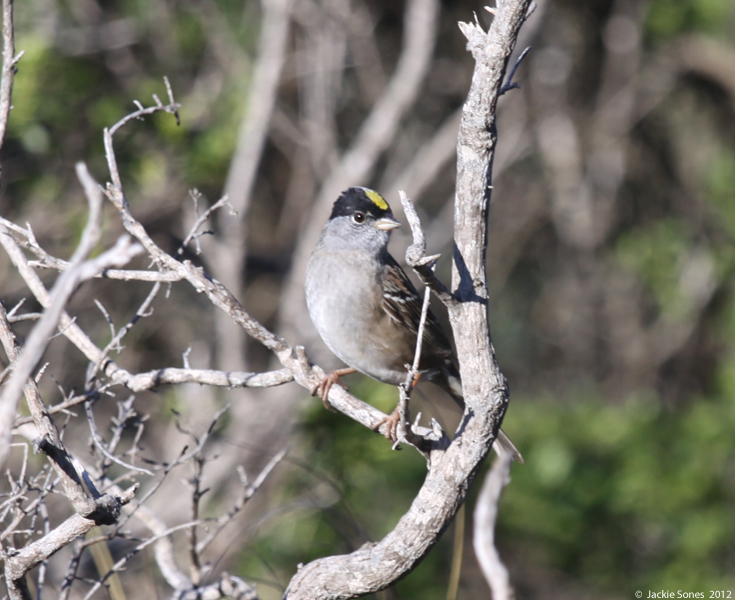

Golden-crowned Sparrows (Zonotrichia atricapilla) are relatively common winter residents on the Bodega Head peninsula (perhaps most common near the village of Salmon Creek, where these photos were taken on 14 April 2012).  The black stripe above the eye is very wide and there is a striking yellow crown (although it's not as bright in mid-winter).

Scientists at the Point Reyes Bird Observatory have recently published an article about migration in Golden-crowned Sparrows.  They used light-level geolocator tags to discover that birds wintering in Bolinas, CA, breed along the coast of the Gulf of Alaska during the summer.   

Here's a description of how the geolocators work: "GLS loggers record ambient light, from which sunset and sunrise times are estimated from thresholds in light curves; latitude is derived from day length, and longitude from the time of local midday with respect to Greenwich Mean Time and Julian day." (Phillips et al. 2004).

To read more about the PRBO study, check out the original article in PLoS ONE.  

 
White-crowned Sparrows (Zonotrichia leucophrys) are the most common of the three "banded thrushes" on Bodega Head and are the only ones that nest locally.  Note the strong black and white stripes (see below) and the lack of yellow in the lores and on the crown.


ADDENDUM (18 April 2012):

Claudia's comment below spurred me to add a couple of notes about Golden-crowned Sparrows.  You can listen to their three-part song here .  And a fun fact:  There is an interesting association between this song and the California Gold Rush.  Apparently, some miners thought the song sounded like, "No gold here."  See if you think so, too!  

Tuesday, February 7, 2012

Sparrows three

Of the 14 species of sparrows recorded on Bodega Head, three species nest here (the others are migrants, winter on Bodega Head and then move elsewhere to breed, or are vagrants to this area).

A bit of etymology: "sparrow" comes from the Indo-European "sper" and Anglo-Saxon "spearwa" meaning "flutterer".

White-crowned Sparrow (Zonotrichia leucophrys)
[Note the prominent black and white head stripes and unstreaked breast;
common among shrubs in grassland and dunes]


 Song Sparrow (Melospiza melodia)
[Note brown and gray head stripes and streaked breast with central spot;
common among shrubs in grassland and dunes]


Savannah Sparrow (Passerculus sandwichensis)
[Note bright yellow eyebrow stripe (especially in front of eye) and relatively short tail;
primarily found along coastal bluffs and in salt marshes]