If you're interested in using any of these photographs or this content in any way, please contact me. Send an e-mail to naturalhistoryphotos(at)gmail.com. Thanks!

Wednesday, November 25, 2015

Frosty


Brrrr!  The air temperature reached near 30°F this morning in Cotati.  It was fun to see these "frosty evergreen trees" on our windshield.  Do you see them?  (Or something different?)

Happy Thanksgiving to all!  Stay warm!

Tuesday, November 24, 2015

Good tidings

These pictures were taken at work today to document the "King Tide" on 24 November 2015.  The tide was predicted to reach about 6.58 feet at 8:56 a.m. this morning (which is a higher high tide for the Bodega Head region).  Tomorrow will be slightly higher = 6.66' at 9:38 a.m.  [For anyone who is curious, it looks like Dec. 24th will be the highest tide of the year = 6.68' at 9:18 a.m.]

I tried to capture a variety of shoreline settings.  See what you think!


Looking north along Salmon Creek Beach:


Looking south along the outer coast of Bodega Head:


Towards the south end of Horseshoe Cove: 


Gaffney Point salt marsh in Bodega Harbor.  Note that the salt marsh, between the foreground and the signs, is almost completely covered.  (That's the town of Bodega Bay and Mount Roscoe in the background.)


And one more, although not really of the high tide.  The light on the ocean was fantastic after the front passed through.  The wind was blowing ~25 mph from the north northwest:


P.S.  If you'd like to see another example of a local "King Tide," you can review the post from 13 December 2012.

Monday, November 23, 2015

Spiralling in


Channeled Top Snail (Calliostoma canaliculatum), photographed along the Bodega Bay shoreline on 23 November 2015.


Here's a view from the side as the snail was crawling.  The tentacles and a small dark eye are visible on the right side.  You can also see the foot speckled, with a fuzzy-looking texture.  And if you look closely, there's a partial view of the operculum ("trap door") golden and circular (although only half is in view below the back edge of the shell).


Here's one more view from below, when the snail was trying to right itself.


What a pretty foot!  And a beautiful snail.  I love the iridescence along the spirals.

Sunday, November 22, 2015

The small singer


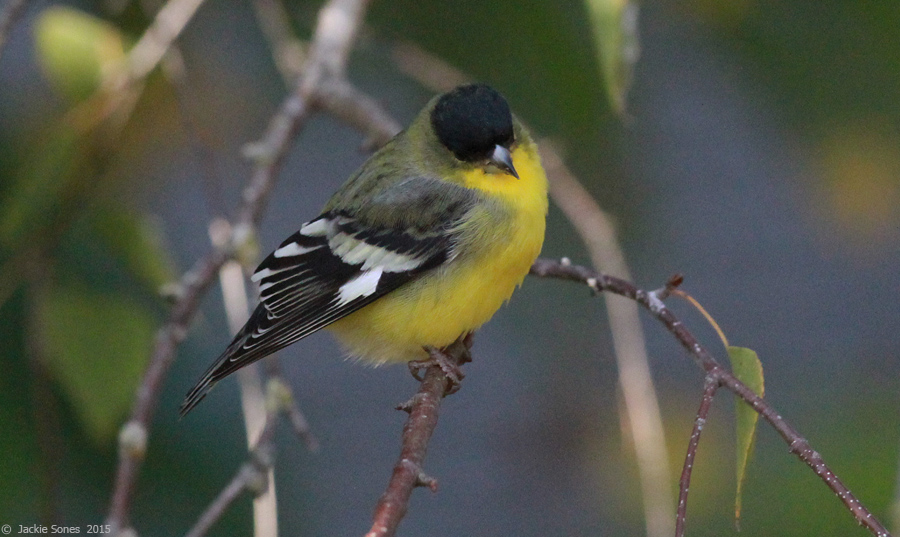
Lesser Goldfinch (Spinus psaltria) near the Lydia Park Community Garden in Rohnert Park on 22 November 2015.

A male is above, while a much paler female is below.


The "Lesser" in their common name refers to their small size about 1/2" smaller (in length) than an American Goldfinch. 

Someday I'll have to record the intricate song of Lesser Goldfinches.  Their species name, "psaltria", means "singer."

Saturday, November 21, 2015

To Catch an Acorn Thief

 
This afternoon we watched two striking Lewis's Woodpeckers (Melanerpes lewis) at Crane Creek Regional Park.

They spent some time hawking insects from the tops of trees providing nice views in flight:


We also watched one of the woodpeckers feeding on cached acorns in an oak tree:


Then we noticed that someone else was interested in the acorns, too:


Did you spot the Oak Titmouse at the top of the picture?


Here's a different view of the two species in one photo.  Can you find the titmouse?

(The titmouse is just right of center at the bottom of the image.) 


It was interesting to watch the woodpecker and the titmouse interact.  The woodpecker would remove an acorn from a crevice, then bring it to the horizontal branch to break it into pieces.  Sometimes the woodpecker would fly off before it had finished the entire acorn, and the titmouse would be waiting to sneak out to the branch to steal some "crumbs."  But the woodpecker was vigilant and protective.  As soon as it realized the titmouse was near the branch, the woodpecker swooped down to chase the titmouse away. 

Sure, the woodpecker had done all the work of finding and caching the acorns in the first place.  And the titmouse was behaving like a thief (or kleptoparasite).  But watching this, it was hard not to root for the titmouse, at least occasionally.

Although most of the titmouse's attempts ended in failure, here's what happened at least once:


Yes!  The Oak Titmouse was successful in securing a piece of an acorn. 

It made us wonder — How much time does the titmouse spend trying to sneak in for "crumbs"?  How much time does the woodpecker spend trying to defend its cache?  It also made us appreciate how highly valued acorns must be.

P.S.  If you're interested in seeing the Lewis's Woodpeckers, try walking the Creek Trail at Crane Creek Regional Park in Santa Rosa.
 

Thursday, November 19, 2015

Big and little


 So, a big Calidris and a little Calidris walk onto a sandbar...

Just kidding!

Two Red Knots (Calidris canutus) and a Sanderling (Calidris alba) along Salmon Creek Beach at sunset.  [There were at least three Red Knots feeding among the other shorebirds.]

Wednesday, November 18, 2015

Beamed across

Here's something interesting that washed up on Doran Beach:


Although it's hard to tell, this beam was about 7 feet long.

Can you see those holes in the end of it?  Do you know what kind of animal made the holes?

Here's a view of some of the smaller holes on the top of the beam:


The holes belong to "shipworms" indicating that the beam was at sea for a while.  Shipworms are actually not worms at all, but rather are marine bivalves small clams that tunnel through submerged wood.

I decided to share pictures of this beam and the shipworm holes because it might have an unusual origin.  Jim let me know that it's possible this is a piece of debris from the Japanese tsunami in 2011.  He's been involved with the Japanese Tsunami Marine Debris project, and there are characteristics of this beam that indicate a possible origin from the Tohoku coast of Honshu.  (An expert is working on identifying the shipworms — they might be a species from the Western Pacific called Psiloteredo.)

It's unknown when the beam washed up at Doran, or how it made its way across the Pacific Ocean, but it's amazing to think about such a long-distance journey.


P.S.  If you'd like to read a little more about shipworms, there's a Wikipedia article here.

P.P.S.  For more information about the Japanese Tsunami Marine Debris program, visit NOAA's web site.