If you're interested in using any of these photographs or this content in any way, please contact me. Send an e-mail to naturalhistoryphotos(at)gmail.com. Thanks!

Thursday, December 10, 2015

Swirls and splash

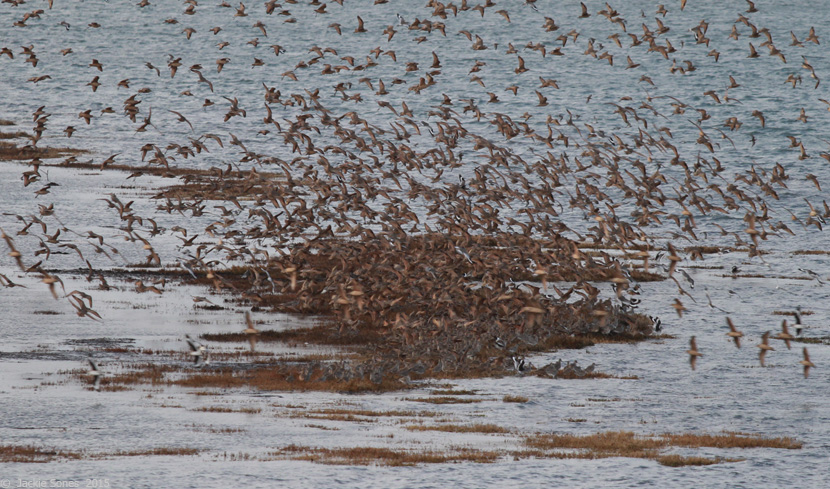
It was a +6.2' tide this morning.  (That's relatively high for Bodega Bay.)  On my way to the Bodega Bay Post Office, movement caught my eye.  Large flocks of shorebirds were swirling over the harbor.  

The nearby salt marsh was almost entirely flooded.  Hundreds of shorebirds were trying to fit on the few small islands of grass remaining above water:


On the outer coast, the swell was impressive, crashing against the rocks.  I think the waves were ~12 feet at this time:


Right now (at ~9 p.m.) wave heights at the Bodega Bay buoy are reading 24 feet! 

P.S.  For the record, there was a significant southward movement of loons this morning.
 

Wednesday, December 9, 2015

Striped barrels

Back on 12 November 2014, I showed an egg mass from a local snail that lives on the tidal flats in Bodega Harbor a Striped Barrel Snail (Rictaxis punctocaelatus).  

In that post, I mentioned that I had found the egg masses, but I hadn't found an adult snail yet.  That was true until December 4.  Once I learned how to see the adult snails, I realized that they're common to abundant in Bodega Harbor this year. 

Although most of the snails were buried just below the surface of the sand, here's an example of one that was crawling on the surface:


I've been doing shorebird surveys in Bodega Harbor for over 10 years now.  I hadn't encountered these snails until this year, so I'm wondering if there's something unusual about the conditions this year (or whether I just missed them if they weren't as common and I didn't know how to look for them).

But if you'd like to see some of these intriguing snails, this would be a good year to look for them in Bodega Harbor!

Sunday, December 6, 2015

"Shield up"

I think it was about 8 years ago when I first saw a Pear Marginella (Granulina margaritula).


This is a very small snail.  Pear Marginellas reach a maximum length of ~2-3 mm.  Here's a photo of the same snail, with more of the rock surface (and associated organisms) for scale:


I thought it would be fun to introduce you to this snail because it has "a trick up its sleeve."

Below is a close-up, showing the pale shell, the long foot (trailing behind the shell), and the anterior end with two tentacles, two dark eyes, and a gold-flecked siphon between the eyes.

Note also the edge of the mantle the darker band (brown and gold) along the margin of the shell.


When a Pear Marginella senses a predator, it extends its mantle to cover its shell.  The mantle offers protection — e.g., a slippery surface and release of toxic chemicals.

Below is a short video clip of a Pear Marginella encountering a predatory sea star.  First you will see the snail exploring on its own.  Then you'll notice a portion of a sea star arm (with tubefeet) in the left corner.  Watch the snail raise its mantle up over its shell.  The slippery surface acts as a shield, likely making it difficult for the sea star's tubefeet to hold onto the snail's shell.  (Later, the snail also starts "running away" from the sea star very quickly!)

There's a bonus: The mantle is beautiful!  Brown, with orange, gold, and blue flecks. 


Pear Marginellas aren't the only snails that cover their shells with their mantles for defense, but they're certainly one of the prettiest!

P.S.  The "Pear" in the common name comes from the shape of the shell.  But I also love the translation of its scientific name "Granulina" means "little pearl." 

Saturday, December 5, 2015

Gray and white


Snowy Plover, Dillon Beach, 5 December 2015

Friday, December 4, 2015

White peaks


12-foot northwest swell, with east winds at about 5-10 knots 


Photographed from Bodega Head on 4 December 2015

Wednesday, December 2, 2015

Olive's in Sonoma County


Tonight I'm very excited to share such a beautiful nudibranch with all of you. 

While conducting surveys on 25 November 2015, Eric spotted two of these Olive's Aeolids (Anteaeolidiella oliviae) in the low intertidal zone at Pinnacle Gulch.

Olive's Aeolid is generally a southern species.  In fact, it appears that it reaches its northern limit in Mendocino County.  Although there were at least two observations of this species in Sonoma County (Coleman Beach and Shell Beach) and one observation in Mendocino County (Fort Bragg) earlier in the year, I haven't been able to find any records further north.  As with Hilton's Aeolid, the presence of Olive's Aeolid in Sonoma County this year may be associated with recent warm water conditions along our coast.

Some of this nudibranch's features are easy to see the orange cerata (projections on its back) and the darker rhinophores (sensory organs).  Here's a close-up of the cerata (below).  Note that they have pale tips.


This next photo also shows the white speckles on the body, and two small black eyes behind the rhinophores.  (And note that the rhinophores, like the cerata, also have white tips.)


Eric was also able to shoot a short video of this nudibranch.  This individual was ~2 cm long.  Because they're rare this far north, we felt lucky to encounter Olive's Aeolid.  We hope you enjoy learning about it as much as we did!

anteaeolidiella oliviae sanford from Jackie Sones on Vimeo


P.S.  CORRIGENDUM (3 December 2015): I updated the distribution description above to reflect a record from Mendocino County.

Tuesday, December 1, 2015

Do you like my spots?


A mystery close-up for you.  Above is a highly magnified view.  The next two images show the upper portions of the branched tentacles:


The following three images provide views of the body.
 

The anterior (front) end, with tentacles retracted:


The mid-section: 


The posterior (back) end:


These pictures serve as an introduction to a wonderful sea cucumber, Pentamera pediparva!

This is a northern species with a reported geographic range of British Columbia to northern California.  We are trying to learn more about this species, but this could be the first record south of Eureka, CA.

Do you remember that sea cucumbers have small, calcified plates called ossicles embedded in their skin?  They're the shiny pieces visible in the first photograph of this post.  The ossicles have very distinctive shapes and are important for species-level identification.

Here's a look at some isolated ossicles from this sea cucumber.  The top photos (blue background) are from the tubefeet, while the bottom photos (gray background) are from the skin.  We were uncertain about the identity of this cucumber until we saw these ossicles and matched them with a diagram:


Below is an illustration of Pentamera pediparva ossicles.  Compare their shapes with the photos above:

 Modified from Sea Cucumbers of British Columbia, Southeast Alaska and Puget Sound (Lambert 1997). 


We're very excited about the possibility of documenting a new site for this little-known sea cucumber.  Eric discovered it on a low intertidal boulder along the Bodega Bay shoreline on 11 November 2015.


P.S.  Hello to Casey and other sea cucumber enthusiasts!