If you're interested in using any of these photographs or this content in any way, please contact me. Send an e-mail to naturalhistoryphotos(at)gmail.com. Thanks!
Showing posts with label salt marsh. Show all posts

Wednesday, July 8, 2026

Seeing lavender


Sea Lavender (Limonium californicum) flowers, 7 July 2026

Thursday, December 11, 2025

On a lark


It was a cold and windy day here in Scituate, Massachusetts, but we went for a short walk this afternoon (11 December 2025) and caught up with a small flock of Horned Larks (Eremophila alpestris).

I love how the russet tones in their feathers match the colors in the salt marsh at this time of year (above).

We also saw a few Horned Larks in a rocky area and it was fun to see how well they blended in with the rocks...although check out those beautiful golden head and throat markings!


One more photo, as I always appreciate when you can see a little more of an animal's behavior — in this case, searching for seeds among some of the upper marsh plants:


Monday, December 12, 2022

Blending in

 
During an afternoon walk in Humarock, MA, we came across a large flock (>100) of Snow Buntings (Plectrophenax nivalis).  We saw them in different settings — resting among cobbles, feeding in the wrack line, flying over the salt marsh.  I'm still sorting through photos, but here are some my favorites so far:


Tuesday, February 1, 2022

To start and end the day


Morning light at flood tide in Bodega Harbor on 1 February 2022.

 And then later...


Peregrine Falcon (Falco peregrinus) overhead, and in silhouette at sunset:


P.S.  I've heard that there have been some issues with the e-mails being sent out from the Natural History of Bodega Head.  (Thanks for letting me know!).  Unfortunately, I'm not sure when I'll have time to resolve that problem, so for now if you're interested in seeing new posts, you can go directly to the NHBH website: https://bodegahead.blogspot.com. I realize that the e-mails are a convenient way to get updates, so I apologize that that option isn't, well, an option right now.  Oh if only I could snap my fingers or sprinkle fairy dust to fix technology issues!

Wednesday, March 17, 2021

Flowers and fruit


On 15 March 2021, I was introducing a student to a few different wetland habitats.  When we walked by a salt marsh, I was a little surprised to see Seaside Arrow-grass (Triglochin maritima) in bloom already.  In fact, we were admiring some of the purple flowers when I noticed others that looked paler (see below) and realized that some plants were already past flowering and producing fruit!   

 
Many of the plants in local salt marshes flower later in the season, so we often botanize in salt marshes in June.  I haven't spent much time looking for flowering plants in this habitat during the late winter/early spring, so it's good to know that this species starts its season much earlier.

Tuesday, August 25, 2020

Ruff around the edges

Last night I heard that Dea found a Ruff (Calidris pugnax) near the entrance pond at Doran Beach.  Ruffs are rare migrants in Sonoma County.  They typically breed in northern Eurasia and winter mainly in Africa.  So when I went to the post office today (25 August 2020), I swung by to see if it was still around.  Luckily, it was!

Here's a series of photos.  This juvenile Ruff spent most of its time feeding in shallow salt marsh pools, but it paused a few times to preen and rest.

Check out the beautiful buffy edges to the feathers:


Sometimes Ruffs walk in a very upright position:


Although it was feeding in the pools a lot (probing in the water), it also spent some time in the pickleweed along the edges of the pools:


I didn't get a great photo of the Ruff in flight, but when it was preening you could see hints of the white U-shaped band on the rump (at the base of the tail feathers):


There were quite a few Red-necked Phalaropes (Phalaropus lobatus) feeding in the same pools, so here's one shot with the Ruff and a phalarope in the background:
 

I think I first wrote about Ruffs in 2012, so to learn more about them check out the post called "Ruff day at the beach" from 30 April 2012.

Many thanks to Dea for spotting this bird and spreading the word!
 

Tuesday, August 4, 2020

Not quite done yet


Nice to see some color in the salt marsh — Sea Lavender (Limonium californicum), 3 August 2020.
 

Tuesday, December 24, 2019

Winter scenes

Winter scenes from the last few days in New England...

Salt marsh in Duxbury:


Snow Bunting habitat:


Frozen ripples in a stream:


 Icy sea dragon?  :)


Happy holidays, everyone!

Friday, October 4, 2019

Coastal scenes

A few more coastal scenes from our visit to Cape Cod and the South Shore of Massachusetts:

From Chatham:


From Provincetown (including wild cranberries):


From Humarock:


Friday, August 23, 2019

Phalaropes and friends


There are still quite a few Red-necked Phalaropes (Phalaropus lobatus) in Bodega Harbor.  When leaving work tonight, we noticed this group in a salt marsh pool.  Much of the water had drained out, so the phalaropes were very concentrated.  (There are over 65 phalaropes in the photo above.)

Some other shorebirds joined the phalaropes, and since it's always helpful to have views of species next to each other, here are a few examples.  See if you can spot the birds that look different than the phalaropes.  [You can click on the images for larger versions.]


A Least Sandpiper (browner) and two Western Sandpipers (pale gray) on the mud behind the phalaropes.


A Least Sandpiper (browner, far left) and two juvenile Western Sandpipers (upper right) behind the phalaropes.


Two Semipalmated Plovers (foreground left, and center) and two Least Sandpipers (far right, and third from left in upper group). 

P.S. The entry ponds at the start of Doran Beach are also a great spot to check for phalaropes.

Sunday, July 8, 2018

Urchin flower?


Doesn't this flower look like a tiny purple sea urchin?

Here's a zoomed-out view:


This is an arrow-grass (Triglochin sp.), a species that grows in our local salt marshes.  I didn't have much time, and I was so focused on the flowers that I didn't confirm which species of arrow-grass, so I'll have to double-check and report back. 

P.S.  I showed Seaside Arrow-grass (Triglochin maritima) in flower last year — see "Sparkling, frilly edges" on 26 June 2017.
 

Sunday, July 2, 2017

Halophytic and hemiparasitic


Point Reyes Salty Bird's-Beak (Chloropyron maritimum ssp. palustre), photographed in Bodega Harbor on 21 June 2017.

This one is salty!  Can you see the salt crystals on the deep maroon floral bracts?

This annual wildflower is a halophyte — it grows in saline environments, e.g., in this case, the upper edge of salt marshes.

It's also a hemiparasite — similar to mistletoe, it obtains some of its nutrients from nearby plants.
  

Monday, June 26, 2017

Sparkling, frilly edges

This is one of my favorite flowers on Bodega Head.  Do you want to guess which species this is?


I'll zoom out a bit, so you can see a little more:


It might be helpful to know where this species grows.  In this area, we find it along the coast, especially in salt marshes.


From a distance, the flowers of Seaside Arrow-grass (Triglochin maritima) might not stand out.  Up close, it's a different story.  Purple with sparkling, frilly edges — Oh, my!

P.S.  Usually Seaside Arrow-grass is tall and straight.  This Dr. Seuss-like version is somewhat unusual, but it was fun to see!

Friday, August 26, 2016

Evening high tide


Evening high tide in the salt marsh, Scituate, MA, 26 August 2016
 

Thursday, December 10, 2015

Swirls and splash

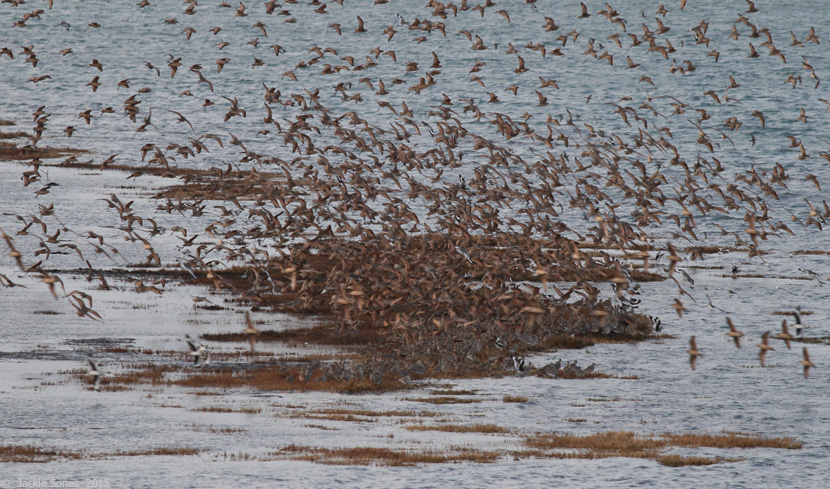
It was a +6.2' tide this morning.  (That's relatively high for Bodega Bay.)  On my way to the Bodega Bay Post Office, movement caught my eye.  Large flocks of shorebirds were swirling over the harbor.  

The nearby salt marsh was almost entirely flooded.  Hundreds of shorebirds were trying to fit on the few small islands of grass remaining above water:


On the outer coast, the swell was impressive, crashing against the rocks.  I think the waves were ~12 feet at this time:


Right now (at ~9 p.m.) wave heights at the Bodega Bay buoy are reading 24 feet! 

P.S.  For the record, there was a significant southward movement of loons this morning.
 

Wednesday, September 30, 2015

Between showers

It was a rainy day on the Outer Cape, but we had a few interesting observations between showers:


Salt marsh near Boatmeadow Creek in Eastham, with Cape Cod Bay in the background


In the late afternoon, we walked the edge of a different salt marsh near Uncle Tim's Bridge in Wellfleet.  Along with the beautiful colors of the grasses in Duck Creek, we came upon the following:


Juvenile Mud Fiddler Crab (Uca pugnax)


 Egg shells of a Diamondback Terrapin (Malaclemys terrapin)


Hundreds of small, silvery fish at the upper edge of the marsh.  Perhaps they were stranded by the high tide?  

Here's a close-up:


My best guess on the identity of this fish is a juvenile Menhaden (Brevoortia tyrannus) — growing up, we called them Pogies.  If you can confirm, or have a different guess, let me know.

I didn't get any pictures, but we also had nice views of terns, jaegers, shearwaters, and Gray Seals off Lecount Hollow Beach in Wellfleet.

Not too bad for a stormy September day!