25-30 mph northwest winds and whitecaps as far as you can see. Off Bodega Head on 5 June 2020.
If you're interested in using any of these photographs or this content in any way, please contact me. Send an e-mail to naturalhistoryphotos(at)gmail.com. Thanks!
Friday, June 5, 2020
Wednesday, June 3, 2020
What?
Recently I was trying to photograph some very small bees. When I'm doing this, I'm often following the blur of a bee in flight. I can't see any detail; I just try to follow the bee until it lands and then focus the lens.
This time I was surprised. First, because this one turned out to be a fly, not a bee. And second, because the fly started to oviposit (lay eggs) in a Yarrow (Achillea millefolium) leaf! What?
In the photo above, the fly has curled her abdomen tip down into the leaf. This is a classic egg-laying position for many insects.
Here's what she looked like with her abdomen extended:
I don't think I've noticed a fly ovipositing in a leaf before, but then again, I don't think I've ever tried to find one doing it, either.
Tuesday, June 2, 2020
Keeping an eye out
I've been sitting outside tonight and just listening, so I haven't had much time to think about a post. But here's a recent Black Oystercatcher photo. I liked the morning light on the high intertidal seaweeds. [You can click on the image for a larger version.]
Please keep an eye out for each other.
Labels:
algae,
bird,
eyes,
light,
oystercatcher,
seaweed,
shorebirds
Monday, June 1, 2020
A family visit
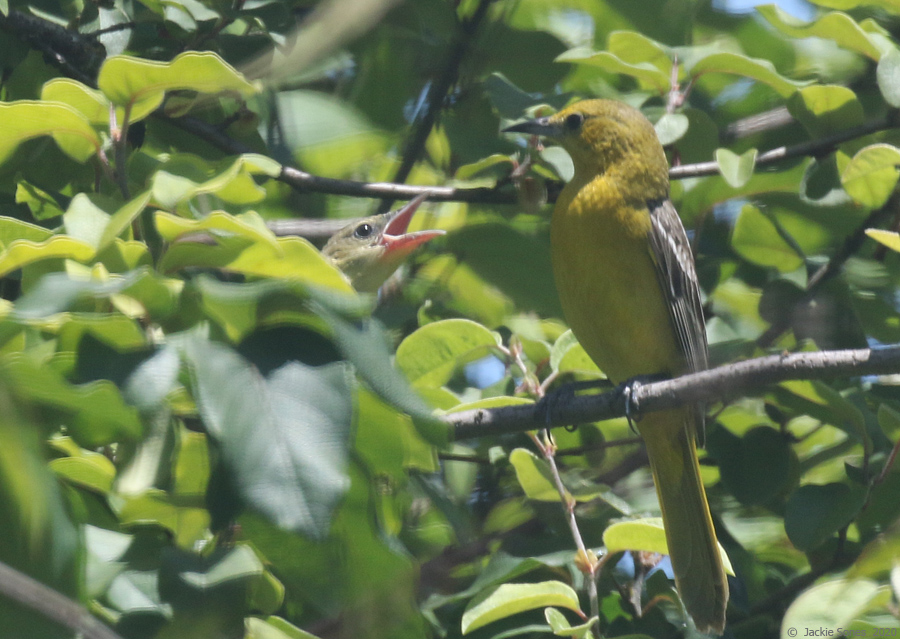
This morning we noticed the flash of a medium-sized bird flying into the plum tree in our backyard, but then we didn't see additional movement after that. Curious, Eric picked up the binoculars and looked around. Here's what he saw hiding among the leaves:
Hmmm...can you tell which species this is?
Here's another view when it flew out into the open:
A hint: We've been seeing the adults of this species in our yard recently, so I've posted photos of an adult female and adult male during the past 12 days.
Perhaps a view from the side will help:
Although paler than the adults, and the bill is shorter in comparison (as well as being pink and gray, rather than black with a blue highlight), perhaps you've guessed that this is a juvenile Hooded Oriole (Icterus cucullatus)?
We think there were two or three juveniles spending time in our yard this morning. They seemed quite interested in the flowers of a Pineapple Guava tree. At one point, I noticed one of the juveniles actively begging from the female:
Another bird family to add to our yard list this year!
Sunday, May 31, 2020
Friday, May 29, 2020
Perched on the hood
I know I've shared some oriole photos recently, but I can't help show one more that was taken today (29 May 2020).
The local male oriole was landing in different places in our backyard and then came to rest on one of our favorite garden statues. In all of our years with this little wizard, we've never seen a bird perched on its head.
How wonderful to see a Hooded Oriole on the hood of the little wizard!
The local male oriole was landing in different places in our backyard and then came to rest on one of our favorite garden statues. In all of our years with this little wizard, we've never seen a bird perched on its head.
How wonderful to see a Hooded Oriole on the hood of the little wizard!
Thursday, May 28, 2020
Subscribe to:
Posts (Atom)