If you're interested in using any of these photographs or this content in any way, please contact me. Send an e-mail to naturalhistoryphotos(at)gmail.com. Thanks!
Showing posts with label oriole. Show all posts

Monday, June 15, 2020

Oriole views

The Hooded Orioles have continued to visit our yard, so I've compiled some recent shots of the juveniles (there are three).

They seem especially attracted to the flowers of the Pineapple Guava tree:


They young orioles are also drawn to the water bath, but they're still trying to figure it out:


This is one of my favorite views (below), perhaps because you don't often get to watch songbirds sleeping and because the light on the feathers is interesting.  

Sometimes the juvenile orioles find a quiet place to take a nap.  Here's a zoomed in view of one of the juveniles with its head turned and its bill tucked under the feathers on its back:


It's been a treat to watch and listen to this family in our backyard!

Monday, June 1, 2020

A family visit

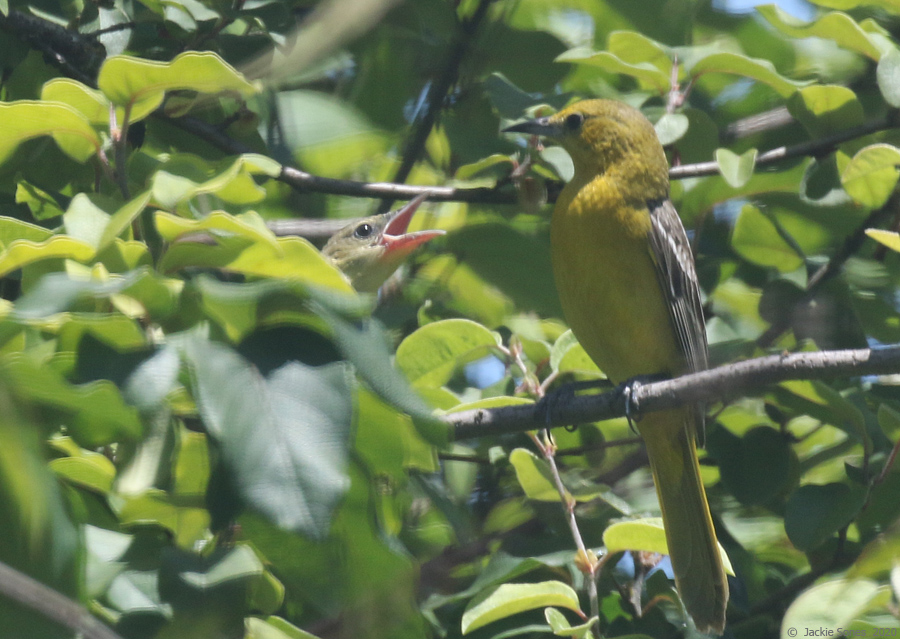
This morning we noticed the flash of a medium-sized bird flying into the plum tree in our backyard, but then we didn't see additional movement after that.  Curious, Eric picked up the binoculars and looked around.  Here's what he saw hiding among the leaves:


Hmmm...can you tell which species this is?


Here's another view when it flew out into the open:


A hint: We've been seeing the adults of this species in our yard recently, so I've posted photos of an adult female and adult male during the past 12 days.

Perhaps a view from the side will help:


Although paler than the adults, and the bill is shorter in comparison (as well as being pink and gray, rather than black with a blue highlight), perhaps you've guessed that this is a juvenile Hooded Oriole (Icterus cucullatus)?

We think there were two or three juveniles spending time in our yard this morning.  They seemed quite interested in the flowers of a Pineapple Guava tree.  At one point, I noticed one of the juveniles actively begging from the female:


Another bird family to add to our yard list this year!

Friday, May 29, 2020

Perched on the hood

I know I've shared some oriole photos recently, but I can't help show one more that was taken today (29 May 2020).  

The local male oriole was landing in different places in our backyard and then came to rest on one of our favorite garden statues.  In all of our years with this little wizard, we've never seen a bird perched on its head.  

How wonderful to see a Hooded Oriole on the hood of the little wizard!


Sunday, May 24, 2020

Cooling off

It was warm in Cotati today (24 May 2020), with air temperatures reaching the high 80s.  In the late afternoon a male Hooded Oriole (Icterus cucullatus) visited our backyard water bath:


Here's a close-up where you can see the decurved bill and the pretty light blue color at the base of the lower mandible:


Tuesday, May 19, 2020

Fleeting

Although we often hear Hooded Orioles (Icterus cucullatus) in our neighborhood, when they stop in our yard, their visit is usually fleeting.  I've had a hard time getting photographs of them.

Recently an oriole has been coming to our water bath, so Eric prodded me to stage my camera nearby so that I was prepared as soon as she arrived.

VoilĂ !  


In Cotati on 19 May 2020.

Thursday, July 25, 2019

At the top of the oak


Hooded Oriole (Icterus cucullatus), 25 July 2019
 

Sunday, May 6, 2018

Boundaries

We've been hearing Hooded Orioles (Icterus cucullatus) around our yard recently.  I was curious about why they were being so vocal, so I looked around a bit.  

I followed some loud chattering to an adult male:


Then I followed his line-of-sight, and some slightly fainter chattering, to a pair of orioles in the distance:


This is an immature male Hooded Oriole (on the left; note the black throat) and a female (on the right).  Perhaps the adult male and this pair were "discussing" the boundaries of their territories?

Sunday, July 24, 2016

Yellow in the orange


This female Hooded Oriole (Icterus cucullatus) has been visiting a citrus tree in our backyard in Cotati.  She's very secretive, so it's been difficult to get a picture.  In the early evening, we are alerted to her arrival by soft "chut chut chut" notes.  I'll have to try to record them.

P.S.  To see a photo of a male Hooded Oriole in the same tree last year, see "Orange in the orange" on 18 June 2015.
 

Thursday, June 18, 2015

Orange in the orange


This Hooded Oriole (Icterus cucullatus) has been visiting our yard in the evenings.  He's shy, so I haven't been able to get a better picture yet — this was my first.

I was curious about the species name — cucullatus.  Quite appropriately, it means "hooded."  When I was searching for the meaning, I realized there were quite a few birds, and other organisms, with "cucullatus" in their name.

This is tough, unless you're familiar with the scientific names of birds.  Can you think of other birds named cucullatus?  Or here's a small hint: other birds that are hooded?

- Hooded Merganser (Lophodytes cucullatus)
- Dodo (Raphus cucullatus)
- Village Weaver (Ploceus cucullatus)
- Bronze Mannikin (Spermestes cucullatus)

I suppose it's not surprising, but I also noticed many other species with cucullatus in their name — fungi, flowers, snakes, a grasshopper, a beetle, and a copepod.

Fun!

I hope the oriole comes back for another visit.

Wednesday, May 27, 2015

Enjoying the flowers


Well, these pictures don't do this bird justice, but because Baltimore Orioles (Icterus glabula) are rare in Sonoma County (there are only ~7 records), and because this is the first one I've seen on Bodega Head, it seemed worthwhile to post a couple of pictures.

And, if you're interested in seeing this bird, it might still be possible.  It seemed drawn to the eucalyptus flowers (see below), so perhaps it will stick around for a little while.


Photographed in Owl Canyon on 27 May 2015.

P.S.  Madrone Audubon has a map showing Owl Canyon.  And Colin Talcroft has provided an aerial view with a written description.

Wednesday, August 6, 2014

Bullock's

Yesterday I thought I might have seen a Purple Martin on Bodega Head, but I wasn't certain.  So today I searched the same area again.  I didn't find a martin, but I came across two orioles.  Since Bullock's Orioles (Icterus bullockii) are rare migrants on Bodega Head, here's a picture of one of them (photographed on 6 August 2014):

Wednesday, January 16, 2013

Color in winter


How lucky we are that Townsend's Warblers overwinter on Bodega Head.  It's always nice to see them — small, bright flashes of intense yellow among the Coyote Brush (Baccharis pilularis).

This may seem random, but the bright coloration reminded me of a couple of other animals I saw this past weekend.


Young male Bullock's Oriole (Icterus bullockii) in the shrubs below Diekmann's Store in Bodega Bay on 12 January 2013.  (It was first reported there on 11 January 2013).  It's rare for Bullock's Orioles to winter here.


I liked the deep orange patches on the plates of this chiton.  It might be Mopalia ciliata, but I'm not certain.  Microscopic examination is required to confirm the identity of most species in this genus.  But it's still easy to appreciate the colors on its plates (including the narrow, jagged brown and green stripes) and the lavender girdle (the fleshy portion encircling the chiton).

[If you look around the photo, you may find a few other animals: a snail (Nucella ostrina), barnacles, and tiny spirorbid tube worms (upper right corner).  And if you're really careful, perhaps you'll discover a nemertean or ribbon worm — it's tough to see, but look to the left of the chiton; the ribbon worm is long, slender, and silvery gray.  More about them in future posts!]