If you're interested in using any of these photographs or this content in any way, please contact me. Send an e-mail to naturalhistoryphotos(at)gmail.com. Thanks!
Showing posts with label calidris. Show all posts

Tuesday, January 21, 2025

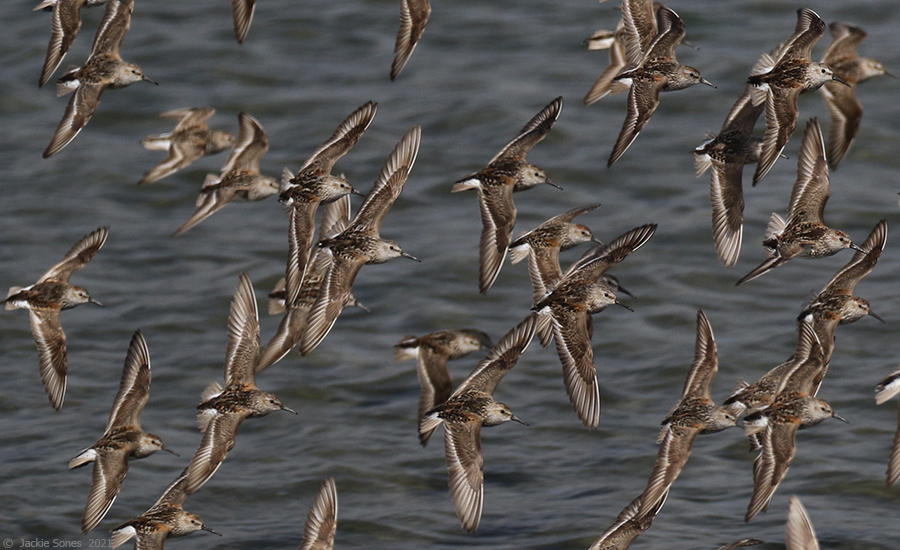
Flocking together


Part of a large flock of shorebirds in Bodega Harbor this morning (21 January 2025) -- mostly Sanderling (Calidris alba) and Dunlin (Calidris alpina), with some Least Sandpipers (Calidris minutilla) and Western Sandpipers (Calidris mauri) mixed in.


Monday, September 11, 2023

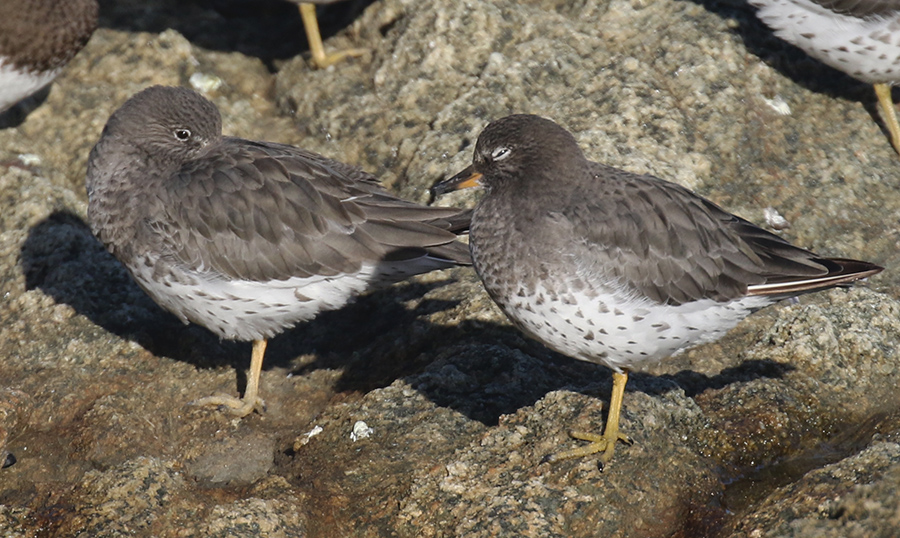
Side by side

 
A couple of days ago I noticed a few shorebirds in the distance on the rocky shore.  At first I thought all three were going to be Wandering Tattlers (Tringa incana), but with a closer view I could see that one of the birds looked different.

You can compare the two species in the photos above and below.  Note the shade of gray, the amount of pale feather edging, the facial markings around the eye, and the bill length and thickness.  In the photo below you might also be able to compare the leg color.


I usually encounter Red Knots (Calidris canutus) on the tidal flats in Bodega Harbor, so I haven't seen these two species side by side very often. 

The Wandering Tattler is darker gray, shows more subtle pale feather edges (so looks less "scaly"), has more substantial white markings encircling the eye, has a slightly long and thicker (less tapered) bill, and has yellower legs.

The Red Knot is paler gray, has extensive pale feather edges (so looks very "scaly"), has more subtle markings around the eye (but does have a dark line through the eye and pale line above the eye), has a slightly shorter and more tapered bill, and has greenish-yellow legs.

Now I'll show one photo of each so you can guess which is which:


Nicely done!  The first of the two photos shows a Red Knot and the second shows a Wandering Tattler.  Both of these birds are juveniles. 

Although knot so obvious from a distance, now that you know what to look for, it will be easier to help anyone who is wandering how to tell these juvenile shorebirds apart.  ;)

Tuesday, September 6, 2022

Lingering


We lingered at the coast for a little while after work today (6 September 2022).  The tide was pretty high, but there were some shorebirds gathered along the harbor side of Doran Beach.  Above, a shorebird flock mostly made up of Western Sandpipers (Calidris mauri) but there's one Least Sandpiper (Calidris minutilla), too.  [Look for the one with the brownest back.]

And below, a Pectoral Sandpiper (Calidris melanotos) was feeding on the flats.  It's the bird on the far right.  There are two Semipalmated Plovers (Charadrius semipalmatus) in the center and on the left, and a Least Sandpiper on the foreground.


Wednesday, November 10, 2021

Afternoon nap

 
Surfbirds (Calidris virgata), Bodega Head, 10 November 2021
 

Saturday, September 25, 2021

Tucked in


Young Western Sandpipers (Calidris maurii).

Fun to see how well they blend in with various shades of granite:


A portion of a large flock that landed on the rocky shore and did some preening and resting in the high intertidal zone:


Saturday, August 21, 2021

That's more like it


Earlier this month, I was looking at a sandpiper and initially wondering if it might be a Baird's Sandpiper (Calidris bairdii).  It turned out to be a Sanderling, but today I found a definitive Baird's, so here you go!

Baird's Sandpiper — in the wrack line (above), walking along the sand, and probing for amphipods.  Photographed on 21 August 2021.


Monday, August 2, 2021

Coastal visitor

At the end of the day today (2 August 2021), I was helping Eric prepare for class tomorrow when I spotted a small group of shorebirds including a sandpiper that I thought could be a Baird's Sandpiper (Calidris bairdii).  I didn't have binoculars or a camera at the time, but afterwards I went back for a quick photo.  Here are the first two images:


After taking these pictures, I realized this was an adult — note the worn feathers on the back — and that I'm not sure whether I've seen an adult Baird's Sandpiper before.  
 
Adult Baird's Sandpipers generally leave the high arctic regions and migrate through the central part of the country to South America.  Most of the Baird's Sandpipers on the coast are juveniles.
 

P.S.  I feel pretty good about this identification, but since I haven't seen adults of this species, if you have a different opinion about the identity of this sandpiper, please let me know!  
 
ADDENDUM [3 August 2021]: I've received some feedback that this might be a Sanderling rather than a Baird's Sandpiper, so the identification might change.  I'll also try to find the bird again to get a better look at a few characteristics!
 
ADDENDUM #2 [3 August 2021]:  I'm leaning towards Sanderling, too, at this time.  I agree that the wings don't look long enough for a Baird's.  In the photos I also noticed a slight hint of red on the breast, which would be a better match for Sanderling.  I didn't think I saw a lot of white in the wing when the bird flew, which wouldn't be a good match for Sanderling, but I didn't have much time and perhaps I didn't get a good enough look to evaluate the wing pattern.  The breast looked very brown, and I wasn't expecting to see such a worn Sanderling at this time of year, but there you go!  I should have given this one a more serious look before suggesting an i.d. last night, but it's also a good example of identifying species that can look similar in some cases.  For some juvenile Baird's Sandpiper photos, check out these posts: 


Thursday, July 8, 2021

First to return

 
A flock of Western Sandpipers (Calidris maurii) in Bodega Harbor on 7 July 2021. 

 
These birds seemed hungry and tired, not so surprising I suppose as they likely just made the long-distance flight from their breeding grounds on the tundra to Bodega Bay.

Tuesday, May 18, 2021

Knot variations

 
Well, I had some trouble deciding which Red Knot photos to share, so here's a selection:


Feather details and variations:


Actively feeding:


A small flock, with a few dowitchers.  The dowitchers are on the left and right sides of the photo, and there's also one dowitcher mixed in with the knots (in the back row, with a browner head and back):


One more photo, showing a banded bird.  I've reported it and made some inquiries, so perhaps we'll find out where this knot was banded (Alaska?  Washington?).  Banded birds can help identify migration routes, which in the case of Red Knots can include ~8,000 km (~5,000 mile) non-stop flights!
 
 
ADDENDUM (22 May 2021):  I submitted this record of a banded Red Knot to the Bird Banding Lab and a few people who might have connections to knot researchers.  Nils Warnock (from Audubon Canyon Ranch) wrote back that Jim Johnson (from USFWS) responded that this bird had been banded on the Seward Peninsula near Nome, Alaska!

Tuesday, May 4, 2021

Red-backed


Along with the Red Knots yesterday, there was a mixed flock of shorebirds including Dunlin (Calidris alpina) and Western Sandpipers (Calidris mauri).  Dunlin are a bit larger, with a longer bill, and in breeding plumage they have a black patch on their belly and bright rufous feathers on their backs.  There are two Dunlin in the photo above; the rest are Western Sandpipers.  

I had trouble finding a Dunlin that was in full view (not partially hidden by the surrounding birds), but here's one closer view (below).  While Dunlin are overwintering in Bodega Harbor, their upperparts are primarily gray, so it's always nice to see their new feathers coming in during the spring.  The beautiful rufous color on their backs in breeding plumage led to an older name for them = Red-backed Sandpiper.


Monday, May 3, 2021

Exceptional


It was still a bit breezy at the end of the day today (3 May 2021), and the tide was high, so there were some nice groups of shorebirds sheltering along the north end of Bodega Harbor.  

The Red Knots (Calidris canutus) were in nearly full breeding plumage.  Eric and I traded the camera back and forth and ended up with a few shots showing their exceptional russet colors and beautifully patterned feathers.  [You can click on the images for larger versions.]


Most of these shorebirds are headed north to the tundra now, but it sure is nice to see them in this plumage!
 

Wednesday, October 14, 2020

Feeding together

Another quick shot from the shore of Bodega Harbor (on 14 October 2020) — this time of a mixed flock of shorebirds.  How many different species can you find in the photo below?  [You can click on the image for a larger version.]


I've circled four species of sandpipers below:
 
 
From left to right —
In red:  Sanderling (Calidris alba)
In yellow:  Dunlin (Calidris alpina)
In green:  Western Sandpiper (Calidris mauri)
In blue:  Least Sandpiper (Calidris minutilla)

Saturday, September 5, 2020

Sleeping sandpipers at the seashore

A few views of roosting Western Sandpipers (Calidris mauri), 5 September 2020.  [You can click on the images for larger versions.]


Saturday, August 1, 2020

2+2+2


Two Semipalmated Plovers (dark breast band, more uniform back color), two Least Sandpipers (smaller, browner, on the left), and two Western Sandpipers (upper right), 1 August 2020
 

Thursday, July 16, 2020

Stilt success

I had heard that Lisa had found a Stilt Sandpiper (Calidris himantopus) near the upper reaches of the Estero Americano, so I swung by there today (16 July 2020) on my way home.

Luckily, Gene spotted the Stilt Sandpiper not long after I arrived.  It was far away, but the views were still decent through a spotting scope.  My camera lens wasn't quite strong enough for a good photo, but here's one for the record, since it's the first Stilt Sandpiper I've seen in Sonoma County.  (Most Stilt Sandpipers migrate through the interior regions of the North America, so they're rare on the West Coast.)


There were a lot of nice shorebirds in this marsh today, so here are a few more examples:


Black-necked Stilts (Himantopus mexicanus) — the juveniles have pale edges on their back feathers, making them look "scaly" in comparison to the adults.  [Three adults in the foreground and three juveniles in the background.]


Another distant view, but note the Wilson's Phalarope (Phalaropus tricolor), the paler bird behind the feeding dowitchers.


Young Peregrine Falcon (Falco peregrinus) in pursuit of a dowitcher (Limnodromus sp.).  [After a long chase, the falcon won.]

Many thanks to all of the local birders who posted information about the Stilt Sandpiper.  It's much appreciated!
 

Thursday, May 14, 2020

Perspective

I don't know about you, but recently I'm finding that it helps to take some deep breaths and to remember to keep things in perspective.

In that vein, tonight I'm sharing four images of the same flock of Sanderlings (Calidris alba).  Choose your favorite perspective!

[You can click on the images for larger versions.]


Tuesday, February 4, 2020

Landing pattern


A flock of Sanderlings (Calidris alba) coming in for a landing (with a few Marbled Godwits in the background).  [You can click on the image for a larger version.]  Bodega Harbor, 31 January 2020.
 

Tuesday, September 17, 2019

Feeding in the fog


I didn't get to post these photos earlier.  Both photographs are from 4 September 2019.  It was a foggy day in Bodega Harbor, but there were nice views of shorebirds on the tidal flats.  Western Sandpiper (above) and Red-necked Phalarope (below).


Wednesday, September 11, 2019

Probing


Juvenile Red Knot (Calidris canutus) near Spud Point on 11 September 2019.
 

Tuesday, July 30, 2019

Resting on the beach


Sanderling (Calidris alba), 27 July 2019