If you're interested in using any of these photographs or this content in any way, please contact me. Send an e-mail to naturalhistoryphotos(at)gmail.com. Thanks!
Showing posts with label corolla. Show all posts

Saturday, December 26, 2020

Not your typical shell...


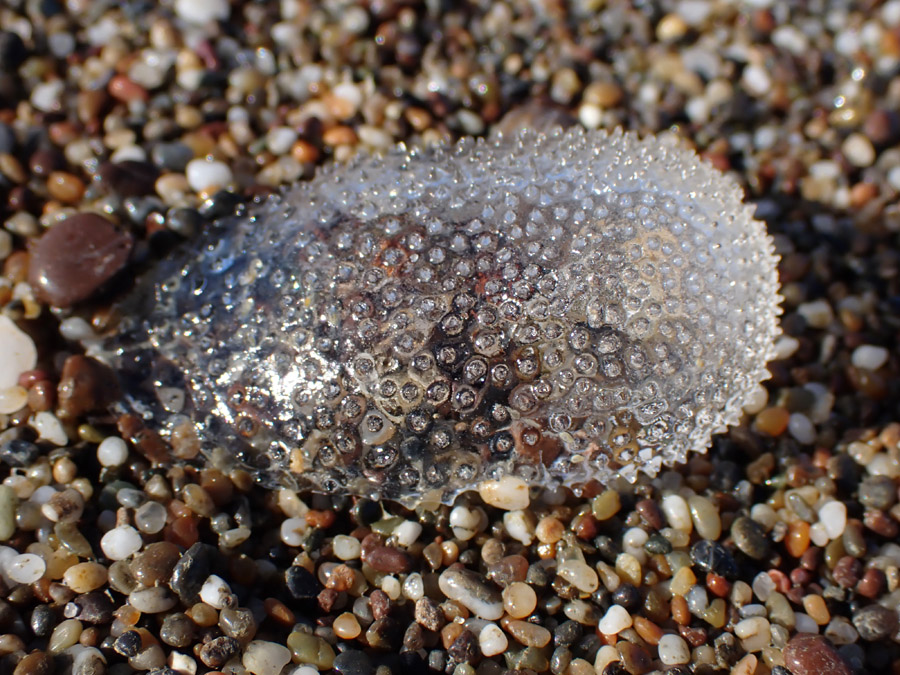
We went for a short walk on the outer beach at Point Reyes today (26 December 2020).  I'm not sure I've ever seen so many Corolla spectabilis pseudoconchs washed ashore.  Here's the flip-side:


I've written about this interesting pelagic snail in several previous blog posts.  For  an introduction, check out "Gelatinous thimble" on 11 August 2012.  If you go to the NHBH website (to do so if you're reading this message in an e-mail, click on the title of the post), you can also enter "corolla" in the search box at the very top left of the web page to see all of the earlier posts that discuss this intriguing member of the plankton.

Wednesday, January 18, 2017

Latticework -- Part 2

Okay, here we go the answer to last night's mystery.

This story started during a beach walk on 12 January 2017.  And I'll admit, it has to do with something that drives me crazy — walking by an animal on the beach that I can't identify.  Especially when it seems like it should be identifiable, e.g., when you see the same obvious and distinctive structures over and over again.

For example, we kept encountering these clear blobs on the beach. Each of them was about the same size, and each had a noticeable purple teardrop-shaped globule.  Here are two examples:


See what I mean?  It had to be something.  It appeared to be part of an animal of some kind.  It wasn't just a random bit of goo on the sand.

I was a little frustrated that I couldn't tell what it was, but I kept looking and hoping that we would fine one with more "parts" that would reveal the identity of the animal.

And then Eric decided to place one of the blobs in some water.  They were incredibly thin and fragile and difficult to pick up, but this step was critical.  Here are two pictures of the blobs when floating:


These specimens were tattered after having come through the surf, but I hope you can see that we now had more clues.  In water the blob expanded into defined structures — broad wings, with a latticework-like design!

This brought to mind an illustration which you might recall from a post in 2012:

Modified from The Light & Smith Manual: Intertidal Invertebrates from Central California to Oregon (2007) 
 
Yes, this is the pteropod Corolla spectabilis.  And the blobs observed during our beach walk on 12 January 2017 represented my first close look at Corolla's wings.  I know many of you have been finding Corolla pseudoconchs on the beach this winter.  The wings are easily separated from the pseudoconch, and they're probably torn apart in rough seas, so they're not often seen on the beach.  

[In the illustration above, also note the "viscera."  The purple globule attached to the wings is a part of the gut (included in the viscera).]

For some reason, quite a few Corolla wings were washed up on 12 January, so it was a rare opportunity to observe them and the muscles in the wings.  [Remember that Corolla and other pteropods are sometimes called "sea butterflies."]

Here's the close-up again from last night's post, showing the fascinating muscle bands running through the wings:


Having seen these specimens and the pattern of the muscle bands under the microscope, can you tell what's missing from the illustration shown above?  Although there are muscle bands drawn in two directions, there's a third set at a different angle.  For the drawing to be accurate, you'd need to add one more set of muscle bands.  The latticework of muscles may be important in achieving the upstroke and downstroke of the large wings as the pteropod swims through the water.

Mystery solved!  And now if we see these blobs washed up on the beach again, we'll know what they are.

P.S.  Click here to watch a video of Corolla wings in action.

P.P.S.  And here's a reminder about the more commonly encountered Corolla pseudoconch:

Tuesday, January 3, 2017

In case you were wondering

I've been receiving some inquiries about these gelatinous objects washing up on beaches.  Since so many people are wondering about them, and it's been a couple of years (I think) since I posted about them, I thought I'd share a recent picture and refer back to some earlier posts where I explained a bit more about this species.


The gelatinous pseudoconch of Corolla spectabilis, a pelagic snail, washed ashore on 2 January 2017.

For an introduction to Corolla, review the post from 11 August 2012 ("Gelatinous thimbles").  There are also pictures in the posts from 19 November 2012 ("Crystals on the beach") and 25 January 2014 ("Gelatinous assortment").

P.S.  Interestingly, I didn't see as many Corolla pseudoconchs washing up during the last two years while the water temperature was above average.  Now that the water has cooled down, they have been much more obvious (and numbers have been noticeably higher).  Their abundance might not be connected to water temperature, but I thought I'd make a note for the record.

Monday, November 19, 2012

Crystals on the beach

In August, I posted several pictures of the gelatinous pseudoconch of a pelagic snail called Corolla spectabilis (review that post for an introduction to Corolla).  

I've observed quite a few of these transparent shells washing up recently.  They look like small, oblong, sparkling crystals on the beach.  I don't remember seeing so many before (e.g., ~25 over a 300-ft stretch of beach), although it's possible I just haven't noticed.  I'll have to keep better notes!


Reviewing the photos I started wondering about the tubercles.  I often think of spines like this being deterrents to predators.  But if this is an internal shell, why do they have tubercles?

Some smaller individuals, ~1 cm long, have also been washing ashore (see next photo).  


Finding smaller individuals made me think about reproduction in this species.  Online there are several sites that state Corolla lays strings of eggs.  But I'm wondering — How do males and females find each other at sea?  What do the juvenile stages look like?  How fast do they grow?  How long before they become mature?  Is this a typical time of year to find smaller individuals?  And is there something about recent water conditions that's driving more of them on shore right now?  (Seawater temperatures have been relatively warm, ~12.5-13.5°C.)