If you're interested in using any of these photographs or this content in any way, please contact me. Send an e-mail to naturalhistoryphotos(at)gmail.com. Thanks!
Showing posts with label pteropod. Show all posts

Friday, October 29, 2021

Storm strandings -- Part 2

Okay, last night I mentioned there were quite a few different types of gelatinous zooplankton washed up on the beach.  Although these "gelatinous bits" can all seem similar at first, the closer you look, the easier it is to tell the different species apart.  It's often helpful to compare side-by-side photos, so here's a parade of plankton for the record:

 
Pyrosome (Pyrosoma atlanticum) see "Fire bodies" from 8 December 2014


A salp, possibly Iasis zonaria see "Wide mouth and ribbon-like muscles" from 29 March 2013


The swimming bell of a siphonophore, Chelophyes appendiculata — see "Swimming bells" from 3 April 2013


Part of a heteropod, Carinaria japonica see "Carinaria -- Part 2" from 7 December 2014


The pseudoconch (false shell) of the pteropod Corolla spectabilis see "Gelatinous thimble" from 11 August 2012


Hard to tell at first, but this is a different pteropod, Cliopsis krohni see "Angel on the sand" from 13 March 2013

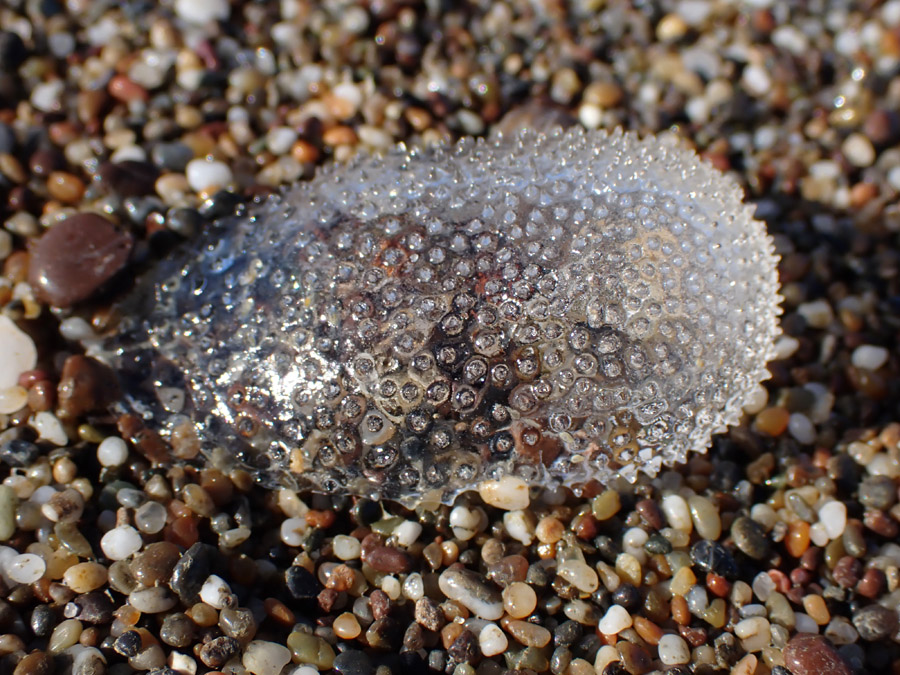
This last species can be tricky to identify.  It really does just look like a round blob on the sand.  But note the darker line running through the middle (that's the digestive tract) -- it's a hint that this is more than just a piece of a jellyfish.  These pteropods are delicate (used to being submerged in offshore waters), so they get beat up when they are tumbled in the surf zone and deposited on the sand.  But if you put them in a little bit of water, sometimes their heads (with tentacles) are revealed, as are their "wings" the foot of a mollusc modified into swimming appendages.  Here's a short video clip so you can see the wings in action.  [If you can't see the video player in the e-mail, click here to see the video.]


Saturday, December 26, 2020

Not your typical shell...


We went for a short walk on the outer beach at Point Reyes today (26 December 2020).  I'm not sure I've ever seen so many Corolla spectabilis pseudoconchs washed ashore.  Here's the flip-side:


I've written about this interesting pelagic snail in several previous blog posts.  For  an introduction, check out "Gelatinous thimble" on 11 August 2012.  If you go to the NHBH website (to do so if you're reading this message in an e-mail, click on the title of the post), you can also enter "corolla" in the search box at the very top left of the web page to see all of the earlier posts that discuss this intriguing member of the plankton.

Thursday, February 23, 2017

Tubes and slippers on the beach

I've heard from several people that pyrosomes have been washing ashore on beaches — in Monterey and Bodega Bay, California and in Seaside, Oregon.  We saw some pyrosomes ourselves last night (22 February 2017) on Salmon Creek Beach:


We estimated there were over 1,000 pyrosomes washed up along about a 1-km stretch of beach.

Below is a closer view.  You might recall that pyrosomes are a type of pelagic tunicate, related to sea squirts.  [For an introduction to pyrosomes, review the "Fire bodies" post from 8 December 2014.]


We encountered a variety of sizes (most of them were on the larger end of this size range):


I've received a few questions about how to tell pyrosomes from Corolla spectabilis pseudoconchs.  So for anyone who's been puzzling over either one, here's a side-by-side comparison.  Note the overall shape (oval vs. elongate) and color (clear and transparent vs. pinkish and opaque) and structural differences (slipper-shaped vs. tubular).


And if you haven't seen it yet, there's an introduction to Corolla on the "Gelatinous thimble" post on 11 August 2012.

Wednesday, January 18, 2017

Latticework -- Part 2

Okay, here we go the answer to last night's mystery.

This story started during a beach walk on 12 January 2017.  And I'll admit, it has to do with something that drives me crazy — walking by an animal on the beach that I can't identify.  Especially when it seems like it should be identifiable, e.g., when you see the same obvious and distinctive structures over and over again.

For example, we kept encountering these clear blobs on the beach. Each of them was about the same size, and each had a noticeable purple teardrop-shaped globule.  Here are two examples:


See what I mean?  It had to be something.  It appeared to be part of an animal of some kind.  It wasn't just a random bit of goo on the sand.

I was a little frustrated that I couldn't tell what it was, but I kept looking and hoping that we would fine one with more "parts" that would reveal the identity of the animal.

And then Eric decided to place one of the blobs in some water.  They were incredibly thin and fragile and difficult to pick up, but this step was critical.  Here are two pictures of the blobs when floating:


These specimens were tattered after having come through the surf, but I hope you can see that we now had more clues.  In water the blob expanded into defined structures — broad wings, with a latticework-like design!

This brought to mind an illustration which you might recall from a post in 2012:

Modified from The Light & Smith Manual: Intertidal Invertebrates from Central California to Oregon (2007) 
 
Yes, this is the pteropod Corolla spectabilis.  And the blobs observed during our beach walk on 12 January 2017 represented my first close look at Corolla's wings.  I know many of you have been finding Corolla pseudoconchs on the beach this winter.  The wings are easily separated from the pseudoconch, and they're probably torn apart in rough seas, so they're not often seen on the beach.  

[In the illustration above, also note the "viscera."  The purple globule attached to the wings is a part of the gut (included in the viscera).]

For some reason, quite a few Corolla wings were washed up on 12 January, so it was a rare opportunity to observe them and the muscles in the wings.  [Remember that Corolla and other pteropods are sometimes called "sea butterflies."]

Here's the close-up again from last night's post, showing the fascinating muscle bands running through the wings:


Having seen these specimens and the pattern of the muscle bands under the microscope, can you tell what's missing from the illustration shown above?  Although there are muscle bands drawn in two directions, there's a third set at a different angle.  For the drawing to be accurate, you'd need to add one more set of muscle bands.  The latticework of muscles may be important in achieving the upstroke and downstroke of the large wings as the pteropod swims through the water.

Mystery solved!  And now if we see these blobs washed up on the beach again, we'll know what they are.

P.S.  Click here to watch a video of Corolla wings in action.

P.P.S.  And here's a reminder about the more commonly encountered Corolla pseudoconch:


Friday, November 7, 2014

Curved needles

On 5 November, Emily e-mailed that she had found more pteropods, or sea butterflies — and this time it looked like a different species (i.e., not Hyalocylis striata, the pteropod she identified in September).

These animals were from a plankton tow about 24 km (15 miles) off Bodega Head.


Emily noticed that the shell was smooth and the wings had a different shape and were of different proportions.

When we looked under high magnification, we could see those characteristics.  We also noticed that the wings had two very intriguing features something that looked like small "hooks" about halfway along the inside edge of each wing and two oval rough patches in the middle of each wing just below those "hooks."


After consulting a few sources, we believe this is Creseis virgula.  We've seen one common name for it — Curved Needle Pteropod. 

I was excited to find an older drawing of this species which matched perfectly with what we were seeing:

Modified from Tesch, J.J.  1946.  The Thecosomatous Pteropods. I. The Atlantic.  Dana-Reports, 28, pp. 1-82.

We learned that the "hooks" are wing protrusions and the "rough patches" are ciliated fields.  This pteropod feeds by capturing suspended food particles in a large mucous net.  The ciliated fields aid in hauling in the mucous net.


Creseis virgula is a warm-water species.  Although the CalCOFI Atlas for pelagic molluscs (McGowan 1967) shows one record for 37°N, most are from south of Point Conception (approximately 34°N).

Because it was important to document the occurrence of this pteropod in northern California, Eric captured some wonderful video footage and compiled the best clips.  

There are many things to watch for in this video:

- the way Creseis frequently holds its wings far forward
- at about 20 seconds, a food particle moves between the wings towards the mouth
- when a side view is shown, note the slight curvature of the shell
- there's a close-up of the rhythmic mouth movements
- throughout the video, the heart is visible beating about 1/3 of the way up from the tip of the shell
- and one of the last segments is a bonus — it's a veliger, or the larval stage, of this pteropod.  The veliger doesn't have its wings yet, but instead has a velum, a lobed ciliated swimming organ around the opening of its tiny shell.


P.S.  Nearshore ocean temperatures are still quite warm, especially for this time of year 14-15°C (57-59°F).
 

Wednesday, November 5, 2014

Tropical butterflies -- Part 2

On 28 September, I wrote about a pteropod, or sea butterfly, Hyalocylis striata, found near Bodega Canyon.

On 21 October, we were very excited to receive an e-mail from Carol letting us know that she had found another one in a plankton sample from about 1 km off Bodega Head.

It turns out that Carol's specimen was in very good condition.  And because Hyalocylis is rare in northern California, we took some time to document this individual carefully.  We learned a lot along the way!


Note the very broad wings.  And that the tip (lower third) of the shell is smooth, lacking striations.  At first we didn't know what this meant, but Eric eventually found a description that led us to understand that the smooth tip of the shell is a protoconch, or larval shell.  Hyalocylis retains its protoconch for a while, but eventually sheds it and then seals the opening with a membrane!  See illustration below:

 Modified from van der Spoel, S. and L. Newman.  1990.  Juveniles of the pteropod Hyalocylis striata (Gastropoda, Pteropoda).  Basteria 54: 203-2010.
Van Der Spoel, S. and L. Newman (1990). Juveniles of the pteropod Hyalocylis striata (Gastropoda, Pteropoda). Basteria, 54: 203-210. - See more at: http://australianmuseum.net.au/Publications-1990#sthash.t8AyVi6z.dpuf


Here's another view of this juvenile found in October: 


Because we don't get a chance to look at pteropods very often, we also zoomed in for a closer view of the head region and the base of the wings:


There's a lot to see, and we were curious about all of it!  We've labeled some of the anatomy in the next picture (below).  Our attention was  drawn especially to the two paired circles in the center of the image.  These are statocysts sense organs that assist with balance and orientation as the pteropod moves through the water.


The story doesn't end here because last night, on 4 November, we received another e-mail, this time from Emily saying that she had discovered some more pteropods in a plankton tow offshore of Bodega Head.

When we went to look at them, we found a tiny Hyalocylis — even smaller than the juvenile from October! (see next image):


This small shell lacked striations, and all of the other characteristics looked good for Hyalocylis.

To make it easier to appreciate the size differences among these individuals, we put together a composite picture with all three side-by-side.  An explanationthe first two pteropods didn't survive and are now important specimens at the California Academy of Sciences documenting their occurrence in northern California during the 2014 warm-water event.  From top to bottom, the picture below shows the shell of the September adult (note that it's missing its protoconch), the October juvenile, and the November juvenile.  Approximate shell sizes = 4.75 mm, 0.93 mm, and 0.33 mm.


It's potentially significant that juveniles have been documented in the plankton here, as it suggests that Hyalocylis was reproducing in California this year.

Okay, I hope you're still with me.  If so, you won't be disappointed.  You're in for a treat, as the next music video from Spineless Studios has been released!  

Click on the link below for wonderful video footage of Hyalocylis striata.  Note that some of the sequences were slowed down to allow observation and appreciation of the swimming behavior.


Sunday, September 28, 2014

Tropical butterflies flying over the canyon


This remarkable animal is a sea butterfly, Hyalocylis striataKate and Emily discovered it when sorting the contents of a deep-water plankton tow from >200 meters depth during an ACCESS (Applied California Current Ecosystem Studies) cruise over Bodega Canyon on 24 September 2014.

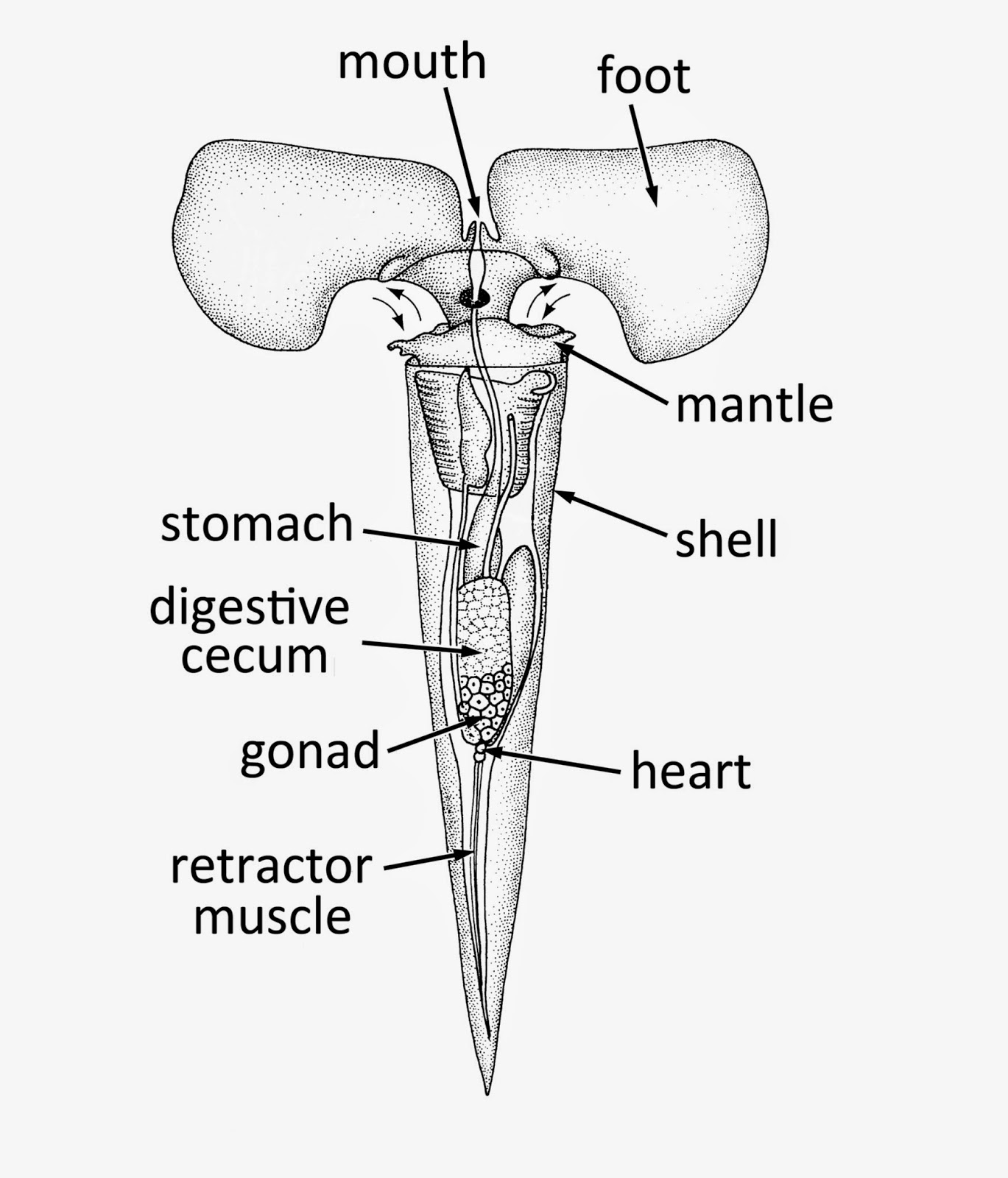
A sea butterfly is a type of pelagic snail called a pteropod.  It spends its entire life at sea.  Note several special adaptations, highlighted in the photo above and the diagram below.
  • The foot has been modified into two, large wings for swimming.  The wings flap together, and slowly, hence the name sea butterfly.  
  • The shell is transparent, and very thin and fragile, traits associated with an open ocean existence.
Modified from Invertebrates (Second edition) by Brusca and Brusca (2003)

Although other pteropods have been documented in this area, Hyalocylis striata is unusual.  Typically it is a warm-water species; most records appear to be tropical and subtropical.  We're actually trying to figure out if this might be the first definite record for California.  

I've done a very basic literature search, as well as a search of online museum collections.  So far I can't find any records along the West Coast north of Baja California, Mexico.  In 1967, McGowan published a Distributional Atlas of Pelagic Molluscs in the California Current Region.  The map below is the only cruise for which he reported finding Hyalocylis striata.  Each dot on the map is a sampling station.  Can you locate the station where Hyalocylis was found?

Modified from McGowan, J.A. 1967. Distributional Atlas of Pelagic Molluscs in the California Current Region. CALCOFI Atlas 6: 1-218.  Hyalocylis illustration from Tesch, J.J. 1913. Mollusca, Pteropoda. In: F.E. Schulze. Das Tierreich. Eine Zusammenstellung und Kennzeichnung der rezenten Tierformen 36. Berlin (Friedberger and Sohn).


I'm guessing you found the one station off the west coast of Baja where Hyalocylis was discovered, just south of 25°N latitude. 

This atlas, along with several other sources, makes it seem like Hyalocylis is generally not expected to be at 38°N, the latitude of Bodega Bay.

It may be that Hyalocylis is another species brought north with the warmer-than-usual water this summer.  For example, warmer ocean temperatures near shore during the mid-late summer are usually in the range of 13-15°C (55-58°F); this summer they have been around 16-18°C (60-64°F).  When I was near Bodega Canyon/Cordell Bank on 19 September, it was 19°C (66°F)!

Although these sea butterflies are small (up to 8 mm long), it's fun to imagine them flying over Bodega Canyon!


P.S.  Many thanks to Roger Seapy for helpful discussions about Hyalocylis striata.

P.P.S.  If you want to see the location of Bodega Canyon, click here.

P.P.P.S.  The Applied California Current Ecosystem Studies (ACCESS) Partnership is an ongoing collaboration between Point Blue Conservation Science, Cordell Bank and Gulf of the Farallones National Marine Sanctuaries, to support marine wildlife conservation and healthy ecosystems in northern and central California.  For more information about ACCESS, visit www.accessoceans.org, and for new collaboration opportunities contact Jaime Jahncke at jjahncke@pointblue.org. 

Wednesday, March 13, 2013

Angel on the sand

Returning from a bird survey on Salmon Creek Beach, I was walking along the lower part of the beach near the surf.  I'm always interested in gelatinous animals washed ashore, so I was watching for anything noteworthy.  I was seeing a few comb jellies (Sea Gooseberries) every now and then, but otherwise there wasn't too much today. But just as I was about to leave the beach, a small blob caught my eye.  It was soft and clear, about 2 cm long, with a dark purplish line inside running through the center.  

I picked it up to see what it was.  It didn't look like much at first.  It was covered with sand, and it pretty much collapsed in my hand; that is, it didn't have much structure at all.  But there was a very small, rounded projection at one end...and something was puzzling about this mystery blob.  So I pulled out a small plastic bag, filled it with seawater, and dropped the blob into the water.

Now the sand grains fell away, and I thought I could see some darker speckling on the mostly transparent "jelly."  But I still wasn't certain if it was an entire animal or just a piece of a much larger organism.  

I kept watching, and turning the bag to look at the blob from different angles.  The small projection at one end appeared to get a little larger...and then the most magical thing happened!  Small wings extended out from either side and began to flap!  I knew right away what it was, but I hadn't seen one on Bodega Head yet, and I'd never seen this species.

Here are two pictures in a bowl of seawater:


This is a pelagic snail commonly called a Sea Angel (Cliopsis krohni).  They belong to a larger group known as gymnosomes ("naked-body," referring to their lack of a shell), a type of pteropod ("winged-foot," referring to their foot being modified into swimming wings).  They swim through the water slowly by flapping their wings.

A diagram will make it easier to see their basic body parts.  Look for the small head with tentacles at the top, the paired, rounded swimming wings at the base of the neck, and the large soft body with internal organs (viscera) visible in the center.

Modified from The Light & Smith Manual (2007)


I took a couple of quick photos under the microscope.  The next photo shows the head and tentacles and the extended wings (in motion).


Below, an extreme close-up of the left wing shows some intriguing patterning  (muscle bands?).  Note that the wing is not damaged.  Sometimes it would crinkle like that when being retracted, but I watched to see that it appeared to be fine during the next stroke.


The surface was covered with dark stellate (star-like) chromatophores and scattered white spots.  Although they look brownish in these photos, I was having a little trouble with the lighting tonight and I would have described them as purplish in natural light.


In Pacific Coast Pelagic Invertebrates, Wrobel and Mills (1998) state that Cliopsis occurs north of southern California in temperate waters to depths of 1500 meters.

Cliopsis is a voracious predator that feeds on another pelagic snail called Corolla spectabilis.  Does that name sound familiar?  Last year I posted a few photos of Corolla's gelatinous pseudoconchs.  You can review those posts from August 2012 and November 2012.  

Although I've seen pteropods elsewhere before, I never would have guessed that my first encounter with one on Bodega Head would have started with a small sandy gelatinous blob on the beach!