I hope you've been enjoying some of the amazing live deep-sea video footage from the Cordell Bank National Marine Sanctuary this week. If you haven't watched yet, you can tune in at www.nautiluslive.org. They'll be in this area until 14 August 2017.
We saved a few images from today's dive to the "Box Canyon" area between Bodega Canyon and Cordell Bank. Here's a map for reference:
Some of our favorite images were the ledges covered with deep-sea invertebrates — a visual wonder!
Here's a close-up:
I am *not* a deep-sea biologist, but if you need a little help, here's what I think you're seeing — most of the white animals above are large sponges; the yellow animal with feather-like arms at the lower left is a crinoid (feather star); the large anemone on the right is a Venus Flytrap Anemone. They're joined by crabs (upper left), shrimp (upper right), brittle stars and different anemones (center).
I learned something cool about the deep-sea octopus that the ROV has been encountering (see image below). I think it's Graneledone boreopacifica — a species that's known to have the longest embryo-brooding time of any animal at 53 months (almost 4.5 years!). You can read more about it here.
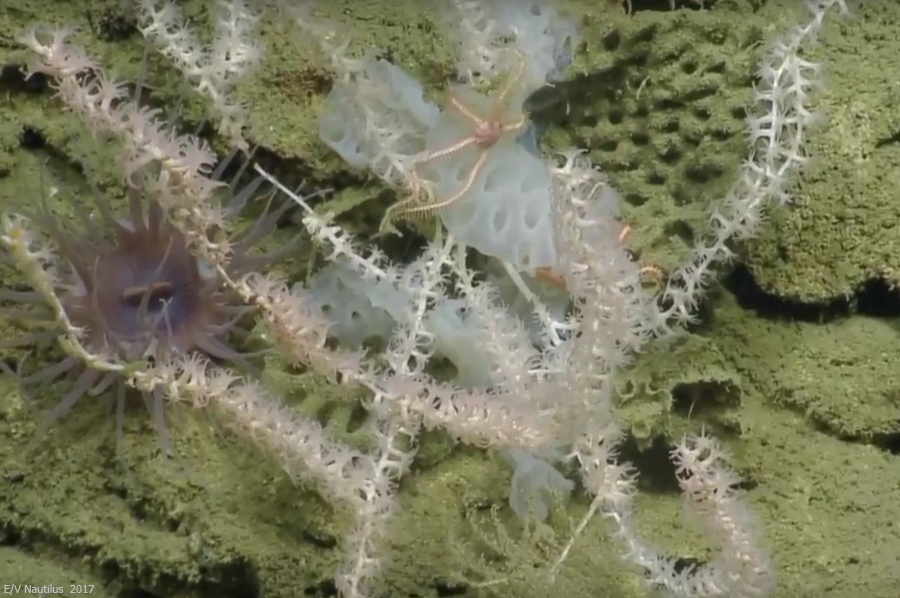
I also learned about a new type of sea star. I was noticing these orange animals (picture below) that looked a little like crinoids and a little like brittle stars. They weren't quite right for either one, so I did more research, and now I think they're brisingid sea stars (not sure which species). Brisingids are unusual sea stars in that they're suspension-feeders, capturing food by creating a net with their arms. You can learn more about brisingids here.
One more shot, featuring a beautiful bamboo coral (gorgonian octocoral) with extended polyps:
Thanks to the E/V Nautilus crew for sharing these amazing images! To see more live discoveries yourself, tune in at www.nautiluslive.org. You'll find it hard to pull yourself away from this incredible glimpse of life in the deep sea not far from Bodega Head.