If you're interested in using any of these photographs or this content in any way, please contact me. Send an e-mail to naturalhistoryphotos(at)gmail.com. Thanks!
Showing posts with label coral. Show all posts

Monday, January 26, 2026

A little orange cup


I've been working on some photo organization, but here's a little Orange Cup Coral for you — Balanophyllia elegans, photographed in Bodega Harbor.

Wednesday, August 9, 2017

30 miles out and over a mile deep

I hope you've been enjoying some of the amazing live deep-sea video footage from the Cordell Bank National Marine Sanctuary this week.  If you haven't watched yet, you can tune in at www.nautiluslive.org.  They'll be in this area until 14 August 2017.

We saved a few images from today's dive to the "Box Canyon" area between Bodega Canyon and Cordell Bank.  Here's a map for reference:


Some of our favorite images were the ledges covered with deep-sea invertebrates — a visual wonder!


Here's a close-up:


I am *not* a deep-sea biologist, but if you need a little help, here's what I think you're seeing — most of the white animals above are large sponges; the yellow animal with feather-like arms at the lower left is a crinoid (feather star); the large anemone on the right is a Venus Flytrap Anemone.  They're joined by crabs (upper left), shrimp (upper right), brittle stars and different anemones (center).

I learned something cool about the deep-sea octopus that the ROV has been encountering (see image below).  I think it's Graneledone boreopacifica — a species that's known to have the longest embryo-brooding time of any animal at 53 months (almost 4.5 years!). You can read more about it here.


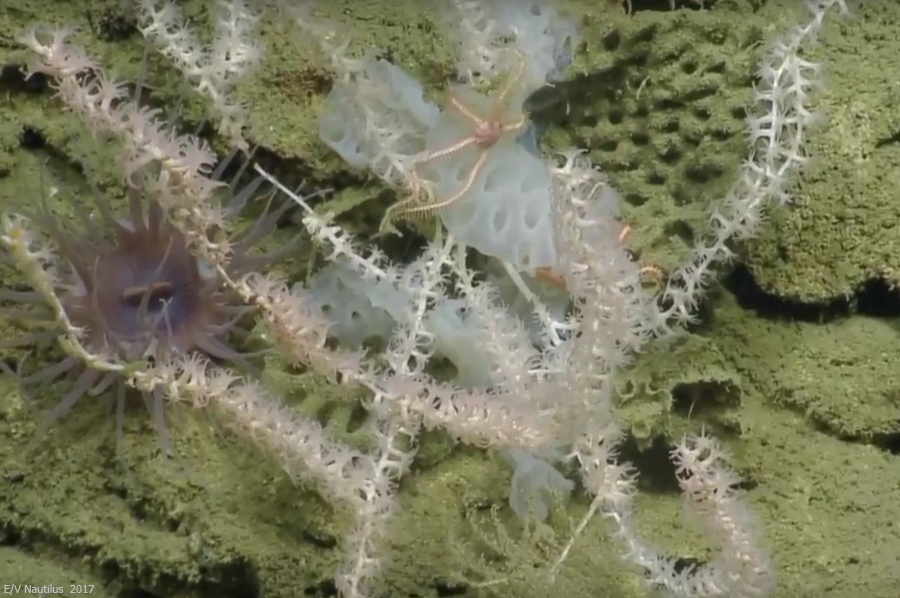
I also learned about a new type of sea star.  I was noticing these orange animals (picture below) that looked a little like crinoids and a little like brittle stars.  They weren't quite right for either one, so I did more research, and now I think they're brisingid sea stars (not sure which species).  Brisingids are unusual sea stars in that they're suspension-feeders, capturing food by creating a net with their arms.  You can learn more about brisingids here.


One more shot, featuring a beautiful bamboo coral (gorgonian octocoral) with extended polyps:


Thanks to the E/V Nautilus crew for sharing these amazing images!  To see more live discoveries yourself, tune in at www.nautiluslive.org.  You'll find it hard to pull yourself away from this incredible glimpse of life in the deep sea not far from Bodega Head.

Monday, August 7, 2017

Far offshore and deep below

Mystery image #1:


And here's another — mystery image #2:


Ready for the answers?

The first image is a segment of the skeleton of a bamboo coral.  This piece is in the collection at the Bodega Marine Lab.  It was collected decades ago from ~500 fathoms off of Bodega Bay.  

The second is a single arm of a crinoid, also known as a feather star.

I'm sharing these images with the hope that it encourages you to tune in to live footage of ROV exploration at Bodega Canyon this week.  You can watch and listen to scientists documenting corals, crinoids, brittle stars, sea spiders, sponges, octopus, and other unusual deep-sea marine life thousands of feet below the surface.  This is a wonderful opportunity to learn about a variety of animals that most people never get to see!

In 2008, during a clean-up of abandoned fishing gear near Cordell Bank, a few animals were brought back to the marine lab.

I took a few quick photos of the beautiful crinoids clinging to the old, tangled ropes.  Crinoids are a class of echinoderms (related to sea stars, sea urchins, and sea cucumbers).  There are about 600 species of crinoids in the world.  Some crinoid species hold on to the substrate with finger-like cirri (see the cluster of short appendages near the center of the image below).


Most crinoids are known for their long feather-like arms.  The side branches of the arms are called pinnules.  Crinoids are suspension-feeders.  They hold their arms upward (like an upside-down umbrella) and capture food particles drifting down from above.  

A long groove runs along the center of the each arm and is lined with clusters of tube feet and modified ossicles (calcified plates) called lappets.  The tube feet and the lappets are involved in directing food particles to the central groove which then transports the particles down to the mouth at the center of the arms.


Since we took these pictures almost 10 years ago, Eric didn't have a great video camera yet.  But he did capture close-ups of the crinoid tube feet as well as the lappets flipping up and down along the food groove (we think they look like little pinball flippers!).  The footage is grainy, but I think you'll be able to appreciate this fascinating feeding behavior.  Then when you see crinoids in the live video from Bodega Canyon, you'll be able to think about how feather stars feed!

Here's Eric's short video clip:


I'll end with an old illustration of a feather star holding on to a tube worm, and a reminder to check out the live deep-sea footage from Bodega Canyon!