If you're interested in using any of these photographs or this content in any way, please contact me. Send an e-mail to naturalhistoryphotos(at)gmail.com. Thanks!
Showing posts with label duxbury. Show all posts

Tuesday, December 10, 2024

Gifts from the north country


It was a bit of soggy day here today (10 December 2024), but we spent a little time walking at Duxbury Beach (in Massachusetts) and encountered a flock of ~25-30 Horned Larks (Eremophila alpestris).  

I thought I could hear some Lapland Longspurs (Calcarius lapponicus) mixed in with them as they flew by, so I snapped a few quick photos and then we spent a little more time trying to find them when they landed.  (You can see at least four longspurs in the photo above.)

Conditions were tough for photos (distant and dark), but here's an example of a Horned Lark (first photo below) and a Lapland Longspur (second photo):


And when we were walking back to the car, we noticed some movement on the ground and were glad to see a few Snow Buntings (Plectrophenax nivalis):
 
 
It was worth going out in the rain!
 

Thursday, December 14, 2023

Sea glass?


Waves like glass at Duxbury Beach, Massachusetts, on 12 December 2023

Tuesday, December 12, 2023

Blue moon


Close-up of a Shark Eye Moon Snail (Neverita duplicata) at Duxbury Beach, Massachusetts, 12 December 2023.  This one was ~1 cm across.

Wednesday, December 15, 2021

Snowy views


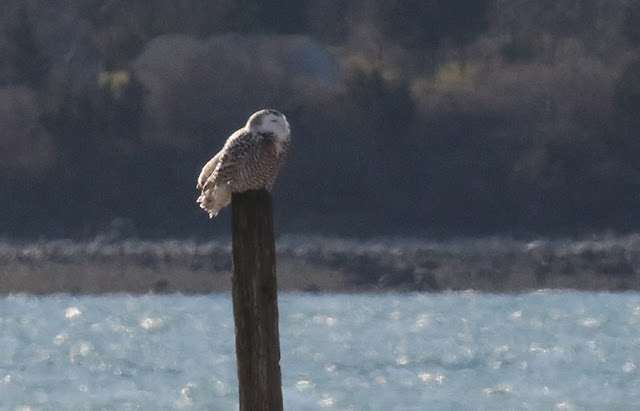
Distant but fun views of a Snowy Owl (Bubo scandiacus) at the edge of the marsh along Duxbury Beach, MA, on 14 December 2021.


Tuesday, December 14, 2021

Along the beach


Long-tailed Duck (Clangula hyemalis) at Duxbury Beach, MA, on 14 December 2021.

Tuesday, December 24, 2019

Winter scenes

Winter scenes from the last few days in New England...

Salt marsh in Duxbury:


Snow Bunting habitat:


Frozen ripples in a stream:


 Icy sea dragon?  :)


Happy holidays, everyone!

Monday, December 23, 2019

Along the beach


My mom and I enjoyed a nice walk down Duxbury Beach (in Massachusetts) today, 23 December 2019.  A couple of small flocks of Snow Buntings (Plectrophenax nivalis) crossed our path a few times.  They were flighty and active and tough to get photos of, but here are a few pictures for the record.


Four birds blending in with the sand and dune vegetation and with the afternoon shadows and light: 


Saturday, December 23, 2017

From Sable Island

Just a few shots of "Ipswich Sparrows" (Passerculus sandwichensis princeps) at Duxbury Beach, Massachusetts, on 22 December 2017.

This is a subspecies of Savannah Sparrow that nests on Sable Island, Nova Scotia.  They winter in the Canadian Maritimes and along the East Coast (primarily in New England).  Note the relatively large size and pale coloration.


The sparrows were well camouflaged among the brown and gold salt marsh vegetation and silvery bits of ice:


We don't get to see "Ipswich Sparrows" in California, so I appreciated this opportunity to watch them for a little while.


Many thanks to Eric and my mom for spotting these sparrows along the shoreline!
 

Friday, December 22, 2017

Winter white

We took a nice birthday walk along Duxbury Beach (in Massachusetts) this morning and encountered three Snowy Owls!  I love seeing these beautiful owls in the winter salt marshes along Duxbury Bay.  The owls were a bit distant, but here a few pictures:


A second, darker individual:


I'll share a few more pictures from Duxbury soon!

Friday, December 23, 2016

Special


We got lucky today.  We had walked most of Duxbury Beach (in Massachusetts) without seeing a Snowy Owl.  And then my mom's friend, Mark, drove by and offered us a ride back to the parking lot.  Mark's a photographer and had been keeping an eye out for Snowy Owls, too.

We were almost back to the parking lot when Mark spotted an owl on top of the dune ridge.  I took the picture above with my zoom lens (with a maximum focal length of 200 mm).  Then Mark offered to let me use his lens an impressive 600 mm lens.  So here's the view through Mark's lens:


And another of this beautiful owl:


A special place, a special bird, and a special time of year!

Thanks, Mark, for giving us a spectacular view of this Snowy Owl.

Thursday, December 26, 2013

A taste of the Arctic

A few more pictures of winter in New England before we head back to California.

Even though I had seen Snowy Owls earlier in the week, Eric wasn't with us that day.  So we went back to Duxbury Beach for a quick look and were lucky to find two owls.  This was one of our favorite views today:


We also spotted this Snow Bunting feeding on seeds along the edge of the road:


And then we saw a larger flock of Snow Buntings foraging in the drift line between the salt marsh and a small sand dune.  It was impressive to see how well the colors of the Snow Buntings matched the sand and the vegetation white, grays, browns, and rust-colored tones.

Now that you've seen one isolated Snow Bunting, how many individuals can you find in the picture below?  (Warning: The answer is below the image.)


There are eight Snow Buntings in the picture above.  Two on the left, two in the center, and four on the right. 


And now that you're warmed up, here's a harder one.  How many Snow Buntings can you find in the next picture?  (Click on the picture to enlarge it.)


There are fourteen Snow Buntings in the picture above.  From left to right: one in the upper left, then a fairly tight cluster of seven, two just to the right of center (one above the other), a group of three at the upper right, and one in the lower right.


Although it would be fun to see a Snowy Owl or Snow Buntings on Bodega Head, I hope you've enjoyed this brief interlude featuring two beautiful species from the Arctic!
 

Wednesday, December 25, 2013

"Flocks of snow"

A few more photos from our afternoon on Duxbury Beach, MA, on 23 December 2013:


As the light was becoming dim at the end of the day, we encountered a large flock of Snow Buntings (Plectrophenax nivalis).

Snow Buntings breed on the high arctic tundra and generally winter across the central plains.  On the East Coast, the southern limit of their winter range extends to the Mid-Atlantic states; on the West Coast, the regular winter range extends to Washington.  They occasionally make it to California, and with a quick scan of the Rare Birds of California, it appears that there are about 6-7 records for Sonoma County.


The birds we encountered on Duxbury Beach were very active and challenging to photograph.  In fact, I didn't really end up with any good quality images.  But this is another species that I miss since moving to California and a few of the pictures are interesting.

Here's a close-up where you can focus on identifying males and females.  Note that the white wing patch in males is very broad, while in females it is much more restricted.  The black wing tips in males are also more distinct.  (There's a male and a female side-by-side in the very center of the photograph.)


And you know how much I'm intrigued by the challenge of counting flocks.  Unfortunately, this flock was restless and it didn't really give us a chance to make a satisfactory count in the field before it took off again and disappeared into the distance.  But I took a few quick photos for the record.

Here's one image that doesn't capture the entire flock, but comes fairly close (below).  It's fun to take a quick look at the image and to come up with a guess about the number of birds...and then to do a real count.  Want to try?  (Remember you can click on the image for a larger version.)


When my mother and I saw this flock in the field, we both agreed that there were more than 100 birds.  When using the picture above, two different counters came up with 171 and 172 individual Snow Buntings.  How many did you count?


Two more pictures, highlighting those black-and-white flashes and the sense of restlessness:


P.S.  Because there is so much white in their plumage and they often occur in tight active flocks, to some people Snow Buntings can look like snowflakes swirling around in the air.

Monday, December 23, 2013

Snow in the rain


Snowy Owl (Bubo scandiacus) on Duxbury Beach, Massachusetts, 23 December 2013. 


In total we observed five Snowy Owls on Duxbury Beach today quite a birthday present!  I was reminded how much I miss seeing these occasional visitors from the far north.

There is an historic irruption of Snowy Owls occurring in the Northeast this winter.  I haven't yet heard the details of where it stands in comparison to other years with high numbers of Snowy Owls (perhaps someone can help me out?), but I'm glad to have seen a very small glimpse of it.

Wayne Peterson (with the Massachusetts Audubon Society) sent around a link to Bruce Mactavish's blog with some information about the incredible numbers of Snowy Owls in Newfoundland and hinting that these birds may be originating from northern Quebec after a very successful breeding season there this past summer.


Here are two more photos of different individuals from Duxbury Beach today.  The next one shows very dark barring, indicating that this may be a young female (females tend to be darker than males).


This individual is much paler (see below).  Note that all of these photos were taken from far away with a long lens and then heavily cropped.  If you look closely, you'll find some wet feathers on these owls as all of us (the owls and my mother and I) were out in the rain today.


I have very fond memories of watching Snowy Owls on Cape Cod.  One of my favorite experiences involved a Snowy Owl that had caught a Common Eider and a Northern Harrier that wanted some of the eider, too.  The owl was perched on the ground holding onto the duck.  The harrier would walk slowly towards the owl and then try to grab hold of the eider by reaching backward with one of its long legs.  Eventually the owl would respond by raising its wings and screeching at the harrier, and the harrier would retreat.  But the harrier kept trying over and over again!  It never succeeded as far as I know, but it was an unforgettable wildlife observation.