If you're interested in using any of these photographs or this content in any way, please contact me. Send an e-mail to naturalhistoryphotos(at)gmail.com. Thanks!
Showing posts with label frog. Show all posts

Thursday, November 21, 2024

Frog weather

 
I'm running out of time tonight, but here's a couple of quick photos of a beautiful Red-legged Frog (Rana draytonii) that we came across in the road tonight.  It's certainly been good weather for frogs!
 
 
I hope everyone is staying safe during these storms!

Monday, January 15, 2024

Out after the rain


We had to move some material on the ground today (15 January 2024), and look who was underneath!

Nice to see this beautiful Sierran Treefrog (Pseudacris sierra)...and it reminded me to check our rainfall totals.  So far we've received ~12 inches of rain, or about 38% of the average annual total.  Frogs have been quite vocal throughout our neighborhood.  Have you been hearing them in yours?

Monday, September 26, 2022

An unusual ending


I took a short walk in Walpole, MA, today (26 September 2022).  I ended up at a small pond and started noticing a few interesting animals in the warm afternoon sun (more on that later).  I was taking photographs and noticed a dragonfly a bit further away along the shoreline.  It was a female ovipositing (laying eggs), so it was in the same area long enough for me to snap a few distant photos.  

When I finished photographing the first subject, I decided to take a quick look for the dragonfly as I wasn't certain which species it was.  I was scanning for a dragonfly in flight and wasn't having any luck when I noticed a fluttering movement near the ground.  I looked down to see this:

 
I couldn't believe it, but the dragonfly had been caught by a Bull Frog (Lithobates catesbeianus)!
 
And amazingly it looked like this was a Great Blue Skimmer (Libellula vibrans), a dragonfly that used to be rare when I last lived in Massachusetts.  It sounds like Great Blue Skimmers (a southern species) have become more common in Massachusetts during the last 18 years, but they are still infrequently encountered.
 
Here are a couple of different angles:


P.S.  Many thanks to Blair for helping to confirm the dragonfly identification and the current status of Great Blue Skimmers in Massachusetts.

Sunday, July 18, 2021

New legs and an old tail


 A tadpole with hind legs (above)...

 and a frog with a tail (below):

 
Sierran Treefrog (Pseudacris sierra) photographed 3 July 2021.

Saturday, February 29, 2020

Leap of faith


At various times in the past, Eric has challenged me to find and photograph a frog for leap year.  I'm happy to say that 2020 is the year I was successful!


Here's the crazy thing.  This is the most common frog in our area, but I'm not sure what to call it.  The taxonomy is confusing and obviously more work is needed to sort out this issue.  

I'll call it a Sierran Treefrog (Pseudacris sierra) for now...but you might also see it called a Pacific Treefrog (Pseudacris regilla), and you might see the scientific name as Hyliola sierra.  In previous posts I have also called it a Pacific Chorus Frog, but the official checklist of the Society for the Study of Amphibians and Reptiles (2017) uses treefrog, so that's what I'll use.

Happy 2020 Leap Year!

Saturday, June 2, 2018

Nearing the end of the tale

A quick follow-up to the "Spring transition" post on 22 May 2018:


A Sierran Treefrog (Pseudacris sierra) that's transitioningthe little froglet has fully developed limbs, but it has yet to resorb its tail.

It was sitting under water in a shallow pool along the coast in northern Sonoma County on 1 June 2018.

Tuesday, May 22, 2018

Spring transition

After field work near Mendocino on Sunday, we were walking up a coastal bluff and noticed some shallow pools off to the side of a small stream running along the rocks towards the ocean.  Looking down, some movement caught our eye:


Little wriggling tadpoles!

We followed the stream up to a small wet seep near the bluff.  Soon we saw tiny, newly-metamorphosed froglets (~1 cm long) jumping among the vegetation.

This one landed and nestled on the leaf of a Seep Monkeyflower (Mimulus guttatus):


And here's one with wet feet:


Good luck little treefrogs!

Monday, May 7, 2018

Go Green


While doing some gardening yesterday, Eric looked down into a clay pot and spotted a small Sierran Treefrog (Pseudacris sierra).  We were enjoying the view, when the frog leaped onto Eric's t-shirt!  

P.S.  Eric's Boston Celtics shirt seemed like an appropriate background for this frog...especially since we've been rooting for the Celtics in the playoffs.  Go Green!

Wednesday, November 8, 2017

Tree frog


Sierran Treefrog (Pseudacris sierra) on a Douglas-Fir (Pseudotsuga menziesii), 7 November 2017.  

We're received 0.7 inches of rain so far today (8 November 2017), and it looks like showers will continue for a couple of days. 

Wednesday, August 16, 2017

Holding on


A young Sierran Treefrog (Pseudacris sierra) holding on to a bur-reed leaf in Bodega Bay on 16 August 2017.

P.S.  You might know this species as a Pacific Treefrog or Pacific Chorus Frog (Pseudacris regilla), but there have been some taxonomic changes during the last few years.
 

Thursday, December 15, 2016

Keeping an eye on the weather


Many of us were keeping an eye on the weather today...over 2 inches of rain fell during the past 24 hours.


California Red-legged Frog (Rana draytonii), 15 December 2016
 

Monday, February 10, 2014

Then and now

In late January I decided I should start taking some pictures to document this year's drought conditions.

Below are two pictures comparing a previous year with this year.  The scene is a small wetland at the north end of the Bodega Dunes.  The first picture was taken in June 2007, after a winter with about 25 inches of rain.


The next image shows the same wetland, in just about the same place compare the horizon line in the backgroundtaken on 20 January 2014.  This was after receiving only ~4 inches of rain this winter.


On 9 February 2014 I stopped to take a picture of this wetland after ~7 inches of rain had fallen at the coast over three consecutive days.  I couldn't get to the same position as in the pictures above because of the water level, but here's a view of the flooded marsh.  The site in the earlier pictures is in the far back center of the image below.


And I'm delighted to report that when I was taking this picture (in the rain), my ears perked up to hear this sound:


chorus by nhbh


I'm sure many of you are now hearing the calls of treefrogs nearby, too!  But if not, head outside to your nearest wetland to enjoy the chorus! 

P.S.  For more about Pacific Treefrogs (also known as Pacific Chorus Frogs), review posts from 17 March 2012 and 15 December 2012.
 

Tuesday, November 19, 2013

Finally, some rain!


And I think just about everyone and everything was enjoying the rain today.  

We left work a little late, and encountered a couple of California Red-legged Frogs (Rana draytonii) in the dark, wet night.

Red-legged Frogs are not common on Bodega Head, but occasionally are reported dispersing during rainy conditions.  We watched very carefully to make sure they made it safely across the road.


I've always loved looking into frogs eyes.  It's like gazing into another galaxy, with swirls of pearlescent patterns floating over deep black backdrops.  I don't know why their eyes are so beautiful, but I'm very thankful for the chance to admire them every now and then.

Saturday, December 15, 2012

An advertisement and an encounter


Although I recorded this on 6 December, it seems appropriate to share it while listening to raindrops on a wet, soon-to-be-winter's night.

Do you recognize this species?


6december by nhbh

 
The recording features two different calls of Pacific Chorus Frogs (also called Pacific Treefrogs).  [It's one recording that repeats.]

Most of what you're hearing is an advertisement call.  It's a two-part call, sometimes written as rib-it, rib-it (or krek-ek, krek-ek — you can choose what suits your ears best!).

The second call is more subtle.  If you listen very carefully at ~2 seconds and again at ~10 seconds you can hear the trilled encounter call.  According to californiaherps.com, this call is given by males to establish spacing when a chorus begins or later if another male approaches (or calls) too closely.

I didn't get any pictures that night, but here are a few of a Pacific Chorus Frog on Bodega Head in May 2012.


Are you hearing Pacific Chorus Frogs at wetlands near you?


P.S.  For more information and pictures of this species, check out the post from 17 March 2012.

Saturday, March 17, 2012

Pacific Chorus Frogs

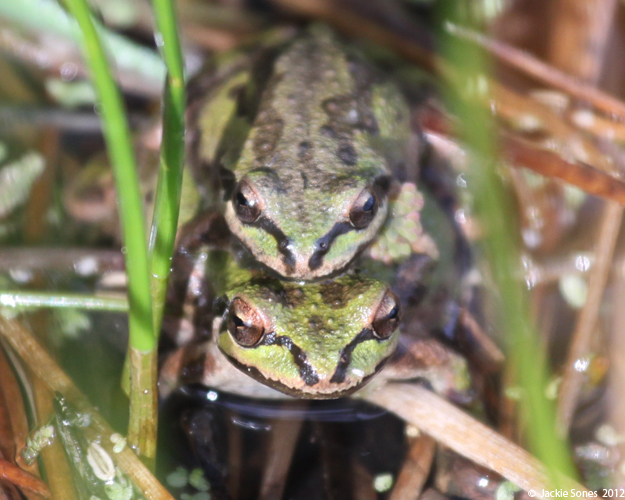
Rain for most of the past week created favorable conditions for amphibians.  The most common frog on Bodega Head is the Pacific Chorus Frog (or Pacific Treefrog), Pseudacris regilla.  You can encounter them just about anywhere, but for breeding they prefer shallow pools.

Here are a few photos from 17 March 2012.  


A male-female pair in amplexus (mating embrace).  The smaller male is holding the larger female from above.  Fertilization is external.  The female will attach eggs to a submerged object (see below), and the male will release sperm to fertilize them. 


View from above.


View from front.


Eggs are laid in small clusters attached to grass or twigs.  They are brown above and cream colored below and are embedded in a gelatinous matrix.


Note the rounded toe pads on the hind foot, a distinctive character of treefrogs.  For this species, the black line running from the snout past the eye and to the shoulder is a helpful field mark.


You can listen to Pacific Chorus Frog calls here.