If you're interested in using any of these photographs or this content in any way, please contact me. Send an e-mail to naturalhistoryphotos(at)gmail.com. Thanks!
Showing posts with label porpoise. Show all posts

Saturday, August 23, 2025

Multi-porpoise


A few quick shots of Harbor Porpoises (Phocoena phocoena) from Limantour Beach on 23 August 2025.

Sea conditions were relatively calm today, making it easier to spot the porpoises.  But it was hard to tell how many were in this group.  Eric and I agree on at least three individuals, but there could have been more.  I wasn't able to photograph more than two at once.


Classic view of the nice triangular dorsal fin: 


Friday, August 30, 2024

Fin in the fog


A couple of weeks ago, Eric looked up from the surf zone to see this animal swimming by.

I was surprised how close to shore it was.  Here's a photo with the fin in the distance and the surf zone (next to the beach) in the foreground:

 
It surfaced a few more times, so we had some better views, but I didn't have my camera ready and it was a bit foggy and distant, so here's my best shot for the record.  Did you guess its identity?
 
 
A Harbor Porpoise (Phocoena phocoena) near Drakes Beach on 17 August 2024.
 
I don't spend a lot of time at Drakes Beach, so I'm not sure how often porpoises are seen near the surf zone in that area.  Is it common?  If you have observations to share, please do!
 
P.S.  This sighting reminded me of an older post showing porpoises in Drakes Bay, but in this case they were photographed looking down from above the Chimney Rock Lifeboat Station — see "Breathe" on 26 November 2014.
 

Thursday, May 11, 2023

With or without porpoise


It's a busy week (!), but here are a couple of Dall's Porpoise (Phocoenoides dalli) photos from the pelagic trip on 7 May 2023.  One with porpoise (above) and one without (below) — by that I mean the splash is more visible than the animal, which isn't uncommon!


Monday, August 29, 2022

Lions, porpoises, and a mystery


Several Steller Sea Lions (Eumetopias jubatus) swimming by while we were offshore on 21 August 2022.  

And although we saw several small groups of porpoises, here's the only photo that came out of a Dall's Porpoise (Phocoenoides dalli).  They're incredibly fast:


P.S.  In part I thought I'd show these marine mammals tonight because I also had an interesting observation from shore today.  Around midday it's possible I saw a group of Risso's Dolphins (Grampus griseus) swimming south past Bodega Head towards Point Reyes.  I'm not 100% certain, but I feel that it's likely, so if you're near the coast, keep your eyes open for tall, curved fins.

P.P.S.  And I'll add a few more photos to this post.  This is just for fun, and also in case anyone can help provide input re: an identification.  During the boat trip I turned to see an animal at the surface that I couldn't identify.  I thought I saw a somewhat bumpy back and then a gap and a bulbous head.  At sea I thought through the mammals it could possibly be, even something like a Pygmy Sperm Whale.  I snapped a few quick photos in the area, and I did capture something, but it was just a glimpse (a "Loch Ness" view?).  I won't bias you, but I'll tell you what I'm thinking below the photos.  [You can click on the images for larger versions.]


This is the same photo as the last one, but showing a wider view:

 
Although I don't think the photos are good enough (at least for me), my best guess right now is a Leatherback Turtle (Dermochelys coriacea).  In the first mystery photo, it's possible that's one or two of the bumpy ridges along a Leatherback's shell.  And in the third mystery photo, perhaps that's part of the head and maybe the top edge of a flipper?  I'm not at all sure, so if you have more experience with Leatherbacks or small cetaceans, let me know what you think!  (And for better photos of a local Leatherback Turtle, you can review Doug Wilgis's photos from 2015.)

Sunday, March 13, 2022

Harbor Porpoises -- Part 2

Last night I mentioned that a large number of Harbor Porpoises (Phocoena phocoena) were visible off Bodega Head yesterday.  Although the porpoises were far from shore (~1-2 km), making photographing them a challenge, I wanted to include a few photos for the record.

I estimate that more than 100 Harbor Porpoises passed by Bodega Head between 10:30-11:30 a.m. on 12 March 2022.  Although there was some back-and-forth movement, they were primarily swimming south. The group sizes ranged from 2 to more than 15 individuals; groups of 6-8 individuals were common. 

In my experience, it's unusual to see so many Harbor Porpoises at one time.  From Marine Mammals of the World: "Most harbor porpoise groups are small, generally consisting of less than five or six individuals.  They do, at times, aggregate into large, loose groups of 50 to several hundred animals, mostly for feeding or migration." (Jefferson et al. 2015)

You can click on the images for larger versions:


Saturday, March 12, 2022

Seeking your porpoise in life


Well, this is a bit of a preview, but I wanted to share an observation from today (12 March 2022).  This morning I noticed a few Harbor Porpoise (Phocoena phocoena) off Bodega Head.  Conditions were good for documenting them (flat calm, gray light), so I went to get my camera to try to get a few photographs.  I was amazed to see some relatively large groups of porpoise — up to 15-20 individuals at a time.  I'm used to seeing 1-2 individuals, but larger groups of six or more seemed unusual.  They kept swimming by, mostly heading south, until I had estimated well over 100 individuals in about one hour!

I'll include some more photos in another post, but I thought I'd share one tonight.  You can click on the image for a larger view.  Look for their small triangular dorsal fins.

Monday, May 31, 2021

Leaning forward

 
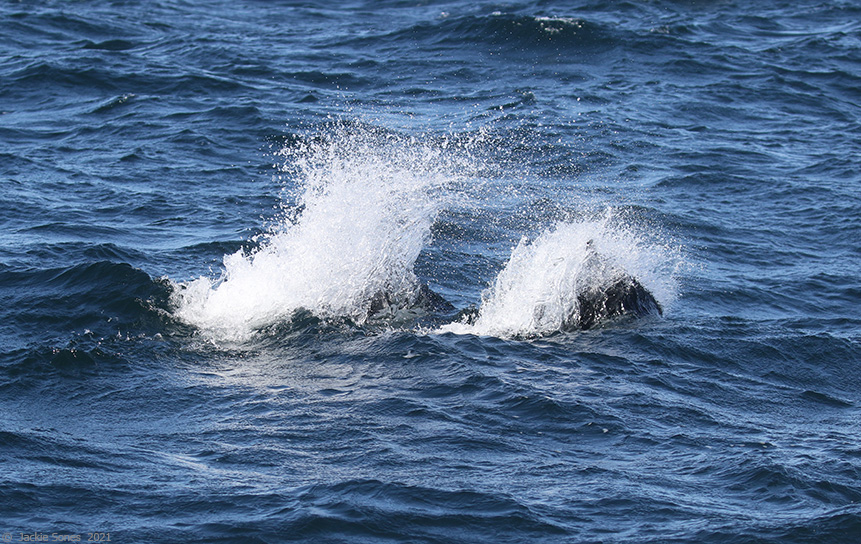
The distinctive forward-leaning splash (often called a "rooster tail") of a Dall's Porpoise (Phocoenoides dalli).  I felt lucky to capture one image with the porpoise somewhat visible (the dark body and the triangular dorsal fin).  A small group of porpoises approached the boat during the pelagic trip on 23 May 2021, but they didn't stay around very long.

Dall's Porpoises are very fast swimmers and create an explosive splash upon surfacing.  The splashes can look like white caps from a distance, but note there's a little more going on there:


Often you don't see much more than the splash itself:


But sometimes you catch a glimpse of the black bodies with contrasting white side panels:


P.S.  For a few more examples of Dall's Porpoises, you can check out the post from 12 September 2017. 

Tuesday, October 16, 2018

Riding the bow wave

I'm at a work-related meeting, so I haven't had much time today, but here's a Dall's Porpoise (Phocoenoides dalli) photo from the offshore boat trip on 14 October 2018:


For a little more information about Dall's Porpoises, review the post called "Splish..." on 12 September 2017.

Tuesday, March 6, 2018

Calm seas and rolling fins

I went for a short walk at the end of the day.  The Pacific Ocean off Bodega Head hardly ever looks like this, especially in winter.  Calm seas and hardly any wind:


I watched for whales, without any luck.  But I noticed some small, dark shapes appearing every now and then and with my binoculars confirmed they were Harbor Porpoises (Phocoena phocoena).

The porpoises were pretty far out — I'd guess ~3/4 mile off the coast — but close enough to see well with binoculars.  I did my best to capture a few photos for the record.  

Often you'd just catch a glimpse of one individual — a small back, with a short, triangular dorsal fin breaking the surface and then rolling forward:


There were some small groups of at least 3-4 individuals.  Here are two together:


Some of the birds were attracted to the porpoise activity.  Here's one porpoise with a gull and several cormorants:


How many porpoise can you see in the next photo?  [Click on it for a larger version.]
 

(There are three porpoises, one on the far left and another two just right of center.)


I think I probably observed at least 15 porpoises over ~45 minutes.  Because of their small size and short fins, it's usually hard to spot porpoises among larger waves or windy seas.  But it's worth looking for them on days like this!


Tuesday, September 12, 2017

Splish...

 ...Splash!

During the pelagic trip on Sunday (10 September 2017), we had great looks at a group of Dall's Porpoises (Phocoenoides dalli) as they swam alongside the boat.  

Dall's Porpoises are always fun to watch, but incredibly frustrating to photograph.  They're so fast — with swimming speeds up to ~30 knots (!), they're one of the fastest of the small cetaceans — and when they surface, it's usually with a very dramatic splash (often called a "rooster tail").  Mostly I end up with photographs of not much animal and a lot of splash.

Here's an example of a Dall's Porpoise surfacing:


Below, I've zoomed in so you can see different features. Dall's Porpoises are mostly black, so the bright white thoracic panel (coming up the side) stands out.  Above that you can see the triangular dorsal fin with a bit of gray frosting at the tip.  And note the small dark pectoral fin between the white panel and the head.


Just for fun, and because they create interesting patterns, here are some of my best Dall's Porpoise splashes of the day.  [Click on the pictures to see the finer details.]


If you'd like to learn more about Dall's Porpoises, check out these fact sheets from the American Cetacean Society and NOAA.
 

Wednesday, October 12, 2016

Splash!


I don't have much time tonight, but here are a few more photos from the offshore boat trip on 9 October 2016.

Can you see the pale triangular dorsal fin hidden within the splash in the photo above?

The dramatic splash itself is also a helpful hint used to identify this small cetacean.

Dall's Porpoises (Phocoenoides dalli) are known for their black-and-white patterning, their fast swimming speed, and their high, "rooster-tail" splashes.

In the image below, look for the white patch along the left side, the white at the trailing edge of the tail, and the white on the dorsal fin.  (There is also a textured white area in front of the dorsal fin — that's a concentration of bubbles.) 


And here's another example of that dramatic splash.  The splash makes it easier to identify Dall's Porpoises even when seen in the distance.


While Harbor Porpoises can be seen from shore, in this area Dall's Porpoises are most often encountered further out to sea.  If you're on a boat offshore of Bodega Head, keep an eye out for these handsome porpoises.

Wednesday, November 26, 2014

Breathe

Nice views of Harbor Porpoises (Phocoena phocoena) in Drakes Bay today, 26 November 2014: 


This was my favorite image: 


It might not seem like much at first, but you don't see Harbor Porpoise spouts that often, so I was happy to get a picture of one.  And it also felt appropriate to capture a picture of a "breath" today.

On the day and night before Thanksgiving, it felt appropriate to pause, breathe, and say thank you.

I'm very grateful for your support during the past year...for sharing a passion for natural history...for accompanying me on this journey to explore local landscapes and seascapes and all of the organisms and patterns that surround us.

Maintaining this blog this year was harder than ever, but meant more to me than I can express, so I thank you for your interest and patience.  I so appreciate all of your comments and inquiries and observations.  I hope you can see me smiling and nodding with understanding when I read them, and that you know they inspire me to continue.  I'm so glad you're out there, reading and learning with me.  Thank you.

P.S.  Now it's your turn to breathe.

Saturday, July 26, 2014

Phocoena phocoena

A few days ago, I was excited to see quite a few Harbor Porpoises (Phocoena phocoena) swimming not too far off of Bodega Head.  Yesterday I was disappointed to hear about this individual that washed up on the beach.  It wasn't alive, so if you're not comfortable viewing pictures of a dead porpoise, you'll want to skip this post.  

These situations have always generated mixed reactions for me — I'd rather see the animals alive and well, but it's an opportunity to learn more about a species that we don't get to see up-close very often.

Here are views from above and from the side.  The porpoise was between 5-6 feet long, the maximum length for a Harbor Porpoise.


Whenever I talk about porpoises, the question often comes up about how to tell the difference between a porpoise and a dolphin.

There are a few characteristics that are generally useful (but not always, because of some exceptions) — like a blunt snout, rather than a long, pointed snout:


And a short, triangular dorsal fin, rather than a taller, falcate dorsal fin:


But one of the best characteristics (although it's not a great one if you're watching a swimming animal!) is the shape of teeth.  Porpoises have flattened, spade-shaped teeth, while dolphins have sharper, conical teeth:


When ocean conditions are very calm, that's your best chance for seeing Harbor Porpoises.  They're small enough that they don't rise very far above the surface, and they don't generate much of a "blow" when they breathe.  So when the ocean is flat, use binoculars to watch for their small arching backs and triangular dorsal fins.  (I posted a few photos of them in Washington last spring.)

For more information about Harbor Porpoises, check out the OBIS-SEAMAP web page.