If you're interested in using any of these photographs or this content in any way, please contact me. Send an e-mail to naturalhistoryphotos(at)gmail.com. Thanks!
Showing posts with label corvid. Show all posts

Thursday, April 24, 2025

Hidden treasures


Each spring, when Eric turns over the soil in our garden, he finds small, often shiny objects that had been buried in the soil.  Shown above is the collection of objects he discovered in the soil last weekend.

We think this is the work of local California Scrub-Jays (Aphelocoma californica).  Interestingly, some of these things aren't from our yard, but more likely from other yards in the neighborhood.

I tried to find more information about why jays might have a penchant for shiny objects like these.  Although I found quite a bit of information about jays caching food items like acorns (a note that we also find peanut shells in our garden), I couldn't find too much about hiding non-food objects.

Do you also see jays hiding shiny trinkets in your yard?

Tuesday, May 21, 2024

Empty nest


During the past month or so we've been enjoying watching a California Scrub-Jay (Aphelocoma californica) nest right outside our kitchen window.  We estimated the four chicks might fledge this week, and sure enough, when we returned home from work tonight, the nest was empty.

Interestingly, when California Scrub-Jays fledge, they are unable to fly.  They spend time in nearby branches and on the ground, and the parents continue to feed them for a month or longer after they leave the nest.  

This fledgling is ~22 days old.  Photographed in Cotati on 21 May 2024.

Sunday, November 14, 2021

Merlin, the Magician


Whew!  We've been attending a virtual meeting during the last few days — which means a lot of time looking at a computer screen.  So it was nice to get out for a walk around the neighborhood in the late afternoon, and even nicer to see a Merlin (Falco columbarius)!

If you're not familiar with them, Merlins are small falcons, a bit larger than American Kestrels but smaller than Peregrine Falcons.  They're generally darker than kestrels...and note the relatively dark face and the pale stripe above the eye:


The Merlin was joined in this tree by an American Crow, making it easy to compare the size difference:
 
 
Merlins are ~10-12" long with a wingspan of ~24-25", while American Crows are ~17.5" long with a wingspan of ~39".

Monday, March 15, 2021

Raven series


Wow, was it windy in Bodega Bay today!  Northwest winds at something like 20-30 knots with gusts to 35 knots (~25-35 mph with gusts to ~40 mph).  I stepped out to take a quick photo to document the conditions and came across this Common Raven (Corvus corvax) with its feathers being ruffled by the wind. 

The raven flew to a more sheltered location and seemed to express a little weariness, as people often do, too, in these blustery conditions:


And then a second raven approached.  The first raven bowed its head, a position usually taken for allopreening (when one raven preens the other during pair bonding):


The preening continued for several minutes, with work on feathers around the head, neck, and bill:


I can't resist including two more.  Lots of interesting reflections highlighting their beautiful feathers:


Thursday, May 21, 2020

Baby blue eyes

A quick shot from our backyard last night (20 May 2020):


This year a pair of American Crows (Corvus brachyrhynchos) nested in a tree in our backyard.  The juveniles (at least two of them) just left the nest and are starting to walk around the tree, jumping from branch to branch and taking short flights.  

I was struck by the beautiful blue color of their eyes.  Apparently the eyes will be blue for ~2 months, then turn to gray and then brown.  Note also the pink gape (at the inner corner of bill), which will be visible for ~3 months.

Perhaps because we've been home more during the shelter-in-place order, we've seen quite a few fledglings in our yard.  Along with the Oak Titmice, Bushtits and American Crows, we've also seen juvenile Bewick's Wrens recently.

Saturday, March 14, 2020

The nutcracker

We walked along the beach with a raven for a little while this afternoon (14 March 2020).  It was searching the wrack line for potential food.  At one point the raven found a walnut (see below).  [I think the walnuts wash down the creeks and rivers and then end up on the beaches.]


The raven walked over to a piece of driftwood and held the walnut in place with its foot:


 Then it tried to open the walnut by hammering it with its bill:


This walnut was apparently too hard to crack, or the raven decided it wasn't worthwhile, so it left the walnut behind and started searching for something else.
 

Tuesday, March 3, 2020

Eating crab on the beach


So intriguing to watch this Common Raven (Corvus corvax) find, dismantle, and eventually eat this Kelp Crab (Pugettia producta) that had washed up in the wrack line.


Saturday, February 1, 2020

For 02/02/2020

Some sets of two for tomorrow's very special date02/02/2020.


Two Common Ravens (Corvus corvax)


Two Tolmie's Star Tulips (Calochortus tolmiei)


Two River Otters (Lontra canadensis


Two Red Octopus (Octopus rubescens) paralarvae 


Happy 2020 palindrome day!

Friday, October 18, 2019

Head-scratcher


Common Raven (Corvus corvax) scratching its head.

And in profile:


Wednesday, March 7, 2018

Majestic


Common Raven (Corvus corvax), 19 December 2017

Tuesday, November 28, 2017

Acorns for dinner


American Crow (Corvus brachyrhynchos) eating an acorn in our yard on 23 November 2017

Tuesday, November 21, 2017

In the morning sun


Common Ravens (Corvus corvax), 21 November 2017
 

Wednesday, July 12, 2017

Beach walk


Common Raven (Corvus corvax), 12 July 2017 
 

Tuesday, June 6, 2017

Young explorers


We've been enjoying watching a new family of California Scrub-Jays (Aphelocoma californica) explore our backyard.  At least four juveniles fledged from a nest in a tree in the corner of our yard.  (No wonder the adults were so busy during the last few weeks!)  Compared to the adults, note the shorter bill and the pale gape (pinkish stripe at the base of the bill).  The juveniles are also grayer and softer looking, and their wings are shorter.


To compare these juveniles with adult California Scrub-Jays, review photos from posts on 6 November 2015 and 13 December 2015.

CORRIGENDA (7 June 2017):  David wrote to point out that there has been a taxonomic change with scrub-jays.  So in this post I've changed the common name of this species from Western Scrub-Jay to California Scrub-Jay.  (Recently, the "Western Scrub-Jay" was reclassified into two species based on differences in distribution, morphology, behavior, DNA, etc.  The second species is now called Woodhouse's Scrub-Jay (Aphelocoma woodhouseii) and is found in the southwestern part of the country.)

Thursday, March 30, 2017

Gathering


Common Raven gathering nest material, 28 March 2017

Thursday, March 23, 2017

Smorgasbord

The local ravens have been sampling a diversity of food items:

Scavenging a seabird:


Dodging the waves while digging for mole crabs:


Assessing a large seed:


Sharing a fish: 


What have you seen them eating?
Thursday, February 2, 2017

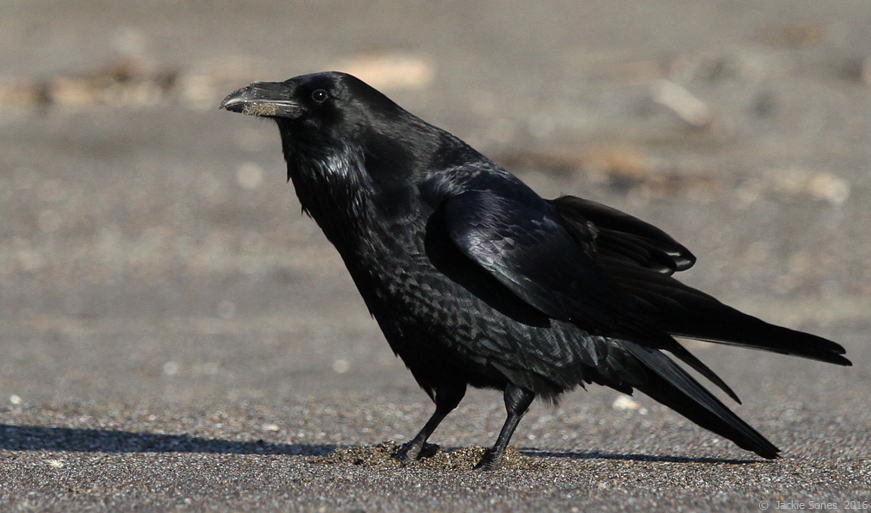
Taking a break

  
I didn't get a chance to share this one — Common Raven, taking  a break from digging in the sand.  Photographed on Salmon Creek Beach, 1 November 2016.
 

Monday, January 9, 2017

Overlooking the Pacific


Common Raven and lichen-covered rocks, Bodega Head, 28 December 2016.

Sunday, September 11, 2016

"crow-motion"


Very large flocks of American Crows (Corvus brachyrhynchos) have been flying by our house around sunset.   

This is our second year at this house.  Last year the crows had a roost site to the south, but this year the roost is apparently to the north.  

Tonight a flock paused and circled overhead for a few minutes before continuing on.  They were very vocal, and it was hard not to look up and wonder what all of the "crow-motion" was about...


Friday, March 25, 2016

Glossed with purplish blue


Common Raven (Corvus corvax), 25 March 2016

I believe this is the female of a pair.  I love the purplish iridescent sheen of her feathers.  (The Birds of North America account describes it as "glossed with purple to purplish blue.")