This is an older photo, but I came across it the other day and was intrigued. Common Raven (Corvus corax) nest with two eggs photographed on Bodega Head on 14 May 2016.
If you're interested in using any of these photographs or this content in any way, please contact me. Send an e-mail to naturalhistoryphotos(at)gmail.com. Thanks!
Showing posts with label raven. Show all posts
Monday, February 16, 2026
Monday, March 15, 2021
Raven series
Wow, was it windy in Bodega Bay today! Northwest winds at something like 20-30 knots with gusts to 35 knots (~25-35 mph with gusts to ~40 mph). I stepped out to take a quick photo to document the conditions and came across this Common Raven (Corvus corvax) with its feathers being ruffled by the wind.
The raven flew to a more sheltered location and seemed to express a little weariness, as people often do, too, in these blustery conditions:
And then a second raven approached. The first raven bowed its head, a position usually taken for allopreening (when one raven preens the other during pair bonding):
The preening continued for several minutes, with work on feathers around the head, neck, and bill:
Saturday, March 14, 2020
The nutcracker
We walked along the beach with a raven for a little while this afternoon (14 March 2020). It was searching the wrack line for potential food. At one point the raven found a walnut (see below). [I think the walnuts wash down the creeks and rivers and then end up on the beaches.]
The raven walked over to a piece of driftwood and held the walnut in place with its foot:
Then it tried to open the walnut by hammering it with its bill:
This walnut was apparently too hard to crack, or the raven decided it wasn't worthwhile, so it left the walnut behind and started searching for something else.
Tuesday, March 3, 2020
Eating crab on the beach
So intriguing to watch this Common Raven (Corvus corvax) find, dismantle, and eventually eat this Kelp Crab (Pugettia producta) that had washed up in the wrack line.
Saturday, February 1, 2020
For 02/02/2020
Some sets of two for tomorrow's very special date — 02/02/2020.
Two Common Ravens (Corvus corvax)
Two Tolmie's Star Tulips (Calochortus tolmiei)
Two River Otters (Lontra canadensis)
Two Red Octopus (Octopus rubescens) paralarvae
Happy 2020 palindrome day!
Labels:
bird,
cephalopod,
corvid,
mammal,
mollusc,
mustelid,
octopus,
raven,
river otter,
wildflowers
Friday, October 18, 2019
Tuesday, May 29, 2018
The mob
I walked across the parking lot at work this morning to see a lot of commotion in the distance. Can you tell what was going on?
A Great Horned Owl (Bubo virginianus) was being mobbed by Brewer's Blackbirds (Euphagus cyanocephalus), a Common Raven (Corvus corvax), and at least one Barn Swallow (Hirundo rustica).
Eventually the owl had enough and it flew off with all of the other birds "in tow" until it found shelter in a tree.
Wednesday, March 7, 2018
Tuesday, November 21, 2017
Wednesday, July 12, 2017
Thursday, March 30, 2017
Thursday, March 23, 2017
Smorgasbord
The local ravens have been sampling a diversity of food items:
Scavenging a seabird:
Dodging the waves while digging for mole crabs:
Assessing a large seed:
Sharing a fish:
What have you seen them eating?
Thursday, February 2, 2017
Taking a break
I didn't get a chance to share this one — Common Raven, taking a break from digging in the sand. Photographed on Salmon Creek Beach, 1 November 2016.
Labels:
bird,
corvid,
raven,
salmon creek beach,
songbirds
Monday, January 9, 2017
Friday, March 25, 2016
Glossed with purplish blue
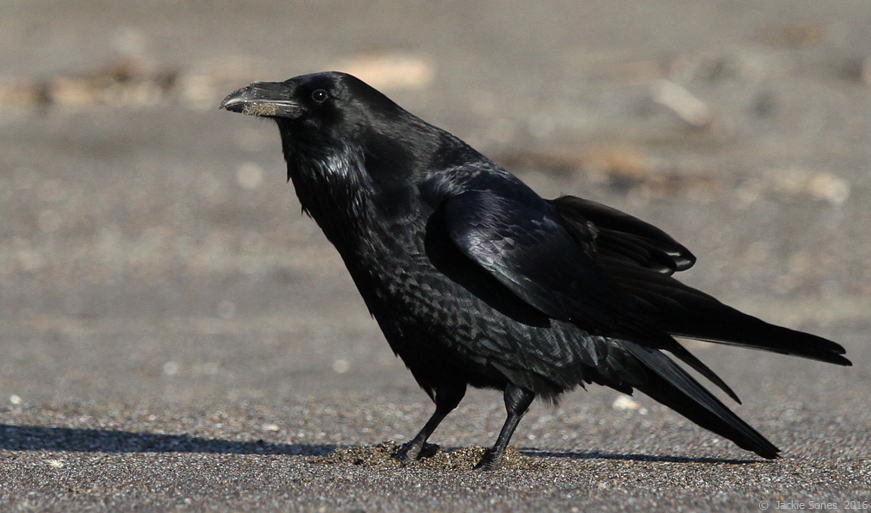
Common Raven (Corvus corvax), 25 March 2016
I believe this is the female of a pair. I love the purplish iridescent sheen of her feathers. (The Birds of North America account describes it as "glossed with purple to purplish blue.")
Sunday, February 14, 2016
Calling from Petaluma
I recorded some fun bird calls and songs in Petaluma this weekend.
Do you want to try to guess which species of birds they are?
I'll reveal the answers at the end of this post.
[If you're reading this in an e-mail, click on the title of the post above to go directly to the website to see the audio files.]
Be sure to turn up the volume of your speakers. (Listening with headphones is even better.)
Here's Sound 2. In this case you'll also hear three different series of notes, but this time the notes are loud whistles and gurgles.
Here's Sound 3. There's some background sound, but focus on the clear, whistled note. You'll hear the note five times — at about 1, 4, 6, 9, and 11 seconds.
Okay, are you ready for the answers?
Sound 1: Common Raven (Corvus corvax). This is sometimes referred to as a percussion-like call. Some liken it to a drumming woodpecker. It's apparently only given by females.
Sound 2: Western Meadowlark (Sturnella neglecta). An impressive vocal array.
Sound 3: Loggerhead Shrike (Lanius ludovicianus). I don't know much about shrike vocalizations, but I was intrigued by this beautiful call note. I couldn't find a good written description of it, and only came across one other recording that was somewhat similar. Have you heard shrikes calling like this? Is it a sound that just hasn't been described very well? Or is there geographical variation in shrike call notes?
Now that you've heard the shrike, here are two pictures of the individual that was calling:
Do you want to try to guess which species of birds they are?
I'll reveal the answers at the end of this post.
[If you're reading this in an e-mail, click on the title of the post above to go directly to the website to see the audio files.]
Be sure to turn up the volume of your speakers. (Listening with headphones is even better.)
Here's Sound 1. There are some background sounds, but listen for the hollow, knocking notes. You'll hear three different series of these notes —
at about 3 seconds, 10 seconds, and 16 seconds.
Here's Sound 2. In this case you'll also hear three different series of notes, but this time the notes are loud whistles and gurgles.
Here's Sound 3. There's some background sound, but focus on the clear, whistled note. You'll hear the note five times — at about 1, 4, 6, 9, and 11 seconds.
Okay, are you ready for the answers?
Sound 1: Common Raven (Corvus corvax). This is sometimes referred to as a percussion-like call. Some liken it to a drumming woodpecker. It's apparently only given by females.
Sound 2: Western Meadowlark (Sturnella neglecta). An impressive vocal array.
Sound 3: Loggerhead Shrike (Lanius ludovicianus). I don't know much about shrike vocalizations, but I was intrigued by this beautiful call note. I couldn't find a good written description of it, and only came across one other recording that was somewhat similar. Have you heard shrikes calling like this? Is it a sound that just hasn't been described very well? Or is there geographical variation in shrike call notes?
Now that you've heard the shrike, here are two pictures of the individual that was calling:
Monday, January 18, 2016
Sunday, July 26, 2015
Close
The raven chicks are getting close to fledging now. This photo was taken on 20 July 2015 when the four nestlings were ~5 weeks old. Perhaps they'll start to fly this week or next?
(To track their progress, review previous posts on 26 June 2015 and 8 July 2015.)
P.S. Two of the Bottlenose Dolphins I posted about on 13 July 2015 have been identified! Check out the new information in the addendum here.
Wednesday, July 8, 2015
Semi-gloss
Remember the "Gargoyles by the sea" from 26 June 2015? I went back to check on them, so here's an update:
All four raven chicks appear to be doing well. They've grown quite a bit in the 12 days between these visits. The chicks are now ~3.5 weeks old.
I'm guessing they probably have a couple more weeks in the nest. After fledging, they'll stay in the area for at least a few weeks, still being fed by the parents.
It's fun to see their glossy feathers, and the development of classic raven postures and behaviors.
Friday, June 26, 2015
Gargoyles by the sea
In 1945, Tyrrell wrote "The young, when hatched or only a day or two old, are not things of joy and beauty. In fact, they reminded us of grotesque gargoyles." I suppose it's true that raven nestlings are not quite as regal as their parents —
it takes a few weeks until they're fully feathered. But look at that mouth! I was impressed with both the width and the color. Even without an adult nearby, these chicks were reaching around with their bills wide open, waiting for a delivery of food.
I'm guessing these raven nestlings are about 2 weeks old. (They'll leave the nest after 5-7 weeks.) They were photographed on Bodega Head on 25 June 2015. I was far away from this nest, but cropped the picture later to view the number and condition of the nestlings. How many can you find?
Subscribe to:
Posts (Atom)