If you're interested in using any of these photographs or this content in any way, please contact me. Send an e-mail to naturalhistoryphotos(at)gmail.com. Thanks!
Showing posts with label crab. Show all posts

Tuesday, March 25, 2025

The flip side


Last week I was watching a small group of Ruddy Turnstones (Arenaria interpres) along the shore of Bodega Harbor.  At first they were resting, but then they started feeding among the cobbles, actively flipping stones in search of prey.

Below is a short video clip showing the active turning-stone behavior.  [At ~12 seconds, a Black Turnstone (Arenaria melanocephala) enters the frame from the right.]


The turnstones appeared to be quite successful finding prey.  Sometimes it was hard to tell what they captured, but several times I could see small shore crabs in their bills:

 
Crab for lunch!

Thursday, April 11, 2024

Bearing a clever defense


Sometimes it's hard to choose which photos to share, but I couldn't resist posting this Teddy Bear Crab (Polydectus cupulifer) from Hawai'i.

This crab is covered with dense setae (chitinous bristles), making it look very fuzzy.  

And check out the area near the tips of its claws.  Can you see how it looks a bit softer there and how it's a slightly different color than the crab (and lacks bristles)?  

Teddy Bear Crabs carry a small sea anemone in each claw.  [They usually choose Pleasing Anemones (Telmatactis decora).]  I read that the sea anemones might be used to defend against predators or in feeding.

Photographed near Honolulu on 7 April 2024.

Monday, April 8, 2024

‘ōhiki sampler


Here's a bit of an ‘ōhiki, or ghost crab, sampler from Hawaii.

Above, a Horn-eyed Ghost Crab (Ocypode ceratopthalmus) on the north shore of O'ahu on 29 March 2024.  This is a large crab, with a carapace of ~4 cm (~1.5 inches) across.

Below, examples of Pallid Ghost Crabs (Ocypode pallidula), the first two from the north shore of O'ahu on 29 March 2024 on coarse sand, and the third from the south shore of Kaua'i on 3 April 2024 on fine sand. 

[You can click on the images for larger versions.]


Interesting to see the different color patterns of the Pallid Ghost Crabs on different beaches.  
 
And just like the ghost crab species on the Atlantic Coast, these crabs are incredibly fast, so hats off to Eric for his persistence in photographing them!

Thursday, February 29, 2024

Fuzzy


Eric found this nice juvenile porcelain crab last weekend.  Meet the Pubescent Porcelain Crab (Pachycheles pubescens)!

I realized I haven't shown this type of crab on the NHBH before, and there's a more common species (Pachycheles rudis) that I should also introduce, so I'll try to do that at some point, too.

Meanwhile, note the short and very dense hairs on the claws giving this crab a pubescent or fuzzy appearance. 

Found in the low intertidal zone among some cobbles.

Wednesday, November 22, 2023

Feasting on crab


There have been lots of folks fishing for crab off Bodega Head this week.


Once caught, it's important to handle your crab carefully.


And then it's time to enjoy it!
 
P.S.  Eric and I are sending warm wishes your way for a day with moments of gratitude.  Perhaps it will include a little time outside giving thanks to our wild neighbors?  And many thanks for tuning in to the Natural History of Bodega Head.  I so appreciate your company on this journey to learn about the natural world around us!

Tuesday, July 11, 2023

Nothing to see here

 
Eric and I have encountered several of these small decorator crabs during the last month or so.  We don't recall seeing them before (in the intertidal zone in the Bodega Bay area), so I'm posting a photo for the record.  
 
It's possible we've missed them, or that they more often occur in subtidal areas.  And maybe a lot of juveniles survived this year, so they're showing up in more places and in sites where they're not as commonly seen in most years.
 
Perhaps it's even hard to tell that this is a crab?  Meet the Masking Crab (Loxorhynchus crispatus).  "Masking" because they attach algae and bits of other animals to their rostrum and carapace (e.g., sea squirts and sponges) and the decorations serve as excellent camouflage.

The individuals we've seen this summer are all smaller juveniles, only ~2 cm across.  Photographed on 6 July 2023.

Saturday, December 24, 2022

Sandy claws


A few days ago Eric and I were walking along the beach during the Yuletide when we came across these sandy claws.  :)

Happy holidays to all!

P.S.  The claws belong to a Spiny Mole Crab (Blepharipoda occidentalis).

Tuesday, July 12, 2022

Hiding among the mussels


Quick shot of a Flat Porcelain Crab (Petrolisthes cinctipes) in a mussel bed, 12 July 2022.

Saturday, July 9, 2022

Nibbling


I was helping Emma and Fern scout some potential research sites this afternoon (9 July 2022) and we started to notice some Western Tussock Moth caterpillars (Orgyia vetusta) in the high intertidal zone.  Eventually we discovered that the caterpillars were coming from the top of the bluff where they had been feeding on lupines.  At one point Fern looked down to see the scene shown above — a Lined Shore Crab (Pachygrapsus crassipes) feeding on one of the caterpillars!  I haven't seen this before, so it seemed worth documenting.

Earlier in the day I had noticed a few of these caterpillars, but in this case what caught my eye is that the caterpillars were eating seaweed!  Here's a Western Tussock Moth caterpillar nibbling on Ulva intestinalis:

 
P.S.  With thanks to Fern and Emma for sharing their observations today!

Wednesday, March 30, 2022

Dashing


Juvenile Hairy Rock Crab (Romaleon jordani, formerly Cancer jordani) with a fun color pattern.  Thanks to Eric for spotting it!

Friday, December 24, 2021

Christmas decoration


Since many folks are decorating at this time of year, we thought you might enjoy seeing this local decorator crab.  Meet the Cryptic Kelp Crab (Pugettia richii)!  They're known as decorator crabs because they add pieces of seaweed to their rostrum (nose) and carapace (back) for camouflage.  In the photo above, the narrow red-brown seaweed and the green leafy seaweed are attached to the back of the crab.
 
If you look closely on the backs of the crabs, you can even see the specialized hooks for holding seaweed.  Below, look for the clusters of narrow curved hooks near the base of the seaweed.  The crab pushed the seaweed under these hooks to hold it in place.  The better to hide from fish and octopus!
 
 
Happy Holidays to all!

Wednesday, April 22, 2020

Masters of camouflage

Here's a fun comparison.  A wonderful grasshopper from the Bodega Dunes:


Below is the same grasshopper viewed from the side.  It's amazing how well the colors and markings match the sand grains.  It almost renders them invisible (especially when seen from a distance).


Reviewing these photos made me think of Ghost Crabs (Ocypode quadrata) from the East Coast.  Although the coloration is finer grained, the palette is similar.  They're both masters of camouflage!


Tuesday, March 3, 2020

Eating crab on the beach


So intriguing to watch this Common Raven (Corvus corvax) find, dismantle, and eventually eat this Kelp Crab (Pugettia producta) that had washed up in the wrack line.


Monday, July 22, 2019

Plane to see?


Can you miss something that you've hardly ever seen?  Sometimes I think back to this discovery of a "rafting crab" in 2016.  That's the only time I've seen this species of pelagic crab.  I wonder if I'll ever see another one?

Planes sp., found on a piece of driftwood washed ashore on Salmon Creek Beach in March 2016.

P.S.  See earlier post about this species called "Rafting out at sea" on 9 March 2016.

Wednesday, November 14, 2018

Sand sculpture


A rock crab (Romaleon antennarium, formerly Cancer antennarius) buried beneath the sand.  I like the way you can see that it's a crab just by the impressions left at the surface.  It looked a bit like a sand sculpture!

Thursday, September 13, 2018

A little furry


Last month we found a very small juvenile Furry Crab (Hapalogaster cavicauda).  The width of the carapace (the back) of the crab was only ~4 mm across.  It was clinging to a patch of pink Derby Hat Bryozoan (Eurystomella bilabiata) in the low intertidal zone.  

P.S.  I've written about this species before, so if you'd like to see what this crab looks like when it's older, check out the post called "Soft belly" on 21 February 2017.
 

Wednesday, July 25, 2018

Nope, no Red Rock Crab here! (just kidding)

 
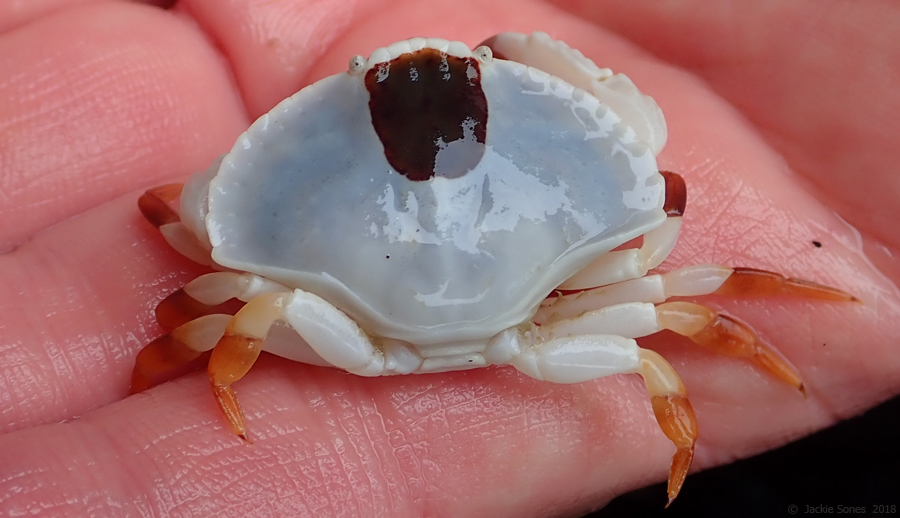
Although you might be familiar with adult Red Rock Crabs (Cancer productus) that are primarily red, juvenile Red Rock Crabs come in a variety of color forms (see below).  We don't see the form shown above (mostly white with a large brown spot) as often, so I thought it would be fun to document.

Here are some of the color patterns that are possible in juvenile Red Rock Crabs (below).  [As they grow, after several molts, the crabs will become uniform red.]


Figure from Krause-Nehring, J., J.M. Starck, and A.R. Palmer.  2010.  Juvenile colour polymorphism in the red rock crab, Cancer productus: patterns, causes, and possible adaptive significance.  Zoology 113: 131-139.

This is a fascinating story.  The basic hypothesis that's been proposed for why there are so many juvenile color patterns involves natural selection imposed by visual predators (e.g., fish) that form search images.  As rare color patterns evolve, they avoid detection by visual predators and are successful.  Eventually predators might catch on to the new color pattern if it becomes common, but new patterns that arise will again enjoy an advantage.  Over long periods of time, more and more color patterns may accumulate through these processes.

If you encounter juvenile Red Rock Crabs when you're tidepooling, it's fun to see how many different color patterns you can find!

Friday, March 30, 2018

Spring cleaning

If you've looked closely at a porcelain crab, you've probably noticed that it has a large pair of claws and three pairs of striped walking legs.  The photo below shows the Chocolate Porcelain Crab (Petrolisthes manimaculis).  They're found under cobbles and boulders in the rocky intertidal zone. 


It's easy to overlook that porcelain crabs also have a 5th pair of limbs that are greatly reduced in size relative to the walking legs.  Porcelain crabs along with some other types of crabs (such as hermit crabs, mole crabs, and pelagic red crabs) belong to a taxonomic group called the Anomura.  Unlike Cancer crabs, kelp crabs, and other “true crabs,” anomuran crabs never use their last (or 5th) pair of limbs for walking.  In the drawing below, the 5th pair of limbs are marked with red arrows:    

 
Modified from Fleischer, J., M. Grell, J.T. Hoeg, and J. Olesen. 1992. Morphology of grooming limbs in species of Petrolisthes and Pachycheles (Crustacea: Decapoda: Anomura: Porcellanidae): a scanning electron microscopy study. Marine Biology 113: 425-435.

These appendages are small enough that they are easy to miss.  The close-up photo below shows this 5th pair of limbs marked with black arrows:


Given the small size of these appendages, one might wonder if they are vestigial structures that no longer serve a useful function?

Well, it turns out that in porcelain crabs, these appendages are actually important for grooming.  The slender grooming limbs can be folded up like a jackknife when not in use, but they are remarkably long and flexible when extended.  As you can see in Siena’s drawing below, the grooming limbs end in a claw.  They are also covered with several types of bristles (or setae).


Drawing by Siena Watson.  Modified from Fleischer et al. 1992.


The grooming limbs are used both to clean the gills within internal chambers and to clean the external surface of the crab of detritus, debris, parasites, and other attached organisms.  The bristles act as cleaning brushes, whereas the toothed claw is well equipped to remove objects that are more firmly attached.  Some of the bristles on the claw are sensory structures that appear to allow the crab to both feel and taste the objects that are encountered during grooming.

Eric captured some nice video of the grooming limb of a porcelain crab in action.  Porcelain crabs are suspension feeders.  Near the beginning of the video you will see the crab sweeping its specialized fans through the water to capture food.  Then the crab starts using one of its grooming limbs (white arrow at ~15 seconds) to vigorously scrub around its back, eyestalks, and long red antenna!  It is amazing to see the flexibility and dexterity of the limb as it diligently cleans and grooms.


[Apologies for not posting more this week.  I'm recovering from surgery on Monday, and my ability to stay upright is more limited than I had hoped.  I'm feeling better now though, and I hope to resume more frequent postings in the near future.  For now, Eric offered to help put together the information for a really fun post.  Many thanks to Eric and Siena!]
 

Tuesday, February 27, 2018

Under the umbrella

Perhaps it's because there's rain in the forecast (finally!) — recently I was thinking about Umbrella Crabs (Cryptolithodes sitchensis).


This is an unusual crab.  The edges of the carapace are expanded outward (like a shield).  So although the legs are visible in the picture above, when they're pulled in the legs are completely concealed (when the crab is viewed from above).

Here's a look at the crab's underside.  Note how all of the legs fit entirely inside the edges of the carapace (including the first pair with claws, even though one is flexed in the photo).


Also note that the abdomen (triangular piece between the legs) has an interesting pattern, somewhat similar to scutes on a turtle shell.  [This species is also known as a Turtle Crab, probably because of the way the shell covers all of the body parts.  But I also wondered if that name could have been derived (in part) from the abdominal pattern?]

Umbrella Crabs are highly variable in color.  Here's another example (below).  [And for a wonderful overview of the many color patterns in this species, check out these photos on iNaturalist.]


The genus, Cryptolithodes, means "hidden like a rock."  When the crab is viewed from above with its legs tucked underneath, it can look very much like the surrounding rock!  (I hear they're eaten by fish and octopus, so perhaps there's an advantage to being well camouflaged.)

These crabs are usually whitish underneath; pictured below is the same individual as shown above.  (Can you find the short, red-and-white striped antennae?)


I haven't observed it myself, but I read that Umbrella Crabs eat coralline algae (!).

One more view — a close-up of the eyes peaking out from the sides of the shelf-like rostrum:


Let's hope that thinking about Umbrella Crabs leads to a need to carry an umbrella!

Friday, November 17, 2017

The violinist of the Pacific

When I heard we would be at a meeting near Newport Bay, I wondered if we'd have a chance at seeing a fiddler crab.  There's only one species of fiddler crab in California, and I vaguely remembered that its northern range limit is near Newport Bay.  (They are now found as far north as Santa Barbara.)

We took a drive along the shore of Upper Newport Bay and stopped to check the upper edges of the marsh.  It didn't take long to spot them!  Meet the Crenulated Fiddler Crab (Leptuca crenulata):


Here's another male with its burrow nearby:


And a female, with two smaller claws (instead of one larger and one smaller claw):


Later, when reviewing photos, I also spotted a few juvenile fiddler crabs.  Can you find the juveniles in the picture below?  (Hint: They're near their small burrows.)


There are two juveniles in the picture — see yellow arrows below:


P.S.  When I was reviewing the common name of this species, I encountered several versions — e.g., Mexican Fiddler Crab, California Fiddler Crab, Crenulated Fiddler Crab.  Because the geographic range spans both (Southern) California and Mexico, it was hard for me to justify using either of those names.  It's always helpful when the common name is linked to something in the scientific name, so I used Crenulated Fiddler Crab in this post.  "Crenulated" means having an irregular, e.g., notched or scalloped, outline.  

I also encountered an alternative Spanish name for this species — Cangrejo violinista del Pacifico.  I think that translates into "Violinist crab of the Pacific."  The "violinist" portion refers to the movement of the male's large claw during courtship.