During our first few days in Iceland, we were fortunate to find some excellent tidepooling locations. We've been taking lots of photographs, but it's hard to find time at the end of the day to write a complete post , so I'm sharing a few fun highlights for now.
Tuesday, September 1, 2026
Tidepooling at 66° North
Tuesday, July 1, 2025
Flecktones?
A nice little chiton for you — a juvenile Lepidozona radians.
Photographed in the low intertidal zone on 29 June 2025.
Wednesday, June 4, 2025
A hat trick?
We were focused on other species while doing surveys along the coast in Mendocino County last weekend, but along the way Eric spotted several nice chitons. Above, meet Tripoplax regularis. (Also refer to the post called "The original sequins" on 26 February 2017.)
Below, this looks like a species of Mopalia, but we're not sure which one. We wondered about Mopalia imporcata, a species we're not familiar with. If anyone has thoughts about the identity of this chiton, we'd be interested!
Saturday, April 27, 2024
Holding fast?
Friday, March 8, 2024
A chiton with flair
Eric snapped this great photo of a Veiled Chiton (Placiphorella velata) during field work this afternoon (8 March 2024). Impressive how well this species looks like the surrounding habitat — rock, coralline algae, and red seaweeds. This individual even has a little bit of branching coralline algae growing on its shell plates!
Here's another image from a little farther back:
Sunday, August 7, 2022
Plates of salmon
Eight plates for 8/8!
This is a large chiton photographed at Point Arena on 3 June 2022. I think it's a species of Stenoplax (perhaps S. heathiana?), but I haven't seen this group of chitons that often. I loved the salmon color of the plates!
Wednesday, August 11, 2021
Camouflaged like coralline
Eric took this beautiful photo of a Veiled Chiton (Placiphorella velata) found with his class today (11 August 2021):
I love the pink and white striping...the color matches the crustose coralline algae growing on the rock. And note that the chiton's plates are festooned with small tubeworms (white or gray calcareous tubes with bright orange tentacles).
For more information about this carnivorous (!) chiton, check out this earlier post from 21 August 2012.
P.S. Thanks for sharing, Eric and summer students!
Thursday, July 1, 2021
White with maroon accents + update about blog e-mails
A very nice chiton called Lepidozona radians. This species is known for being highly variable in color. Most of the individuals we've found in Sonoma County have been more brownish overall, with radiating flecks on the plates (see note below). But during a recent low tide we came across several individuals with this white and maroon combination. Interesting!
P.S. For a look at a different color form, check out the post called "The original sequins" on 26 February 2017.
P.P.S. I've been informed that the service for sending out e-mails with NHBH blog posts will no longer be offered starting this month. I'll be looking into a new one, and I hope I can transfer everyone over to a new service, but if not, watch for a note here (on the NHBH website) with a new way to subscribe to receive blog posts via e-mail. Sorry about this! I'm not that savvy about these types of things, but I'll be working on a solution.
Saturday, June 12, 2021
A van Gogh or a galaxy?
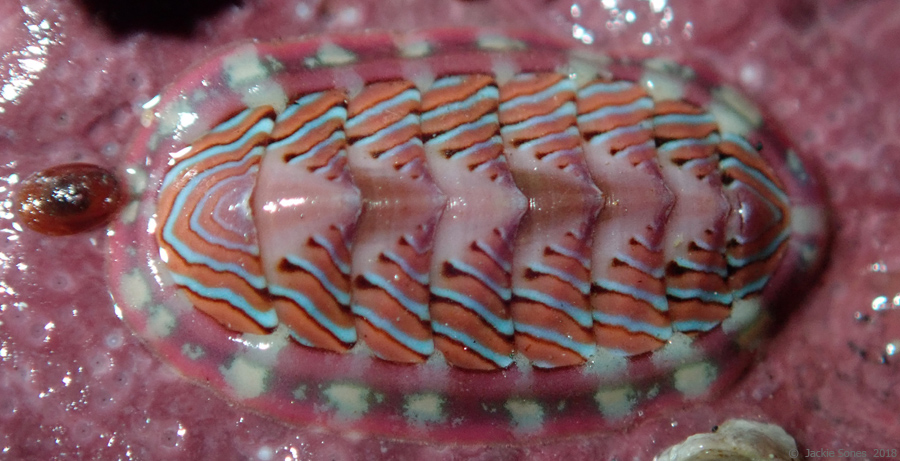
A close-up of the girdle or margin of a Woody Chiton (Mopalia lignosa), photographed on 12 June 2021. In the field, Eric noticed the amazing colors and patterns, especially the different shades of blue. It reminded him of a celestial sky in a van Gogh painting, while it made me think of looking out at a galaxy:
Sunday, February 14, 2021
Red end of the spectrum
There's a lot of red in the intertidal zone, along with pinks and oranges and golds at that end of the color spectrum. Sometimes it's fun to scan across different species to see the color similarities. Here's a little tour from a recent outing:
Aldisa sanguinea (nudibranch)
Clam siphons
Sunday, July 26, 2020
Beads and bristles
Monday, July 13, 2020
The tail end
We were looking for something else, so we had to continue our surveys, but I took a few quick photos for the record.
Sunday, March 3, 2019
Zigs and zags
Sunday, February 24, 2019
Waiting
Monday, February 18, 2019
All together now
Monday, January 21, 2019
High and low
Monday, August 13, 2018
Little ones
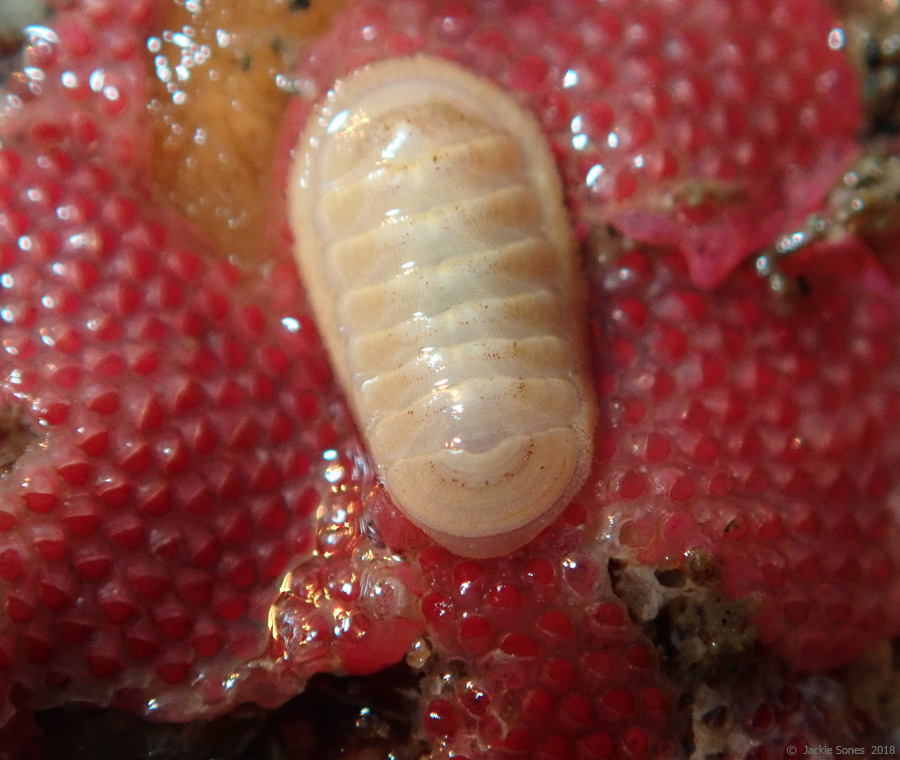
This year Julia introduced us to a wonderful chiton called Leptochiton rugatus. This is a small chiton — at full size, it only reaches lengths of ~12 mm (~0.5 inches). Most of the individuals we've encountered have been ~6-7 mm long.
During the past few months we've taken a few photos of Leptochiton rugatus for the record. Here's a nice view of three individuals on a patch of Derby Hat Bryozoan (Eurystomella bilabiata):