If you're interested in using any of these photographs or this content in any way, please contact me. Send an e-mail to naturalhistoryphotos(at)gmail.com. Thanks!
Showing posts with label kinglet. Show all posts

Thursday, December 21, 2023

Happy Solstice!


Close-up of a Ruby-crowned Kinglet (Corthylio calendula) to wish you a Happy Winter Solstice!

 Photographed in Cotati on 20 December 2023.

Saturday, January 23, 2021

A flash of gold


 Golden-crowned Kinglet (Regulus satrapa) in Bodega Bay in 18 January 2021

P.S.  There's a little more information about Golden-crowned Kinglets in an older post called "Grooves on the soles of her shoes" on 27 January 2013.

Monday, November 25, 2019

The cave-dweller and the king

The light was getting dim, but it was fun to see this wren and kinglet up close while walking near the Russian River yesterday (25 November 2019).  Both were feeding on the ground, loosely associated with a small flock of sparrows:


Pacific Wren (Troglodytes pacificus)


Ruby-crowned Kinglet (Regulus calendula)


P.S.  "Trogolodytes" means cave-dweller and "Regulus" refers to a king.

Saturday, November 17, 2018

Late afternoon baths

We haven't spent much time outside lately because of the wildfire smoke and poor air quality, but at times there have been quite a few birds visiting the water bath in our yard.  Here's a sampler (photos taken through the kitchen window on 17 November 2018).  [Click in the images for larger versions.]


Bushtit (Psaltriparus minimus)


Ruby-crowned Kinglet (Regulus calendula)


Townsend's Warbler (Setophaga townsendi)


Yellow-rumped Warbler (Setophaga coronata)


Fox Sparrow (Passerella iliaca)

Sunday, March 11, 2018

Bright-eyed


Golden-crowned Kinglet (Regulus satrapa) foraging in a Monterey Cypress (Hesperocyparis macrocarpa), 11 March 2018.

P.S.  I posted a little more information about Golden-crowned Kinglets in January 2013see "Grooves on the soles of her shoes" .
 

Tuesday, December 22, 2015

"The hardest thing of all to see..."


Ruby-crowned Kinglet (Regulus calendula), Santa Rosa, 21 November 2015

A picture from last month, but one I really like, and was reminded of recently when I read this quote:

"The hardest thing of all to see is what is really there." (J.A. Baker, The Peregrine, 1967).

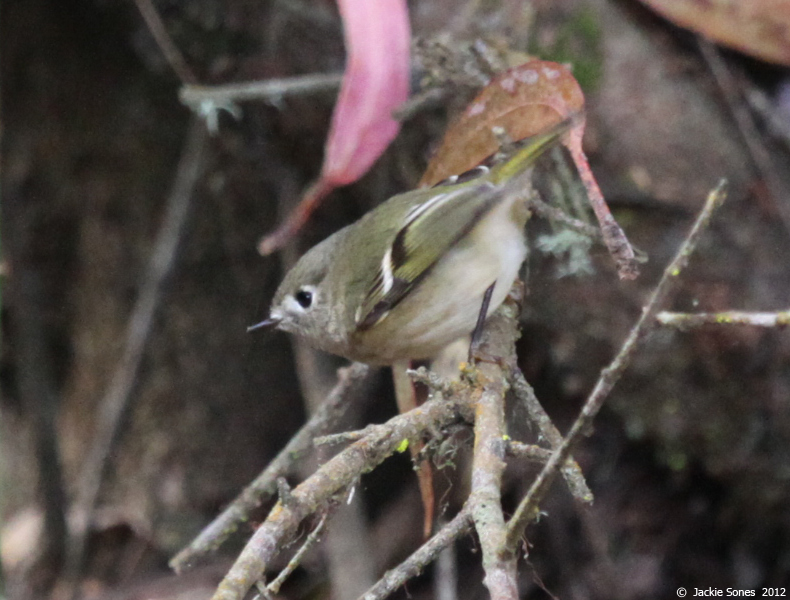
Many of us have observed Ruby-crowned Kinglets, but have you seen those beautiful yellow edges to the wing and tail feathers?  And have you wondered why they're there?

And have you noticed the wonderful lichens where the kinglets search for food?

It is hard, but I'm glad there's so much more to see.

Sunday, January 27, 2013

Grooves on the soles of her shoes

Whew, this species is tough to photograph!  I've been wavering about whether to post these images, but it's what I have ready from today's natural history adventures (watch for some fun marine invertebrate posts coming later this week!).

Can you find the bird in the picture below?


Here's a close-up:


Golden-crowned Kinglets (Regulus satrapa) are tiny songbirds (only 8-11 cm long) that are always on the move.  They tend to prefer conifers (these photos are in Monterey Cypress) and often forage high in the trees, moving quickly among the branches.

They're named for the gold-colored patch on top of their heads.  (Males have orange in addition to yellow.)  In the photos below, you can see the gold crown bordered by black.  Note also the gray nape (hind neck), olive green back, and white underparts.


The facial markings are distinctive and help distinguish Golden-crowned Kinglets from Ruby-crowned Kinglets.  Look for the narrow gray stripe extending downward from the base of the bill, the gray stripe through the eye, and the white eyebrow stripe.


Golden-crowned Kinglets often feed by hanging upside down (see below), gleaning insects, mites, and spiders from the foliage.  

Fun fact: The soles of their feet are grooved — to grip the narrow branches of the conifers among which they prefer to forage.


Golden-crowned Kinglets are uncommon winter residents on Bodega Head.  Recently I've encountered them in the Bodega Dunes Campground in mixed species flocks.  Today they were with Bushtits, Chestnut-backed Chickadees, and a Hutton's Vireo.

Thursday, January 3, 2013

"Eye-ringed Leaf Gleaners"


Hutton's Vireo (Vireo huttoni) 
photographed in Occidental on 3 January 2013


Hutton's Vireos look remarkably similar to Ruby-crowned Kinglets.  The differences are subtle, so it takes a close look to distinguish them.  In 1984, Rich Stallcup wrote a nice article about how to separate these two species; he titled it, "The Eye-ringed Leaf Gleaners."

There are several important field marks and behaviors.  When the birds are flitting around from branch to branch, the easiest field mark to see might be the wing pattern.  In Hutton's Vireos, the narrow yellow edges on the primary feathers run all the way up to the lower white wing bar.  In Ruby-crowned Kinglets, there is a distinct black patch between the yellow primary edges and the lower wing bar.  Here are two comparison photos (below).  Can you tell which is which?


[Hutton's Vireo in the first photo, Ruby-crowned Kinglet in the second.]


If you can see the bill, that's helpful, too.  In Hutton's Vireos the bill is thicker, has a distinct (although small) hook at the tip, and is paler below.  In Ruby-crowned Kinglets, the bill is thinner, pointed, and dark throughout. Compare the bills in the next two photos. 


[Hutton's Vireo in the first photo, Ruby-crowned Kinglet in the second.]  


An interesting side note: Vireos are related to shrikes, which also have hooked bills.  To appreciate this feature, here's a close-up of the first photo.


You can also check the legs and feet.  In Hutton's Vireo, the legs and feet are thick and blue-gray.  In Ruby-crowned Kinglets, the legs are very thin and black and the feet are slender and orange. 


[Ruby-crowned Kinglet in the first photo, Hutton's Vireo in the second.]


Their behavior can be different, too.  As Rich Stallcup says, "When foraging at ease, Ruby-crowned Kinglet is much more nervous acting and Hutton's Vireo slower and more deliberate."  Another useful description is that Hutton's Vireo has "slightly slower perch changes."

Hutton's Vireos are uncommon on Bodega Head, but look for them in oak woodlands, willow thickets, and Douglas-fir forests.  

Wednesday, November 21, 2012

The little things

I'm thankful for many, many things.  But at the top of the list would have to be "the little things."  That phrase could be a metaphor for different things in life, including the knowing look from someone who loves you, the twinkle in a friend's eyes, finding treasure, being proud of someone you don't even know, experiencing the collective cheer for a team.

For me, "the little things" also include natural history observations.  I'm thankful beyond words that there's always something to discover every time we step outside.

Here are a few of "the little things" that live on Bodega Head.  (They really are little!)

A tiny chiton crawling among sand grains (!).


Dark-eyed Gilia (Gilia millefoliata) flowering in the dunes.  
(The flowers are ~8-11 mm across.  They bloom in spring/early summer.)


Ruby-crowned Kinglet (Regulus calendula) photographed in Owl Canyon on 20 October 2012.  
(Total length = 4.25 inches.)


I usually have a hard time finding cards with wording I like.  But this one resonated with me, so I'm passing it on to you:

"Sing a song of gratitude,
Dance a little, too...
Feel the autumn's magic
In everything you do...

Wrap yourself in laughter, 
Give some love away...
Pass around the goodness
Have a happy Thanksgiving Day!"