If you're interested in using any of these photographs or this content in any way, please contact me. Send an e-mail to naturalhistoryphotos(at)gmail.com. Thanks!
Showing posts with label vireo. Show all posts

Sunday, October 4, 2015

"greenlet"


Bell's Vireo (Vireo bellii), at Campbell Cove on 4 October 2015.  This is the first record for this species in Sonoma County.

Gene Hunn spotted this bird on 2 October 2015, so I felt lucky that it was still there today.

Bell's Vireos breed in the central and southwestern U.S. and winter in central/southern Mexico and in Baja California.  They're rare in northern California.  This individual appears to be the eastern subspecies (Vireo bellii bellii), which is even rarer in California.  This subspecies is greener above, yellower below, with shorter wings and shorter tail.

The next picture shows the green coloration above.  Although there isn't much in the picture for scale, note that this vireo is small ~4.75 inches (120 mm) long.  [The Birds of North America account mentions that Bell's Vireos are sometimes called "greenlets" probably due to their greenish coloration and small size.]


Note also the two wings bars, with the lower wing bar being more obvious and the upper wing bar being very faint.


There is a narrow white eye ring and a pale stripe above the lores (between the eye and the bill), giving the appearance of "spectacles" from certain angles:


This bird was very yellow below...had thick, gray legs and feet (in contrast to a kinglet)...and was very actively feeding low in shrubs — primarily Coyote Brush (Baccharis pilularis) and California Wax Myrtle (Morella californica).


What a nice way to be welcomed back to California!

Monday, September 28, 2015

Fall colors

Fall colors, in migrants and foliage, in Alstead, NH, on 28 September 2015:

Black-throated Green Warbler (Setophaga virens)


Black-and-white Warbler (Mniotilta varia)
 

Blue-headed Vireo (Vireo solitarius)


 Leaves turning color along the shore of Lake Warren
 

Wednesday, June 4, 2014

Yellow spectacles

Today I got lucky.  Lucky that Dan found a rare bird nearby (near Owl Canyon).  Lucky that Mike was thoughtful enough to call me.  Lucky that I was at my desk when he did.  Lucky that I had 15 minutes to spare before I had to leave for a meeting.  Lucky that the bird was there when I arrived, and that it appeared in the open and sang loudly before I had to turn around and leave.  Lucky that I got a few pictures and a couple of rough audio recordings.

Here's the bird:


This is a Yellow-throated Vireo (Vireo flavifrons), a species that's primarily found in eastern North America.  It's only the second time a Yellow-throated Vireo has been observed in Sonoma County, and the first time one has been seen on Bodega Head.

Note the yellow throat and yellow "spectacles" around the eye:


At times this bird was singing loudly:


I'm including two audio recordings below.  This is the first time I've recorded a bird singing with my camera.  The quality isn't the best (you can hear some background camera noise), but if you want to listen to examples of a Yellow-throated Vireo singing on Bodega Head, here you go!


ytvi1 by nhbh


ytvi2 by nhbh


P.S.  The individual phrases in the song are written out in various ways, such as ahweeo, eeyay, ayo, away, oweeah, eeoway see if you think they match the sounds above. 

Monday, September 23, 2013

Fall migrants


We’re in New England visiting family and friends and have been lucky to catch up with a few flocks of migrant songbirds.  How I miss warbler migration on the East Coast! 

I didn’t end up with great shots, but here are a few for the record and to remember the experience.  We found at least 12 species of warblers in just a couple of very small flocks near the house where we’re staying in southern New Hampshire.  Beautiful!

Black-and-white Warbler (Mniotilta varia)


Black-throated Green Warbler (Setophaga virens)


Chestnut-sided Warbler (Setophaga pensylvanica)


Blue-headed Vireo (Vireo solitarius)


And the 12 species of warblers?  Yellow Warbler, Chestnut-sided Warbler, Magnolia Warbler, Black-throated Blue Warbler, Yellow-rumped Warbler, Black-throated Green Warbler, Bay-breasted Warbler, Blackpoll Warbler, Pine Warbler, Black-and-white Warbler, American Redstart, and Common Yellowthroat.

Monday, May 13, 2013

Singing in the parking lot

On 11 April 2013, I stepped out of my car in the Bodega Marine Laboratory parking lot to hear a vireo singing.  That's the first time that's happened in 9 years of working at the lab!  I started looking around in the shrubs and soon found the bird responsible for the song:


Although Cassin's Vireo (Vireo cassinii) is described as a "fairly common summer resident and fall migrant" in Sonoma County (Bolander and Parmeter 2000), it's considered a rare migrant on Bodega Head.

In both of these images, look for the bold white "spectacles," gray head and face, olive-green back, white underparts with hints of yellow, and two white wing bars.


The vireo was foraging among the Myoporum shrubs.  It caught at least one moth and a caterpillar (see below).


In the image above, the vireo is holding an inchworm against the branch with its right footInitially the vireo had picked up the caterpillar with its bill, but then it placed it on the branch and held it there before eventually picking it up again and swallowing it.

Here's a quick trivia question related to this vireo's name.  It honors John Cassin, a 19th century ornithologist who wrote one of the first major accounts of birds in the western U.S.  Do you know how many other birds were named after him?  That is, how many other birds can you think of with "Cassin's" in their name?  The answer is below the next image.


Answer: Four other birds were named after John Cassin: Cassin's Auklet, Cassin's Finch, Cassin's Kingbird, and Cassin's Sparrow.
 

Thursday, March 14, 2013

Early bird

Last weekend I was watching a mixed foraging flock of birds in the Bodega Dunes Campground.  There were Chestnut-backed Chickadees, Ruby-crowned Kinglets, Golden-crowned Kinglets, Hutton's Vireos, Townsend's Warblers, Yellow-rumped Warblers, Dark-eyed Juncos, and Pine Siskins all feeding in a few cypress trees.

Here's a photo of one of the Hutton's Vireos:


A Hutton's Vireo started singing (I think), so I started to record the song.  I say "I think"  because it sounded different from the more typical song I've been hearing near our house.  This is a little frustrating for me, as it reveals my lack of experience with this classic West Coast species.  

In Sebastopol, I've been hearing a Hutton's Vireo sing a raspy, two-parted, ascending "zo-eet, zo-eet, zo-eet" over and over again.  But the song I heard in the campground was different.  Here it is.  [There's also a chickadee calling, and the foghorn, but ignore those for now.]  Remember to turn up your volume, especially because this is a quiet recording.


huvi by nhbh  

I wouldn't have described these phrases as two-parted.  And it seemed that each phrase was slightly descending.

I've read several different descriptions of Hutton's Vireo songs.  The best match so far for this song, at least to my ear, is David Sibley's in The Sibley Guide to Birds. One way that he writes out the song is trrweer...trrweer...trrweer.

An interesting thing I've learned about Hutton's Vireos: They start singing very early in the season, often in late winter.  Because of this, they're often missed during breeding bird surveys that take place later in the spring.  One account said that their singing in California peaks between early February and mid-April, so now's the time to be listening for them!

Thursday, January 3, 2013

"Eye-ringed Leaf Gleaners"


Hutton's Vireo (Vireo huttoni) 
photographed in Occidental on 3 January 2013


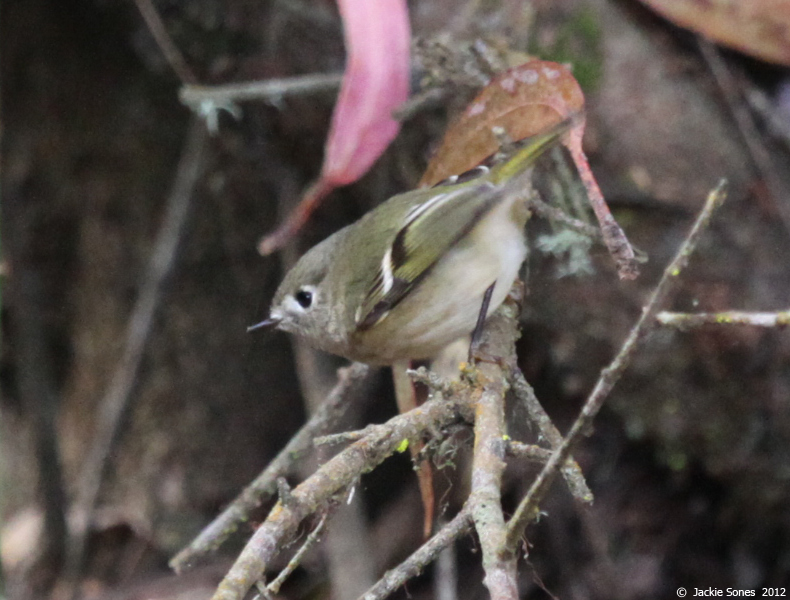
Hutton's Vireos look remarkably similar to Ruby-crowned Kinglets.  The differences are subtle, so it takes a close look to distinguish them.  In 1984, Rich Stallcup wrote a nice article about how to separate these two species; he titled it, "The Eye-ringed Leaf Gleaners."

There are several important field marks and behaviors.  When the birds are flitting around from branch to branch, the easiest field mark to see might be the wing pattern.  In Hutton's Vireos, the narrow yellow edges on the primary feathers run all the way up to the lower white wing bar.  In Ruby-crowned Kinglets, there is a distinct black patch between the yellow primary edges and the lower wing bar.  Here are two comparison photos (below).  Can you tell which is which?


[Hutton's Vireo in the first photo, Ruby-crowned Kinglet in the second.]


If you can see the bill, that's helpful, too.  In Hutton's Vireos the bill is thicker, has a distinct (although small) hook at the tip, and is paler below.  In Ruby-crowned Kinglets, the bill is thinner, pointed, and dark throughout. Compare the bills in the next two photos. 


[Hutton's Vireo in the first photo, Ruby-crowned Kinglet in the second.]  


An interesting side note: Vireos are related to shrikes, which also have hooked bills.  To appreciate this feature, here's a close-up of the first photo.


You can also check the legs and feet.  In Hutton's Vireo, the legs and feet are thick and blue-gray.  In Ruby-crowned Kinglets, the legs are very thin and black and the feet are slender and orange. 


[Ruby-crowned Kinglet in the first photo, Hutton's Vireo in the second.]


Their behavior can be different, too.  As Rich Stallcup says, "When foraging at ease, Ruby-crowned Kinglet is much more nervous acting and Hutton's Vireo slower and more deliberate."  Another useful description is that Hutton's Vireo has "slightly slower perch changes."

Hutton's Vireos are uncommon on Bodega Head, but look for them in oak woodlands, willow thickets, and Douglas-fir forests.