If you're interested in using any of these photographs or this content in any way, please contact me. Send an e-mail to naturalhistoryphotos(at)gmail.com. Thanks!
Wednesday, February 8, 2017
A few more swirls
Well, I just can't get enough of these bubbles, so here are a few more images from 4 February 2017. [Click on the pictures for larger versions.]
Tuesday, February 7, 2017
Pelagic Red Crab update
Just a quick update about Pelagic Red Crabs (Pleuroncodes planipes). We have continued to survey for them since the discovery of live crabs on Salmon Creek Beach on 24 January 2017. We haven't found additional live animals, but on 4 February 2017, I found some claws and legs:
And a few of these:
This is a pellet made up of Pelagic Red Crab pieces. (Many birds cough up pellets of indigestible prey parts.)
I'm not sure which species of bird ate these Pelagic Red Crabs, but my guess would be a gull. Herring Gulls (Larus argentatus) and Western Gulls (Larus occidentalis) have been documented feeding on Pelagic Red Crabs in southern California during previous El Niño years (Stewart et al. 1984).
P.S. I've written about pellets before — for examples, see "Identify the Prey in the Pellet" on 25 November 2014, and "Rounded and flattened" on 2 November 2015.
Labels:
arthropod,
crab,
crustacean,
el nino,
gull,
pellet,
pleuroncodes
Monday, February 6, 2017
Kelp!
An amazing amount of Giant Kelp (Macrocystis pyrifera) washed up on local beaches during the last two days. Although abundant in the Monterey area, Giant Kelp is less common in Bodega Bay. I don't think I've ever seen this much Macrocystis on beaches in Bodega Bay (during the last 12 years).
The photo above shows the rippled or corrugated blades of Giant Kelp.
Below, note its relatively loose and sprawling holdfast (the portion of the kelp that attaches to the substrate):
(Why is the holdfast purple? Maybe someone out there can provide some ideas?)
There was some large Bull Kelp (Nereocystis luetkeana) mixed in with the Giant Kelp. Bull Kelp is the more common large kelp in our area. In the photo below, the Bull Kelp is tangled up with the Giant Kelp, but you'll recognize Bull Kelp's very large float (pneumatocyst) and the smooth and shiny blades (the Bull Kelp blades also lighter in color than the Giant Kelp blades):
Here's a photo comparing the holdfasts of the two species:
The Giant Kelp holdfast is on the left and the Bull Kelp holdfast is on the right.
I had wondered if this kelp might have been ripped out by the powerful 20-21 January storm, but upon closer inspection, I noticed quite a few pelagic barnacles (Lepas sp.) attached to the kelp, indicating it had been at sea for quite some time. [There's a lot going on in this photo, so I've highlighted a good example of a pelagic barnacle with a circle.]
Based on the amount of kelp, its age, and strong recent currents from the south, I'm still guessing that this Giant Kelp originated from sites to our south. But I'm not sure why so much has arrived on our beaches! (Let me know if you have some ideas!)
Labels:
algae,
arthropod,
barnacle,
cirripedia,
crustacean,
kelp,
macrocystis,
nereocystis,
pelagic,
seaweed
Sunday, February 5, 2017
New England memories
Okay, I'll admit that I've been thinking about New England tonight (where I grew up). So here are a few pictures from my past:
Homer (the golden retriever on the left), in front of lobster traps on Trouants Island in Marshfield, MA.
And to include some natural history: an Atlantic Halibut (Hippoglossus hippoglossus). Fun Fact: Atlantic Halibut are the largest flatfish in the world, with record lengths of up to ~15 feet and weights of ~700 lbs. [That's my dad on the right.]
I'm thinking about all of my family and friends in New England tonight!
Saturday, February 4, 2017
Galaxies below
Well, you know me, and how I can't resist the colorful swirls in foam bubbles. Here are a few shots from the rocky shore today (4 February 2017). [Click on the images for larger versions. It's worth it!]
I could watch the swirls in those bubbles all day!
P.S. For previous posts on bubbles, see "Humbled by a bubble," "Humbled by a bubble -- Part 2," or "Colorful bubbles."
Friday, February 3, 2017
Red-and-white revisited
Remember Paraconcavus pacificus, the red-and-white barnacle that grows on sand dollars? I wrote about them in September 2016 (see posts from 25 September and 27 September).
Well, we're still encountering a few of these southern barnacles here and there. Below is a recent example — an individual found washed up on Salmon Creek Beach tonight (3 February 2017):
On the bottom, you can still see a small remnant of the skeleton of a sand dollar attached to the base of this barnacle:
We're still very interested in any sightings of this barnacle north of San Francisco. If you spot one, let me know!
Labels:
arthropod,
barnacle,
cirripedia,
crustacean,
echinoderm,
sand dollar
Thursday, February 2, 2017
Taking a break
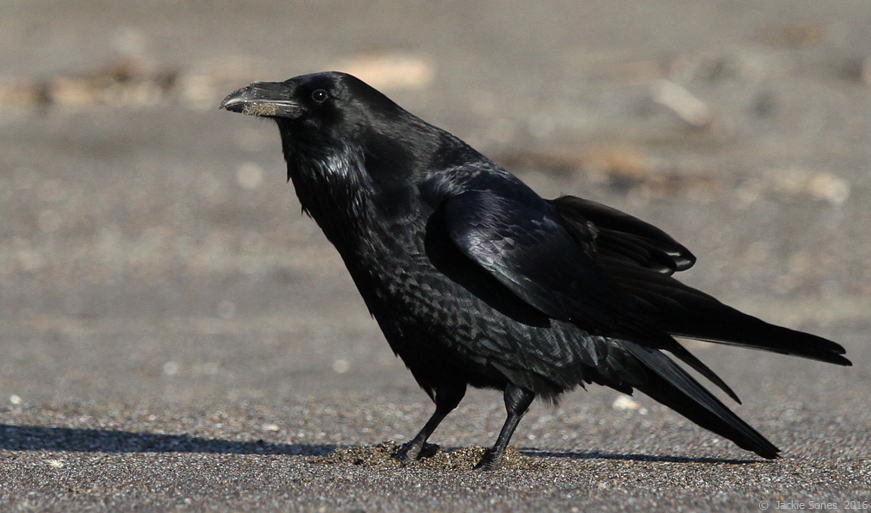
I didn't get a chance to share this one — Common Raven, taking a break from digging in the sand. Photographed on Salmon Creek Beach, 1 November 2016.
Labels:
bird,
corvid,
raven,
salmon creek beach,
songbirds
Subscribe to:
Posts (Atom)